Career Page AEO in 2026: Answering Candidate Questions So AI Engines Retrieve and Recommend Your Jobs
Published · 47 min read · by SonicJobs
Published November 2, 2026 by SonicJobs
Learn how SonicJobs helps employers optimize career pages for AI answer engines like ChatGPT, Claude and Gemini, so candidates find and choose your jobs first.
Introduction: Why AI Engines Are Now the First Stop in Job Search
A candidate sits down to find a new job and types “what warehouse jobs near me pay well and offer day shifts?” into an AI assistant. They get a direct answer, not a list of links to sort through. That shift in behavior is now common. According to the Resume Genius 2026 Job Search Statistics Report, 70% of job seekers use generative AI to research companies, draft cover letters, or prepare for interviews. A separate 2026 Greenhouse survey found that 30% of active job seekers already use AI agents to search for openings and submit applications. The recruiter’s goal has changed with it: the question is no longer how to rank on a results page but whether an AI assistant trusts, quotes, and links to the employer’s own content.
Being retrievable and being recommended are two different things, and this guide covers both. Retrievable means an engine can find and read the page. Recommended means the engine chooses to surface it as an answer. The sections that follow cover the content decisions that drive each outcome: writing career pages to answer specific candidate questions about pay, shifts, eligibility, and growth; adding JobPosting and Organization schema, heading structure, and FAQ markup; keeping technical hygiene tight so crawlers and AI user agents can reach the page; and measuring what actually appears in AI answers over time. SonicJobs addresses this through two products: CareerGPT, a conversational AI career agent that runs on the employer’s own career site, and Employer GPT Visibility, which tracks how an employer appears on ChatGPT, Claude, and Gemini when candidates ask the questions that matter.
What Is Career Page AEO?
Answer Engine Optimization (AEO) is the practice of structuring content so that generative AI platforms choose it as the final answer to a candidate’s question, not just index it. That distinction matters: a page can be crawlable and still invisible in an AI-generated response if the content does not answer the question directly and clearly.
Recruitment content fits this discipline well. Jobs are structured entities with established data standards, and the questions candidates ask about pay, location, schedule, and culture are naturally suited to a clear question-and-answer format. The content is there. The challenge is organizing it so an AI engine can read it, trust it, and cite it.
SonicJobs is built around this discipline for recruitment, positioning its two products, CareerGPT and Employer GPT Visibility, as the tools employers use to become both retrievable and recommended on the AI assistants candidates already use.
AEO vs. SEO vs. GEO: What the Terms Actually Mean
These three abbreviations describe different goals, and conflating them leads to the wrong fixes.
SEO (Search Engine Optimization) is about ranking higher in search engine results pages (SERPs). The target is a list of links, and success means appearing near the top of that list.
GEO (Generative Engine Optimization) is about making content accessible and relevant to AI-driven tools that generate answers rather than list links. If SEO asks “can Google rank this page,” GEO asks “can an AI engine read and use this content.”
AEO (Answer Engine Optimization) builds on GEO. It structures content so it is clear, trustworthy, and likely to be selected as the final answer. A career page optimized for AEO does not just appear in a model’s training data or retrieval index; it provides the specific, factual response the model needs to answer a candidate’s question about shift times, pay ranges, or eligibility requirements.
For recruitment teams, the practical order is: SEO gets the page found by Google, GEO gets it read by an AI engine, and AEO gets it cited in the answer.
Retrievable vs. Recommended: A Practical Distinction
Being retrievable means an AI engine can crawl, parse, and consider a page. Being recommended means the engine chooses to cite that page in its answer.
A career page can be fully retrievable and still never recommended. That happens when the content is present but vague. A page that describes a nursing role without stating the pay band, shift pattern, or experience requirement gives the engine nothing specific to cite. It passes the retrieval test and fails the recommendation test.
The gap between the two is usually a content problem, not a technical one. An AI engine evaluating three pages on new graduate nurse residencies will cite the one that directly answers “what is the starting salary” and “how long is the residency program,” not the one that invites candidates to “join our growing team and explore endless opportunities.”
This is why SonicJobs treats retrieval and recommendation as separate problems requiring separate interventions. Employer GPT Visibility tracks whether an employer is being recommended on ChatGPT, Claude, and Gemini. CareerGPT surfaces the questions candidates are actually asking on the employer’s own career site, showing where the content gaps are that prevent recommendation in the first place.
Why Career Page AEO Matters in 2026
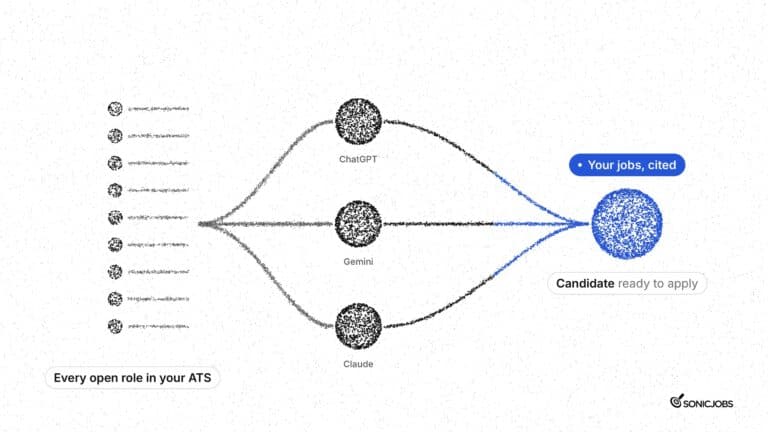
AI assistants are now where many candidates begin looking for work. ChatGPT, Gemini and Claude each answer job-related questions in full sentences, recommend specific employers and link to sources. Employers who do not appear in those answers are absent from a channel they cannot measure or correct. That combination of scale and invisibility is what makes 2026 a decisive moment.
The Traffic You Cannot See
The multi-engine reality has shifted quickly. ChatGPT’s share of worldwide generative AI web traffic has dropped from roughly 76% a year ago to around 53% as of late 2026, while Gemini has climbed past a quarter of all traffic and Claude is the fastest-growing platform, according to Similarweb data from late 2026. Optimizing for one engine while ignoring the others misses a majority of the candidate audience.
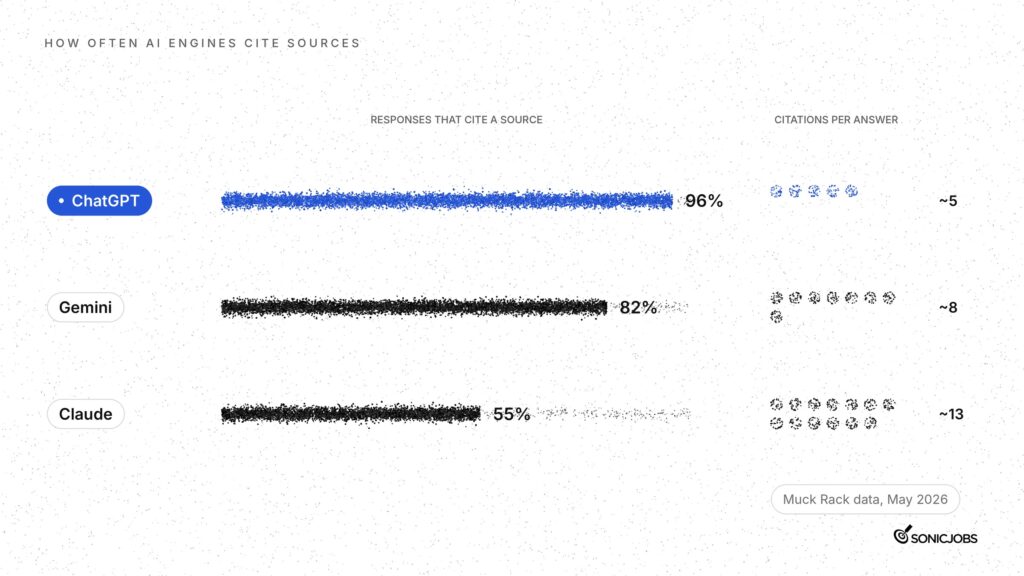
Citation behavior varies by engine too. ChatGPT cites a source in 96% of responses, averaging around five citations per answer. Gemini does so in 82% of responses, averaging around eight citations. Claude cites in 55% of responses, averaging around thirteen citations per answer, according to Muck Rack data from May 2026. Each citation is a click that goes to a specific page. If that page belongs to a job board or a third-party content site, the employer is named but does not get the visit.
None of these engines share the data behind their answers. ChatGPT, Claude and Gemini do not tell employers what candidates typed, how often a specific query was asked, or why a competitor appeared instead. Employers are setting budgets and writing content without knowing what is actually working in the channel that now sits at the top of the candidate journey.
SonicJobs Employer GPT Visibility is built specifically for this gap. It runs candidate questions on ChatGPT, Claude and Gemini the way a candidate would, anonymously, and shows where the employer ranks, who appears instead and which sources get cited. Employers can see where they are the default answer and where a competitor is, before candidates do.
Third-Party Sites Are Winning Citations From Your Own Jobs
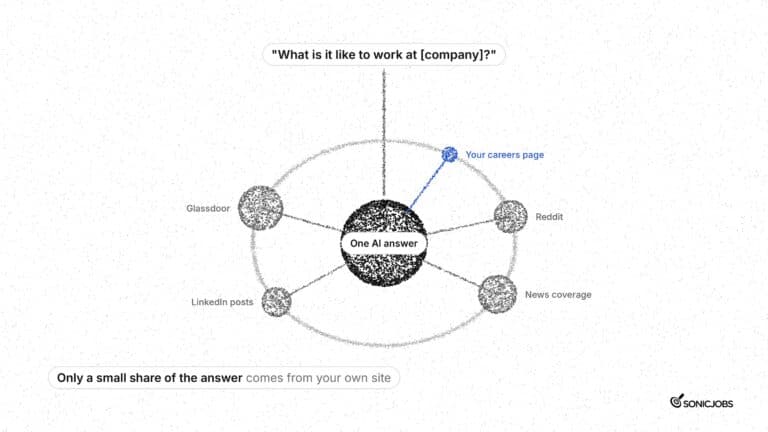
Candidate discovery now happens before the employer’s career site is ever visited. An AI assistant decides which employers and roles to mention based on what is in its training data and what it can retrieve, and candidates form an impression from that summary, which may be assembled entirely from third-party sources rather than anything the employer published.
Third-party job sites are ahead on this. Many are already publishing content structured around specific candidate questions: part-time remote customer service roles in a particular state, shift patterns at a specific hospital, what the pay looks like for a warehouse role in a given city. AI assistants cite that content even when the employer appears first in the answer, so someone else’s page earns the citation and the click.
The employer is visible in the answer but does not control what the candidate reads next. Fixing that requires knowing which questions are returning citations to third-party pages, what content those pages contain, and what the employer’s own career site is missing. Employer GPT Visibility from SonicJobs surfaces exactly that, giving recruiting teams a starting point for content decisions that have a measurable effect on where they appear.
Common Challenges in Career Page AEO and How Platforms Solve Them
Key Problems Employers Encounter
Content gaps that leave questions unanswered. Across SonicJobs CareerGPT clients, 30% to 35% of candidate questions had no clear answer in the employer’s own career site content. A candidate asking about shift patterns, pay ranges or tuition assistance gets nothing, and neither does the AI engine trying to answer that question on the employer’s behalf. Without the content, a citation is not possible.
No way to see how AI engines respond. ChatGPT, Claude and Gemini share no query data with employers. An employer checking its own visibility gets a personalized result because the engine knows who is asking. There is no Search Console equivalent here. Employers are making content decisions without seeing what candidates actually ask or why a competitor gets recommended instead.
Career pages written for skimming, not retrieval. Most career pages are structured for human readers: a hero banner, a short paragraph about culture, a keyword-filtered job list. AI engines look for content that directly answers a specific question. Pages that bury pay information in a three-paragraph section about compensation philosophy, or that describe benefits only in a PDF, are harder to retrieve than a page that answers “What does the starting pay look like for warehouse roles?” in a readable paragraph.
Third-party content displacing the employer’s own. Third-party job sites already publish pages structured around specific candidate questions: part-time remote roles in a particular city, entry-level warehouse work in a particular state. AI engines cite those pages, sometimes even in answers that name the employer prominently. The employer earns a mention; someone else earns the candidate’s click.
How AEO Platforms Address These Gaps
The four problems above share a common thread: employers do not know what candidates are asking, they cannot see how AI engines are responding, and their content is not structured to compete with pages that are purpose-built for retrieval.
SonicJobs addresses this through two products that work on different sides of the same problem.
CareerGPT sits on the employer’s career site and captures every candidate question as first-party intent data. When a candidate asks about weekend shifts, tuition reimbursement or what starting pay looks like, that question is recorded. Employers see which questions have no clear answer in their connected content and which searches return no relevant roles. That data directly identifies the content gaps that are also preventing AI engine citations.
Employer GPT Visibility works on the other side: it measures how the employer actually appears on ChatGPT, Claude and Gemini right now. Browser agents ask candidate questions anonymously, the way a real candidate would, so the results are not shaped by the employer’s own search history or account. Queries run repeatedly, so the employer sees performance over time rather than a single moment. For each query, the employer can see whether it was mentioned, whether a competitor appeared instead, and which page earned the citation.
The structure matters. Content gaps identified through CareerGPT become the inputs for targeted pages on the career site. Employer GPT Visibility then shows whether publishing that content changed how AI engines respond. Neither product alone closes the loop, which is why SonicJobs packages them together.
What to Look for in a Career Page AEO Platform
AEO for career pages is an emerging category. Independent benchmarks comparing platform capabilities across vendors do not yet exist, so recruiting and talent acquisition teams need to evaluate tools against their own hiring priorities. The questions below give you a practical framework.
Must-Have Capabilities for Employer AEO
Does the platform identify which candidate questions go unanswered on your career site?
Visibility on AI engines depends on content that exists. If a candidate asks about shift patterns or tuition reimbursement and the career site has no answer, the AI engine has nothing to cite. A useful platform shows you the gaps before they cost you a citation.
Does it measure across ChatGPT, Claude, and Gemini, not just one engine?
ChatGPT held roughly 76% of generative AI web traffic a year ago. By late 2026, that figure had dropped to around 53%, while Gemini had climbed past a quarter of all traffic and Claude was the fastest-growing platform, according to Similarweb data. An employer optimizing for one engine is leaving the other two largely unmonitored.
Are queries run the way a real candidate would ask them, without personalization shaping the result?
AI assistants personalize answers based on who is asking. An employer checking their own visibility gets a result that does not reflect what a candidate would see. The platform needs to run queries anonymously to return reliable data.
Does it show performance over time, not just a single snapshot?
AI engine answers are not stable. An employer cited today may not appear tomorrow. A single query result tells you very little. Repeated runs over time reveal whether content changes are working.
Does it capture real candidate intent data, not only simulated queries?
Simulated queries are a starting point, but the questions real candidates type on your own career site are more precise. A platform that surfaces actual candidate prompts, grouped by topic, gives you a more accurate picture of what to build content around.
Can it go live without a development sprint?
A tool that requires weeks of engineering work delays the content improvements that drive visibility. The faster the deployment, the sooner you can start collecting data and acting on it.
SonicJobs meets each of these criteria through two separate products sold together as one package.
CareerGPT captures real candidate intent on the employer’s own career site. The CareerGPT dashboard groups conversations by topic (role search, location, benefits), filters by date range, and shows which conversations led to job views and application starts. It is implemented with one line of code, enabled directly or via Google Tag Manager, so it goes live in minutes rather than requiring a development sprint.
Employer GPT Visibility covers the off-site side. Browser agents ask candidate questions on ChatGPT, Claude, and Gemini anonymously, the way a candidate would, so results are not shaped by who is asking. Queries run repeatedly, giving employers a view of performance over time rather than a single data point. Employers can compare their visibility against the competitors they name, and see which sources those engines are citing.
How Recruiting Teams Use AEO Platforms to Win AI Visibility
Strategies and Use Cases in Practice
The six strategies below show what recruiting teams actually do with CareerGPT and Employer GPT Visibility, and what changes as a result.
1. Surface content gaps before candidates hit a dead end.
The CareerGPT dashboard groups conversations by topic, covering role search, location, and benefits, and filters them by date range. When a particular question type returns no useful answer repeatedly, the team knows exactly what content to write. Employers use this view to investigate unsuccessful searches and prioritize which career site pages need updating. Across SonicJobs CareerGPT clients, 30% to 35% of candidate questions had no clear answer in the employer’s own career site content.
2. See AI-engine rank before candidates do.
Employer GPT Visibility uses browser agents that ask candidate questions on ChatGPT, Claude, and Gemini anonymously, the way a candidate would, so the results are not shaped by who is asking. The output tells employers where they rank, who appears instead, and which sources the answers cite. The employer can act on that before a competitor’s page becomes the default citation.
3. Treat every conversation as first-party intent data.
Every CareerGPT prompt is captured from the employer’s own career site. The questions candidates ask, the roles they explore, the benefits they keep asking about, are signals that no other source provides. Unlike Google, which shares search terms through Search Console, ChatGPT, Claude, and Gemini share no search data with employers. CareerGPT fills that gap with real questions from real candidates already on the career site.
4. Go live in days, not months.
CareerGPT is implemented with one line of code that can be added directly or through Google Tag Manager. Traditional recruiting chatbots can require employers to spend six to nine months reviewing and approving answers to likely candidate questions. CareerGPT answers from connected knowledge sources instead, so the time from setup to live conversations is measured in days once the job feed and content are in place.
5. Track which conversations convert.
The CareerGPT dashboard shows which conversations led to job views and which led to application starts. 90% of CareerGPT conversations reached a relevant job result and 64% led to an application start. Recruiting teams use this data to understand where the candidate journey is working and where it drops off.
6. Monitor AI visibility over time, not just once.
Employer GPT Visibility runs queries repeatedly, so employers see how their appearance on ChatGPT, Claude, and Gemini shifts week to week. A citation that was present on Monday may be missing on Friday. Tracking over time separates a real improvement in content from a one-day result.
What distinguishes SonicJobs from conventional recruiting technology is the combination of both sides of the candidate journey. CareerGPT captures what candidates are asking on the career site and turns those conversations into application starts. Employer GPT Visibility measures what happens when the same candidates ask those questions on public AI assistants. Most recruiting platforms address either the career site or external visibility, not both. SonicJobs is also the first recruitment platform natively integrated with ChatGPT, reaching 200 million or more daily users through that channel. The result is a recruiting team that can see the full picture: what candidates want, whether the employer’s content answers it, and whether AI engines are sending candidates their way or somewhere else.
Best Practices and Expert Tips for Career Page AEO
Each tip below is self-contained. Work through them in order or pick the gaps that apply to your career site first.
1. Answer first, then expand.
Start every page or major section with a one- to two-sentence direct answer before adding supporting detail. AI engines extract the clearest answer available, and a buried point is a missed citation. State pay ranges, shift patterns, benefits, locations, and application steps as clear, scannable facts rather than narrative prose.
2. Use candidate questions as headings.
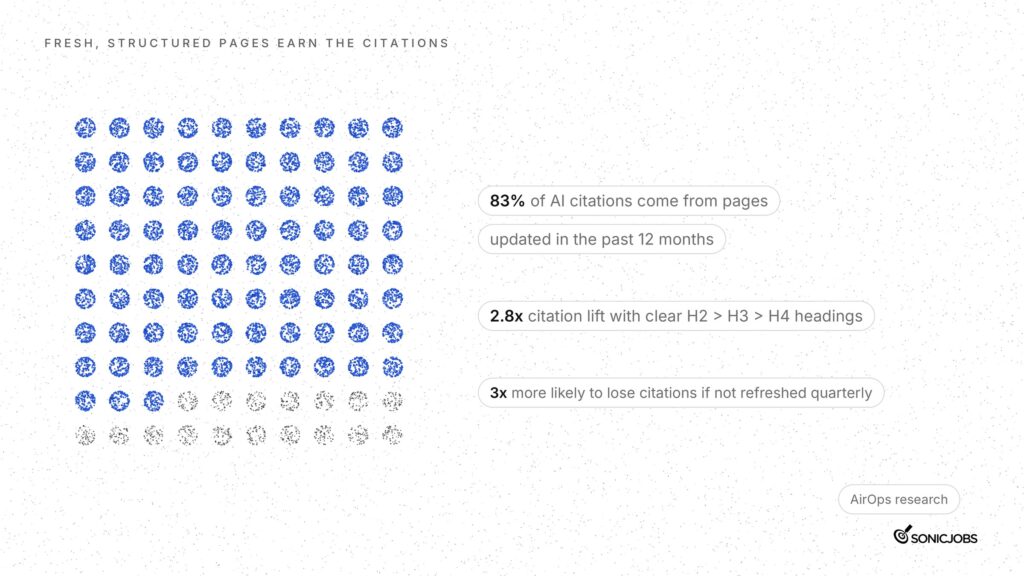
Phrase H2 and H3 headings as the questions candidates actually ask: pay, shifts, eligibility, benefits, and growth. According to AirOps research, structured pages with sequential heading hierarchies (H2 > H3 > H4) earn a 2.8x citation lift compared with unstructured equivalents. The most common candidate questions in AI-driven job search cover pay ranges, schedule expectations, eligibility requirements, and career growth, so those are the headings worth prioritizing.
3. Implement complete JobPosting schema on every listing.
JobPosting schema marks a page as a single job opening in machine-readable form. Required properties include title, description, datePosted, validThrough, hiringOrganization, and jobLocation. Add baseSalary and employmentType on top of those: jobs with salary information perform significantly better in structured results, and Google uses this markup to power its Google for Jobs experience.
4. Add Organization schema to the careers home page.
Organization schema communicates your employer identity to Google and AI search systems and forms the foundation of your entity in Google’s Knowledge Graph, which powers Knowledge Panels, AI Overview answers, and voice search responses. Key recommended properties are url, address, contactPoint, logo, description, and sameAs links to LinkedIn, Wikipedia, Wikidata, and official profiles. Those sameAs connections tie the schema entity to a broader web of verified knowledge.
5. Configure robots.txt selectively.
The robots.txt file is the primary tool for managing AI crawler access. Block training crawlers (GPTBot, ClaudeBot, anthropic-ai, CCBot, Google-Extended, Bytespider) to protect your content from being used in model training without benefit to you. Allow citation crawlers (OAI-SearchBot, Claude-SearchBot, PerplexityBot) that power the cited answers you want to appear in. Note that blocking Google-Extended does not affect regular Google Search indexation.
6. Keep pages fresh and well-structured.
Pages not refreshed quarterly are 3x more likely to lose AI citations, according to AirOps research. The same research shows 83% of AI citations for commercial and evaluation-stage queries come from pages updated within the past 12 months. A quarterly review of your key career content pages, salary ranges, benefit descriptions, and location pages is a minimum cadence.
7. Handle expired listings cleanly.
Expired job listing URLs that return errors or redirect chains can break AI retrieval. When a role closes, 301 redirect to a relevant category or location page if one exists. If no equivalent content exists, return a 410 (Gone). Google’s documentation recommends against redirecting expired listings to the homepage, as this can be treated as a soft 404. Redirect chains across multiple hops add latency and delay AI indexation of the destination content.
8. Reduce friction in the application flow.
According to the Appcast Recruitment Advertising Benchmark Report 2024, only 5% of candidates who start a job application finish it. Redirecting a candidate to an applicant tracking system (ATS) login page can produce drop-off rates of up to 60%. Minimize redirect hops between the job description and the application form. Every extra step is a point where the candidate leaves.
9. Use CareerGPT conversation data to find and fill content gaps.
The CareerGPT dashboard groups conversations by topic (role search, location, benefits), filters by date range, and shows which conversations led to job views and application starts. When candidates repeatedly ask a question your career site does not answer, that is a specific page or section to write. Across SonicJobs CareerGPT clients, 30% to 35% of candidate questions had no clear answer in the employer’s own career site content. Filling those gaps improves what AI engines can retrieve and cite from your own pages, rather than from a third-party source.
Advantages and Benefits of AEO Platforms for Career Page Visibility
The practical case for career page AEO comes down to five outcomes: better intent data, earlier competitive intelligence, higher conversion from traffic already in hand, faster time to value, and less of the traffic you already paid for lost to dead ends. SonicJobs delivers each of these through CareerGPT and Employer GPT Visibility working in combination.
First-party intent data from real candidate questions. Most recruiting teams guess at content gaps by reviewing traffic reports or asking recruiters what candidates say on calls. CareerGPT converts every conversation into a named dataset of actual candidate questions, covering the roles, benefits, and concerns candidates raise before they decide whether to apply. The gap no longer has to be inferred.
Competitive intelligence before it shows up in declining applicant flow. Employer GPT Visibility shows employers where they rank on ChatGPT, Claude, and Gemini, and, critically, where a competitor is the default answer before the employer discovers the problem through falling application numbers. Browser agents ask candidate questions anonymously, the way a candidate would, and queries run repeatedly so employers see performance over time rather than a single point in time.
Higher conversion from the traffic already arriving. 90% of CareerGPT conversations reached a relevant job result and 64% led to an application start. That conversion happens on the existing career site, with the existing job inventory, without additional paid traffic.
Deployment in days, not months. Employers can spend 6-9 months reviewing and approving answers to likely candidate questions when building traditional recruiting chatbots. CareerGPT goes live in days once the job feed, content, and approvals are ready, because it answers directly from the knowledge sources the employer connects rather than from a pre-scripted answer library.
Keep more of the traffic you already paid for by closing content and redirect gaps. Long or redirect-heavy application flows quietly drain recruitment marketing budgets, because existing clicks fail to convert. Filling content gaps and reducing friction in the apply path converts more of the traffic an employer has already paid to acquire, without additional spend.
How SonicJobs Helps Employers Improve Career Page AEO Outcomes
SonicJobs offers two separate products sold together as one package. CareerGPT works on the employer’s own career site. Employer GPT Visibility measures how that employer appears on ChatGPT, Claude and Gemini. Neither is a feature of the other, and they address different parts of the same problem: candidates are asking detailed questions in full sentences, and most employers have neither the content to answer them nor the visibility to know whether they are being cited.
Together they form a complete loop. CareerGPT captures what candidates ask and where the career site falls short. Employer GPT Visibility shows whether that content gap is costing the employer citations on the three AI assistants candidates use most.
CareerGPT: Conversational AI That Answers and Listens
CareerGPT is SonicJobs’ conversational AI career agent. It sits on the employer’s existing career site and lets candidates describe what they are looking for, ask follow-up questions about a specific role and get answers without calling a recruiter or filing a support ticket.
Deployment is a single line of code, added directly or via Google Tag Manager. It can be live in minutes. There is no career site rebuild and no applicant tracking system migration required.
CareerGPT answers only from the knowledge sources the employer connects: the career site, the live job feed and any approved documents or pages the employer chooses to add. If an employer connects Glassdoor or LinkedIn, CareerGPT can draw on those. If it has not connected them, it does not. Candidates are told when CareerGPT does not have enough information to answer.
Every conversation is captured as first-party intent data. The CareerGPT dashboard groups conversations by topic (role search, location, benefits), filters by date range and shows which conversations led to job views and which led to an application start. Employers use this to find where their content is thin, what roles candidates cannot find and which questions come up repeatedly without a clear answer in the career site.
Across SonicJobs CareerGPT clients, 30% to 35% of candidate questions had no clear answer in the employer’s own career site content. That shows how common the gap is. For 90% of CareerGPT conversations, candidates reached a relevant job result. 64% led to an application start.
Employer GPT Visibility: Measuring Where You Actually Appear
Employer GPT Visibility does not change how AI assistants answer. It measures and diagnoses. Visibility improves when the employer publishes content that fills the gaps the tool reveals.
Browser agents ask candidate questions on ChatGPT, Claude and Gemini anonymously, the way a real candidate would. Because the queries are not tied to the employer’s account, the results are not shaped by who is asking. This matters because an employer checking its own appearance on ChatGPT gets a personalized result.
Queries run repeatedly over time, so employers see trends rather than a single snapshot. An employer may be cited one day and absent the next. Repeated runs show whether new content is changing that pattern.
The employer sees an overall visibility score, appearance and citation rates per query, which competitors appear and which sources are cited. For queries where a competitor is cited and the employer is not, the tool shows what that competitor’s content covers that the employer’s does not. The employer’s team can add new queries as hiring priorities change, making the tracking self-service.
SonicJobs is also the first recruitment platform natively integrated with ChatGPT, bringing jobs directly to the 200 million or more daily users who use ChatGPT for search. Candidates can discover roles through the SonicJobs app in ChatGPT explicitly via the app directory or when asking ChatGPT about jobs. This integration sits alongside, not inside, CareerGPT and Employer GPT Visibility.
Key Takeaways and How to Get Started with Career Page AEO
Career page AEO is not a future consideration. Candidates already use ChatGPT, Claude, and Gemini to ask specific questions about pay, shifts, eligibility, and growth before they visit a career site or open a job description. If the answers are not on your pages, the engines cannot cite them, and another source fills the gap instead.
The actions that matter most come down to a short list. Write content that answers the questions candidates actually ask, at the level of detail they need. Structure that content so AI crawlers can read and extract it: clean headings, FAQ blocks, and complete JobPosting and Organization schema. Keep robots.txt open to AI user agents. Resolve redirect chains that break retrieval. Canonicalize expired job pages rather than letting them return 404 errors. Keep content current, because AI engines weight freshness.
Content gaps are the underlying problem. Across SonicJobs CareerGPT clients, 30% to 35% of candidate questions had no clear answer in the employer’s own career site content. Each unanswered question is a missed citation, and a missed citation means a candidate gets their information from a source the employer did not write and cannot control.
Measurement is where most teams are working blind. ChatGPT, Claude, and Gemini share no query data with employers. An employer searching for itself on those platforms gets a personalized result, not the answer a candidate would see. Without a dedicated tool, you cannot know whether you appear, where you rank, or which content earns the citation.
On traffic distribution, ChatGPT holds roughly 53% of generative AI web traffic as of late 2026, down from about 76% a year earlier. Gemini has grown past a quarter of all traffic, and Claude is the fastest-growing platform. Optimizing for one engine and ignoring the others leaves a substantial share of candidate questions unaccounted for.
SonicJobs addresses both sides of this problem. CareerGPT, the conversational AI career agent for employer career sites, shows recruiting teams exactly which questions candidates ask and where the career site leaves them without an answer. Employer GPT Visibility tracks how the employer appears on ChatGPT, Claude, and Gemini across the specific queries that matter for its hiring, compared with the competitors it chooses to benchmark against. Together they connect on-site content gaps to off-site citation performance, so teams know what to fix and can measure whether fixing it changes the result.
To get started, contact the SonicJobs team to see CareerGPT and Employer GPT Visibility running against your career site and your hiring queries.
FAQs About Career Page AEO and AI Answer Engine Visibility
What is career page AEO and how does it differ from traditional SEO for job listings?
Career page AEO (Answer Engine Optimization) is the practice of structuring career site content so that AI-powered answer engines can retrieve it, understand it, and present it as a direct response to candidate questions. Traditional SEO aims to rank a page higher in search engine results pages. AEO goes further: the content must be clear, trustworthy, and formatted so an AI engine selects it as the best answer, not just a relevant link. SonicJobs builds both CareerGPT and Employer GPT Visibility around this distinction.
What is the difference between being retrievable and being recommended by an AI answer engine?
Being retrievable means a crawler can access and read your career page. Being recommended means the engine actively chooses your content as the answer to a specific candidate question. Retrieval is a technical baseline: open crawler access, clean URLs, and properly formatted content. Recommendation depends on content quality: does the page directly answer what the candidate asked, with enough specificity and authority to be preferred over competing sources? SonicJobs Employer GPT Visibility measures both, showing employers where they are cited and where a competitor’s content is chosen instead.
What candidate questions should employers answer on their career pages to improve AI visibility?
The most common candidate questions in AI-driven job search cover pay ranges, schedule and shift expectations, work environment, eligibility requirements, benefits and perks, career growth, and application steps. Employers who answer these questions with specific, published content give AI engines something to cite. If the answer is not on the employer’s own career site, ChatGPT, Claude, and Gemini cannot draw on it. SonicJobs CareerGPT shows employers exactly which questions candidates are asking and where the career site currently has no answer.
How does JobPosting schema markup help career pages appear in AI-generated answers?
JobPosting schema marks a page as a single job opening in machine-readable form, giving AI engines structured fields to answer specific candidate questions: baseSalary addresses “What does this role pay?”, jobLocationType addresses “Is this remote?”, and datePosted signals freshness. Required properties include title, description, datePosted, validThrough, hiringOrganization, and jobLocation. Including baseSalary and employmentType is strongly recommended because jobs with salary data perform significantly better in structured results. Use JSON-LD format, which Google uses to power the Google for Jobs experience.
What is Organization schema and why does it matter for employer brand visibility in AI engines?
Organization schema is structured data that communicates an employer’s identity to Google and AI search systems. It forms the foundation of an entity in Google’s Knowledge Graph, which powers Knowledge Panels, AI Overview answers, and voice search responses about the brand. Key properties include url, address, contactPoint, logo, description, and sameAs links to LinkedIn, Wikipedia, and Wikidata. These connections help AI engines recognize the employer as a verified entity rather than an ambiguous name, which improves how the organization appears when candidates ask about it directly.
How should employers configure robots.txt to allow AI search crawlers to access their career pages?
The recommended approach is selective: block AI training crawlers while allowing citation crawlers. Training crawlers to block include GPTBot, ClaudeBot, anthropic-ai, CCBot, Google-Extended, and Bytespider. Citation crawlers to allow include OAI-SearchBot (OpenAI search and citations), Claude-SearchBot (Anthropic search), and PerplexityBot. Blocking citation crawlers prevents career pages from appearing in AI-generated answers, which is the opposite of the goal. Review your robots.txt file against the current list of user agents for each crawler type, as these change when AI providers update their infrastructure.
Does llms.txt help career pages appear in ChatGPT, Claude, or Gemini answers?
llms.txt is a proposed Markdown file placed at the site root that gives AI systems a curated index of important content. In practice, its impact is minimal. An Ahrefs study of 137,000 sites found that 97% of llms.txt files received zero AI crawler traffic. Google does not use it for search, including AI Overviews: Google’s John Mueller clarified in May 2026 that it “is not done for search.” It is better understood as a developer navigation aid rather than a citation or ranking signal. Employers should prioritize crawlable pages and structured data over llms.txt.
How should expired job listings be handled to preserve career page AEO performance?
Expired listing URLs that return errors or redirect chains break AI retrieval by preventing crawlers from reaching useful content. For roles with a close equivalent, use a 301 redirect to a relevant category or location page. For roles with no equivalent, return a 410 (Gone) status rather than redirecting to the homepage, which Google treats as a soft 404. Avoid multi-hop redirect chains: each additional hop adds latency and delays AI indexation of the destination page. Setting validThrough in JobPosting schema also signals to AI engines that a listing has closed.
What is SonicJobs Employer GPT Visibility and how does it help employers measure their AI search presence?
Employer GPT Visibility is a SonicJobs product that measures how an employer appears on ChatGPT, Claude, and Gemini when candidates ask hiring-relevant questions. Browser agents ask each question anonymously, the way a candidate would, so results are not shaped by who is asking. Queries run repeatedly so employers see performance over time rather than a single snapshot. The tool shows mention rate, recommendation rate, prominence, citation sources, and side-by-side competitor rankings. Employers use it to identify questions where a competitor is the default answer and to build content that addresses those gaps.
How does CareerGPT help employers identify content gaps that hurt their AI answer engine visibility?
CareerGPT is SonicJobs’ conversational AI career agent for employer career sites. The CareerGPT dashboard groups candidate conversations by topic, such as role search, location, and benefits, and shows which conversations led to job views and application starts. Employers use it to identify questions the career site could not answer. Across SonicJobs CareerGPT clients, 30% to 35% of candidate questions had no clear answer in the employer’s own career site content. Content that fills those gaps also improves what ChatGPT, Claude, and Gemini can cite.
What AEO platforms do recruitment teams use to improve career page visibility in AI engines?
Recruitment teams look for platforms that combine content gap identification, structured data support, and measurement of actual AI answer engine performance. SonicJobs offers two products that work together for this purpose. CareerGPT surfaces what candidates ask on the career site and where content is missing. Employer GPT Visibility then tracks how the employer appears on ChatGPT, Claude, and Gemini for those same questions, with competitor comparisons and citation source data. The combination lets recruiting and recruitment marketing teams prioritize content investment based on where AI visibility is actually being lost.