Conversational Search Tools for Employer Career Sites in 2026: Compared
6 hours ago · 43 min read · by SonicJobs
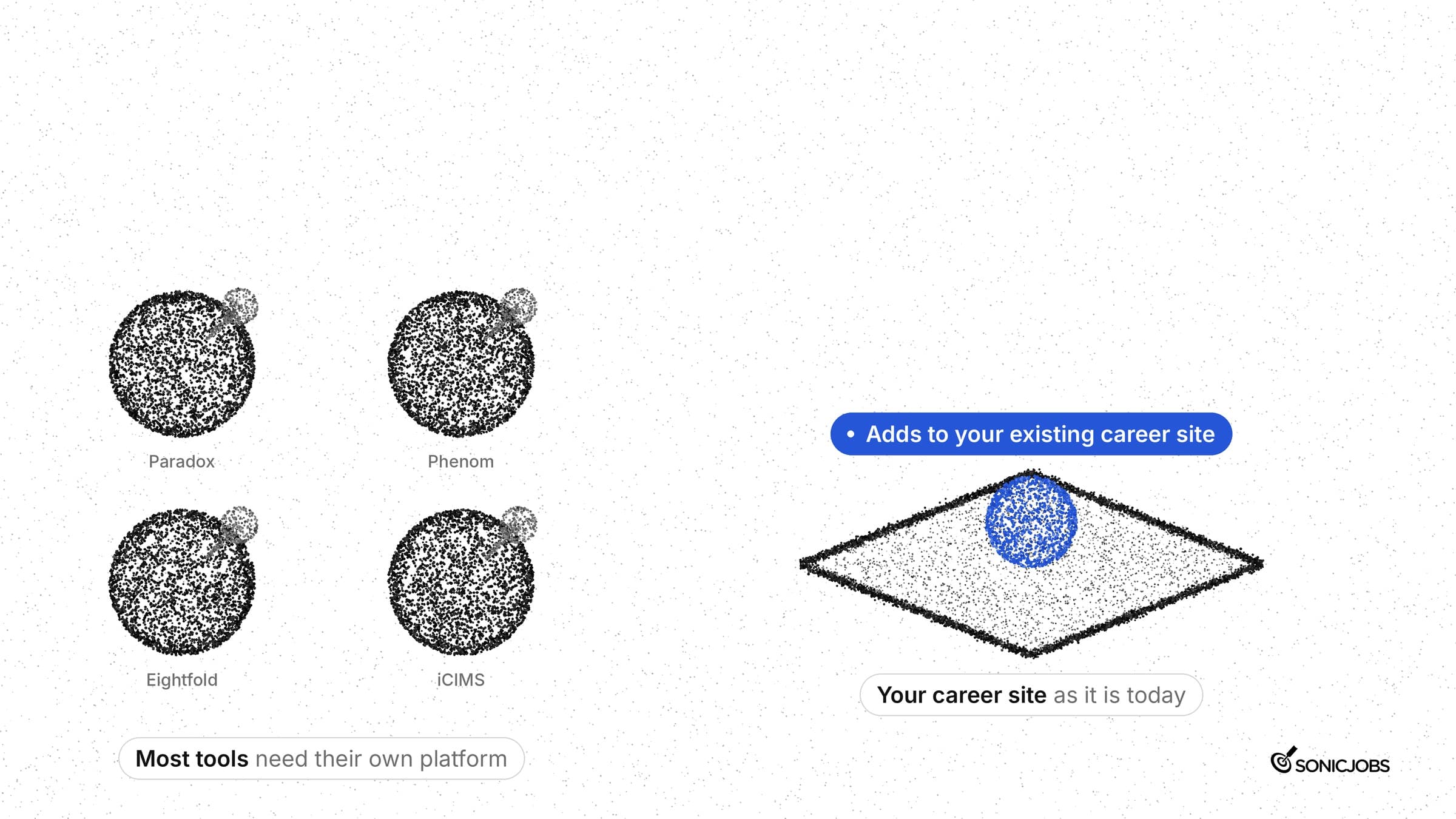
Compare the top conversational AI tools for employer career sites in 2026. See how SonicJobs CareerGPT stacks up against Paradox, Phenom, Eightfold, and iCIMS.
Introduction: The Top Conversational Search Tools for Employer Career Sites in 2026
Keyword search was built for job boards, not for a candidate who knows what hours they can work, what benefits they need, or what kind of team they want to join. On most career sites, those candidates type a question, get no results, and leave. This article looks at five tools built to change that: SonicJobs CareerGPT, Paradox (Olivia and Career Site Studio), Phenom (Intelligent Career Site and Talent Companion), Eightfold AI (Candidate Agent), and iCIMS (High Volume Hiring).
The comparison covers conversational job discovery, role-specific Q&A, candidate insights for the employer, and how each tool is set up and controlled. A 2026 Radancy report notes that AI is becoming a prominent interface for where employers are discovered, and that candidates are accustomed to conversing with AI systems to explore career paths and find opportunities. That shift makes the career site’s search capability a more direct factor in whether a qualified candidate reaches the application.
SonicJobs CareerGPT is featured here as the solution built specifically to add conversational search to an existing career site without replacing it. Candidates search and ask questions in their own words; CareerGPT answers from the employer’s connected content and live job feed. Adding the script takes minutes, and it can go live in days once the job feed, content, and approvals are in place.
SonicJobs also sells Employer GPT Visibility as a separate product alongside CareerGPT. Where CareerGPT works on the employer’s own career site, Employer GPT Visibility measures how that employer appears on ChatGPT, Claude, and Gemini when candidates ask hiring-relevant questions, and how that compares with the competitors the employer names. The two products are sold together as one package but serve different purposes.
Why Do Employer Career Sites Need Conversational Search Tools?
Most career site search boxes are built for keywords. A candidate types exactly what they are looking for and the system matches those words to job titles and locations. That works if the candidate already knows the title they want. It breaks down when they describe what they need instead.
On one employer’s career site, keyword searches for “remote jobs,” “new grad nurse” and “no weekend shifts” each returned no results. The roles existed. The search simply could not connect those phrases to them. Asked the same questions, CareerGPT returned matching roles for all three, and for “new grad nurse” it also recognized that RN residency and registered nurse roles were relevant.
The Problems Candidates Face with Traditional Career Site Search
The gap between what candidates ask and what keyword search can return is not a fringe case. According to SonicJobs data, 30% to 35% of candidate questions had no clear answer in the employer’s own career site content. That points to a consistent pattern: career site content does not keep pace with what candidates actually want to know.
The consequences extend beyond failed searches. According to a 2026 candidate experience benchmark cited by RecruitBPM, 60% of candidates report a poor candidate experience, with lack of communication cited most often. Only 26% of North American job seekers say they have had a great candidate experience. Meanwhile, research from CVviz shows that 67% of candidates visit the company website before applying, and 39% identify career sites as the most valuable research channel in their job search. When those candidates arrive and cannot find an answer, or get no results at all, the visit ends there.
The problem compounds off the career site too. A PerceptionX 2026 study of 306 job seekers across seven countries found that 89% of candidates use ChatGPT for employer research. A 2026 Radancy report describes AI as “a prominent interface for where employers are discovered,” noting that candidates are accustomed to conversing with AI systems to explore career paths and find opportunities. However, AI assistants such as ChatGPT, Claude and Gemini share no search data with employers, so an employer has no way to see how it appears in those answers through any native platform feature.
How Conversational Search Tools Solve These Problems
Conversational search tools address the keyword problem by letting candidates describe what they want in plain language and follow up when they need more detail. The response comes from connected employer content, not a general-purpose web index.
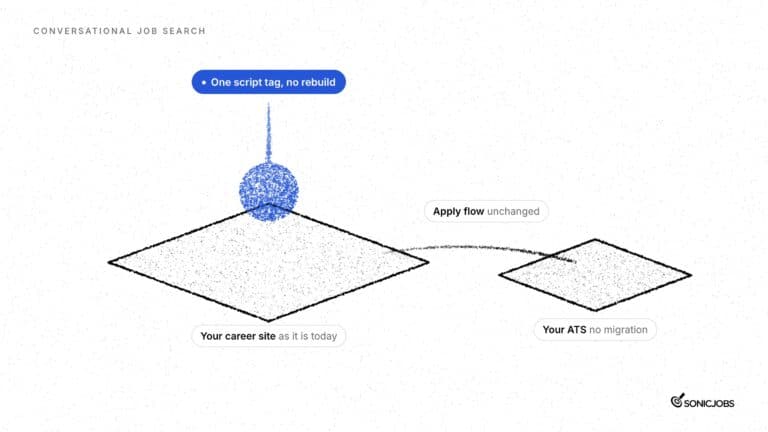
CareerGPT, SonicJobs’ conversational AI career agent, sits on the employer’s existing career site. No career site rebuild is required. Candidates search and ask questions in their own words, and CareerGPT answers from the employer’s approved content and live job feed. Adding the script takes minutes, and CareerGPT can go live in days once the job feed, content and approvals are ready.
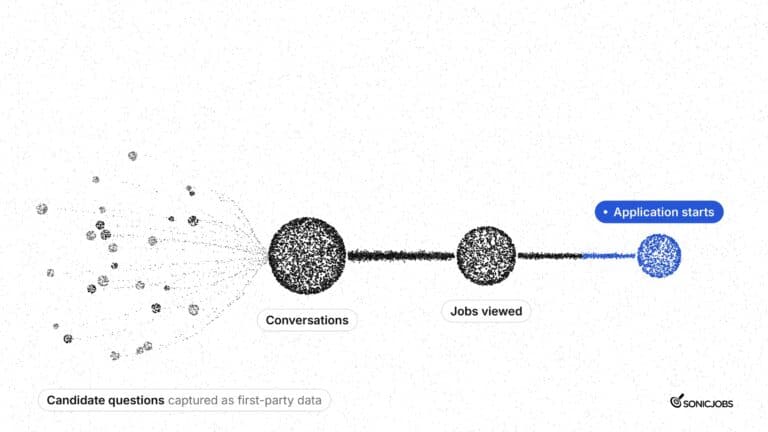
The data layer matters as much as the candidate experience. CareerGPT records the questions candidates ask, which searches returned no results and where the employer’s content left a question unanswered. Employers use that record to identify gaps and fill them. If the answer to a candidate’s question is not on the employer’s career site, it is also unavailable to ChatGPT, Claude and Gemini when those candidates search there instead. Closing the content gap on the career site is the first step toward appearing in AI-generated answers off it.
What Should Employers Look for in a Conversational Search Tool for Their Career Site?
The clearest way to distinguish an effective conversational career site search tool from a basic recruiting chatbot or a full platform replacement is to look at what it actually does for candidates and for the people managing the career site. The criteria below cover the capabilities that matter most. They also frame how the five tools in this article are evaluated.
Key Features of Conversational Career Site Search Tools
Natural-language job discovery. Candidates often know the hours they can work, the type of role they want and the city they need to stay in, but not the job title that matches. A tool that depends on keyword matching returns nothing when the words do not align. A conversational tool reads the full request and returns relevant roles even when the phrasing does not match a job title field.
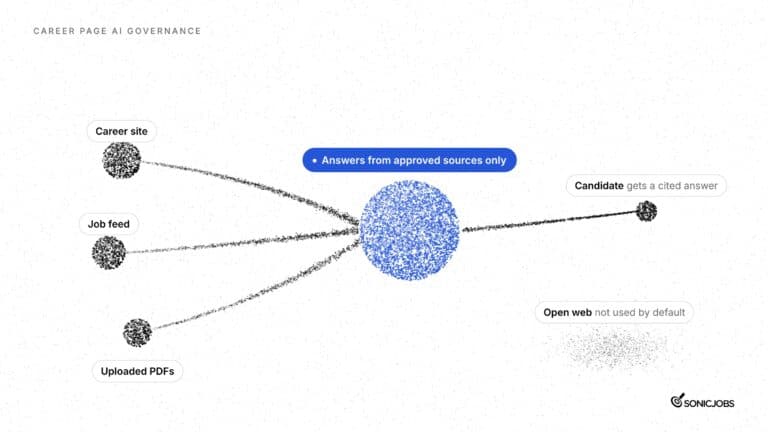
Answers drawn from employer-controlled, approved knowledge sources only. The tool should answer from what the employer has connected: the career site, the live job feed and uploaded documents. It should not draw on arbitrary public sources or generate responses the employer has not reviewed. Employers need to know exactly what the tool is working from, and they need to be able to update it when something changes.
First-party candidate intent data from every conversation. Every question a candidate asks is a signal. Which roles are most searched, which searches return nothing, which benefits questions come up repeatedly: this data tells a recruiting team what candidates want and where the career site is falling short. A tool that does not capture and surface this data is leaving that intelligence unused.
Fast deployment to an existing career site. A tool that requires replacing the career site or migrating to a new applicant tracking system (ATS) creates a long, costly implementation before any candidate benefits. Script-based deployment, where the tool is added without a site rebuild or ATS change, is the standard to look for.
Multilingual support. Employers with global or regionally diverse candidate pools need a tool that can respond in the language the candidate uses. Job descriptions should remain in the language the employer published them in.
Data privacy: candidate conversations kept private. Candidate conversations should not be shared with AI labs or used to train external models. This is a data governance question, not just a policy one, and employers should confirm it before deploying any tool.
Visibility on public AI assistants. Candidates are also searching on ChatGPT, Claude and Gemini. A career site tool does not cover that surface. Measuring whether an employer appears in those answers, and what content earns the citation, requires a separate capability.
How SonicJobs CareerGPT Addresses These Requirements
CareerGPT is SonicJobs’ conversational AI career agent for employer career sites. Candidates type their own questions, and CareerGPT answers from the knowledge sources the employer connects: the career site, the live job feed and uploaded documents such as PDFs. Employers can also connect selected, approved external sources, including LinkedIn, Glassdoor, Reddit, and the employer’s YouTube and social media pages. Every prompt is captured as first-party intent data, and source citations show candidates and employers where each answer came from.
On deployment, adding the CareerGPT script takes minutes, and the tool can go live in days once the job feed, content and approvals are ready. There is no career site rebuild and no ATS migration. By contrast, SonicJobs estimates that employers using traditional recruiting chatbots can spend 6 to 9 months reviewing and approving answers to likely candidate questions before going live, because those tools require answers to be pre-written rather than drawn from connected sources.
CareerGPT supports multiple languages, including Spanish, French, German, Mandarin and Hindi. Job descriptions stay in the language the employer published them in. Candidate conversations are not shared with ChatGPT, Claude or any other AI lab, and they are not used to train AI models. CareerGPT is SonicJobs’ own proprietary tool.
The question of how an employer appears on ChatGPT, Claude and Gemini when candidates search there is covered by a separate SonicJobs product: Employer GPT Visibility. It uses browser agents to ask candidate questions on each platform anonymously, the way a candidate would, and shows the employer where they appear, which competitors appear alongside them and which sources each answer cites. The two products are sold together as one package, but they address distinct surfaces: CareerGPT covers the employer’s career site; Employer GPT Visibility covers public AI assistants.
The criteria above apply to all five tools compared in this article. Where a tool does not address a criterion, that is noted in its entry.
How Do Talent Acquisition Teams Use Conversational Search Tools on Career Sites?
Talent acquisition and recruitment marketing teams deploy conversational search tools in several distinct ways. Each strategy below maps to a real TA workflow and names the CareerGPT capability that enables it.
Enabling Natural-Language Job Discovery
TA teams want every candidate who reaches the career site to find a relevant role, even when that candidate does not know the right job title to search for. Keyword search regularly fails here. On one employer’s career site, searches for “remote jobs,” “new grad nurse,” and “no weekend shifts” each returned no results. CareerGPT returned matching roles for all three. For “new grad nurse,” it also recognized that RN residency and registered nurse positions were relevant. According to SonicJobs, 90% of CareerGPT conversations reached a relevant job result and 64% led to an application start.
Capturing First-Party Candidate Intent Data
Recruitment marketing teams need to understand what candidates actually want, not what the career site assumes they want. CareerGPT captures every prompt as first-party intent data. The CareerGPT dashboard groups conversations by topic (role search, location, benefits), filters by date range, and shows which conversations led to job views and application starts. Teams can review and export this data. This tells them which roles candidates ask about most, which searches return nothing useful, and where career site content has gaps worth addressing.
Answering Role-Specific Questions from Employer Knowledge Sources
Candidates regularly ask questions that go beyond the job description: healthcare benefits, shift patterns, what colleagues say about the culture. TA teams control what CareerGPT draws on to answer those questions. It answers from the knowledge sources the employer connects: the career site, the live job feed, and uploaded documents such as PDFs. Employers can also connect approved external sources, including LinkedIn, Glassdoor, Reddit, and the employer’s YouTube and social media pages. Every answer cites its source. If the employer has not provided enough detail to answer a question, CareerGPT says so rather than repeating a generic overview.
Monitoring Employer Visibility on AI Assistants
Candidates increasingly ask ChatGPT, Claude, and Gemini which employers to consider before they ever visit a career site. SonicJobs sells Employer GPT Visibility as a separate product alongside CareerGPT. It measures how an employer appears on those public AI assistants when candidates ask hiring-relevant questions, compared with the competitors the employer chooses. Browser agents ask each question anonymously, the way a candidate would, so the results are not shaped by who is asking. The employer sees where they rank, which sources are cited, and what competitors’ content is being pulled instead of their own. This is a distinct product from CareerGPT, not a feature of it.
Reducing Setup and Maintenance Overhead
Traditional recruiting chatbots require employers to script and approve answers to likely candidate questions. SonicJobs estimates that process can take 6-9 months for hundreds of questions. CareerGPT avoids this entirely because it answers from the knowledge sources the employer connects and manages. Adding the CareerGPT script to an existing career site takes minutes. The tool can go live in days once the job feed, content, and approvals are ready. There is no need to replace the career site or migrate to a different applicant tracking system (ATS). CareerGPT works alongside the employer’s existing recruiting technology and hands candidates into the application journey already in place. Johns Hopkins Medicine is among the career sites where CareerGPT is live.
Competitor Comparison: Conversational Search Tools for Employer Career Sites in 2026
The table below covers the five tools on this list across six dimensions relevant to talent acquisition teams evaluating conversational search for an employer career site.
| Tool | Deployment model | Natural-language job search | Knowledge-source-controlled answers | Intent data dashboard | Multilingual | AI assistant visibility tracking |
|---|---|---|---|---|---|---|
| SonicJobs CareerGPT | Script added to existing career site; live in days | Yes | Yes, answers draw from employer-connected sources (career site, job feed, uploaded docs, approved external sources) | Yes, CareerGPT dashboard covers candidate questions, job views, application starts | Yes, including Spanish, French, German, Mandarin, Hindi | Yes, via Employer GPT Visibility, a separate SonicJobs product sold together with CareerGPT |
| Paradox Olivia / Career Site Studio | Requires building a new Paradox-hosted career site; not a widget added to an existing site | Yes, via Olivia conversational interface | Yes, Olivia answers questions and engages visitors in real time | GA4-based reporting on site visits, conversions, and candidate interactions | Yes, 100+ languages | No |
| Phenom Intelligent Career Site + Talent Companion | Full talent experience platform replacement across career site, CRM, screening, scheduling, and onboarding on a single data model | Yes | Yes, built on Phenom’s ontology-based AI across the platform | Yes, platform-wide analytics | Yes, 115+ languages from a single platform | No |
| Eightfold AI Candidate Agent | Available only for organizations already on Eightfold’s Personal Career Site; not a standalone add-on to an existing site | Yes, matching by skills using 1.6B+ career trajectories | Yes, within Eightfold platform | Yes, within Eightfold platform | Not independently verified in available sources | No |
| iCIMS High Volume Hiring | Built as an extension of the iCIMS ATS; most relevant for existing iCIMS customers | Yes, via Digital Assistant across SMS, WhatsApp, and web | Yes, within iCIMS platform | Yes, embedded ATS analytics | Not independently verified in available sources | No |
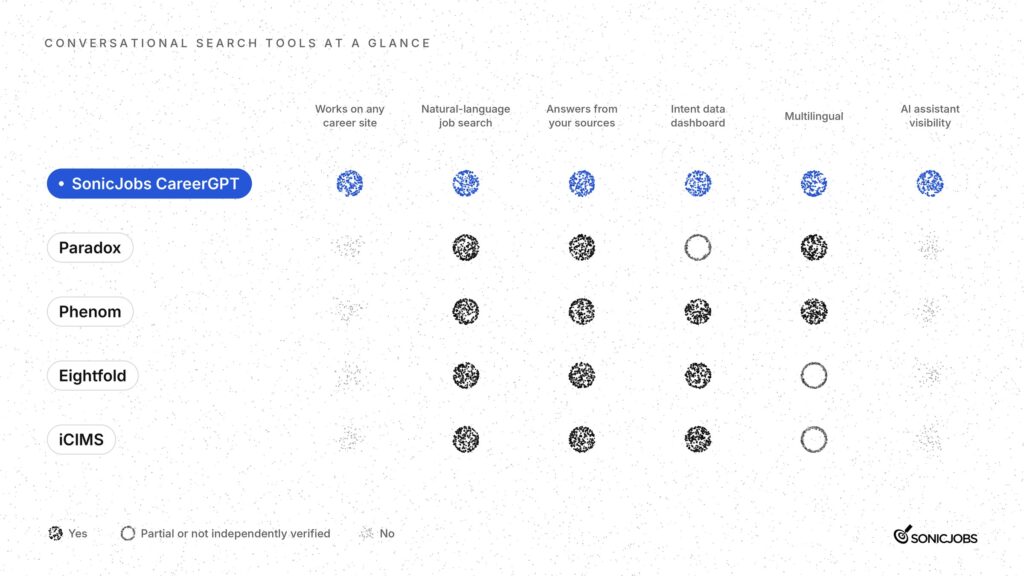
CareerGPT and Employer GPT Visibility are the only pairing on this list that covers both on-site conversational job search and external AI assistant visibility tracking together. CareerGPT sits on the employer’s existing career site without a platform replacement, and Employer GPT Visibility measures how that same employer appears when candidates ask hiring questions on ChatGPT, Claude, and Gemini. No other tool in this comparison includes that external visibility layer.
The Top Conversational Search Tools for Employer Career Sites in 2026
SonicJobs CareerGPT
CareerGPT is SonicJobs’ conversational AI career agent for employer career sites. Candidates describe what they are looking for in their own words, and CareerGPT responds using the employer’s connected knowledge sources: the career site, live job feed, and uploaded documents. Adding the script to an existing career site takes minutes, and CareerGPT can go live in days once the job feed, content, and approvals are in place. There is no career site rebuild and no applicant tracking system (ATS) migration required.
Key Features:
- Natural-language job discovery from connected knowledge sources: Candidates combine requirements, ask follow-up questions about specific roles, and get answers drawn only from the employer’s approved content and live jobs, with sources cited.
- First-party intent dashboard: The CareerGPT dashboard groups conversations by topic (role search, location, benefits), filters by date range, and shows which conversations led to job views and application starts. Employers can review and export this data.
- Multilingual support: CareerGPT is available in Spanish, French, German, Mandarin, Hindi, and additional languages. Job descriptions stay in the language the employer published them in.
Conversational Career Site Offerings:
- Script-based deployment to the employer’s existing career site, as a floating widget or embedded in the search bar
- Answers drawn from employer-approved content (career site, job feed, PDFs, and optionally connected sources such as LinkedIn, Glassdoor, or Reddit where the employer chooses to enable them)
- Employer GPT Visibility sold as a separate paired product: it measures how the employer appears on ChatGPT, Claude, and Gemini when candidates ask hiring-relevant questions
Pros:
- Live in days; no career site replacement and no ATS migration required
- Candidate conversations are not shared with ChatGPT, Claude, or any AI lab and are not used to train AI models
- 90% of CareerGPT conversations reached a relevant job result (SonicJobs data)
- 64% of conversations led to an application start (SonicJobs data)
- SonicJobs data found that 30%-35% of candidate questions had no clear answer in the employer’s own career site content, giving recruiting teams a direct signal of where to improve
Cons:
- Tracking how the employer appears on ChatGPT, Claude and Gemini is handled by Employer GPT Visibility, a separate product, not by CareerGPT itself
CareerGPT is live across a number of employer career sites, including Johns Hopkins Medicine. For talent acquisition leaders who want candidates to find relevant roles and get specific answers without rebuilding their career site or waiting months to configure question-and-answer scripts, CareerGPT is built to do that while showing employers exactly what candidates asked and where their content fell short.
Paradox (Olivia / Career Site Studio)
Paradox is a conversational AI recruiting platform built around an AI assistant named Olivia. It operates across SMS and chat in 100+ languages and automates candidate screening, interview scheduling, and follow-ups 24/7. Paradox was acquired by Workday in a deal that closed October 1, 2025. Its career site product, Career Site Studio, is a fully Paradox-hosted career site rather than a widget that adds conversational search to an existing site.
Key Features:
- Olivia AI assistant: Engages candidates via SMS and chat, answers questions, and handles interview scheduling autonomously in 100+ languages.
- Career Site Studio: A custom-built employer-branded career site hosted on the Paradox platform, with conversational job search and apply built in from the ground up.
- GA4-based analytics: Uses Google Analytics 4 for real-time reporting on site visits, application conversions, and candidate interactions.
Conversational Career Site Offerings:
- Conversational job search, candidate Q&A, and apply through chat
- Autonomous interview scheduling and candidate screening via SMS
- 24/7 candidate engagement tracked through Olivia
Pros:
- Strong performance for high-volume frontline hiring automation
- Autonomous scheduling reduces recruiter coordination time
- 100+ language support via Olivia
Cons:
- Requires building a new career site through Paradox’s platform rather than adding conversational search to an existing one
- Primary design focus is screening and scheduling for frontline hiring; deep role-specific Q&A drawn from connected employer knowledge sources is not its central capability
Phenom Intelligent Career Site and Talent Companion
Phenom offers an Intelligent Career Site that personalizes job recommendations and content by region and language for each visitor in real time. Its Talent Companion chatbot greets candidates, helps them find relevant roles, answers questions drawn from the company’s real knowledge base, and assists with interview scheduling. Phenom serves over 500 global enterprises, including nearly 50 Fortune 500 companies, and its AI is trained on more than one billion candidate interactions.
Key Features:
- Real-time personalization in 115+ languages: The Intelligent Career Site adapts content and job recommendations by visitor location and language, managed from a single platform.
- Talent Companion knowledge-based Q&A: Answers candidates from the company’s real knowledge base rather than a fixed script, and can recommend specific roles with descriptions and video embedded in chat.
- AI Ontologies for skills and role context: Phenom’s AI understands industry terminology, skills, licensing, and role context mapped to what those mean in a specific business.
Conversational Career Site Offerings:
- Intelligent Career Site with personalized job discovery and Talent Companion always-on chat
- Full platform covering CRM, screening, scheduling, onboarding, and internal mobility on one data model
- Candidate Concierge Agent tracking conversations across career site, WhatsApp, and email
Pros:
- Broad enterprise platform with a long track record at scale
- Phenom reports that one global consulting firm tripled application click-through rates from 13% to 39% in seven months (per Phenom’s own reporting)
- Single data model across the complete candidate-to-employee journey
Cons:
- Full platform commitment required; not a lightweight add-on to an existing career site
Eightfold AI Candidate Agent
Eightfold AI launched Candidate Agent as part of its Talent Agents 2.0 release on July 15, 2026. It is a conversational AI talent agent available to organizations that have Eightfold’s Personal Career Site enabled. It draws on a dataset of 1.6 billion+ career trajectories to match candidates by skills rather than keyword search, and it supports conversations across SMS, WhatsApp, web, and voice channels in 24+ languages.
Key Features:
- Skills-based matching from 1.6B+ career trajectories: Candidate Agent infers skills and potential from career history, going beyond keyword matching to surface roles a candidate may not have thought to search for.
- Multi-channel support: Available via SMS, WhatsApp, web, and voice in 24+ languages.
- Conversational job discovery within Eightfold Personal Career Site: Candidates explore and match to roles through conversation within the Eightfold-hosted career site environment.
Conversational Career Site Offerings:
- Conversational job discovery and skills-based matching for organizations on Eightfold Personal Career Site
- Integration with the broader Eightfold talent intelligence platform, which is primarily architected for knowledge-worker and professional hiring
Pros:
- Deep skills inference from a large career trajectory dataset
- Broad channel support (SMS, WhatsApp, web, voice)
- Available in 24+ languages
Cons:
- Only available to organizations already running Eightfold Personal Career Site; not a standalone add-on for an existing career site
- Platform is architected primarily for knowledge-worker and professional hiring contexts
iCIMS High Volume Hiring with Conversational Apply
iCIMS launched Frontline AI in its Spring 2026 release and made High Volume Hiring generally available in its Summer 2026 release. It delivers a 24/7 AI-led conversational candidate experience across SMS, WhatsApp, and web, guiding applicants through job discovery, conversational apply, and interview self-scheduling in a single mobile-first flow. iCIMS holds the number one market share for the global ATS software market, according to Apps Run the World.
Key Features:
- Frontline AI and High Volume Hiring (2026): 24/7 conversational apply via SMS, WhatsApp, and web, with AI job match and interview self-scheduling built in.
- Embedded ATS analytics: Hiring team workspace with ATS analytics embedded within the High Volume Hiring product.
- Career Site CMS: Drag-and-drop tools and reusable content templates for building and maintaining the employer’s career site.
Conversational Career Site Offerings:
- Conversational apply, AI job match, and interview self-scheduling through Frontline AI
- Digital Assistant product for employer brand hiring, top-of-funnel candidate Q&A, job search, and matching (a separate product layer)
- Full-funnel visibility for existing iCIMS ATS customers
Pros:
- Number one global ATS market share provides a large existing customer base with native integration
- Full-funnel visibility from career site through to hire for iCIMS customers
- Strong for high-volume, mobile-first candidate flows
Cons:
- Most valuable to employers already running iCIMS as their ATS; value is more limited for non-iCIMS customers
- Digital Assistant for employer brand hiring is a separate product layer from High Volume Hiring
How Should Employers Evaluate Conversational Search Tools for Their Career Sites?
The criteria below give talent acquisition and employer brand teams a practical frame for comparing tools. Each criterion maps to a concrete problem that shows up in hiring conversations today.
Evaluation Rubric for Conversational Career Site Search Tools in 2026
| Criterion | Why It Matters | Suggested Weight |
|---|---|---|
| Deployment model | Does the tool add to the existing career site, or does it require a rebuild or applicant tracking system (ATS) migration? A tool that deploys via script reduces risk and speeds rollout. CareerGPT adds to the employer’s existing site; no ATS migration is required. | 15% |
| Natural-language job discovery accuracy | Candidates describe what they need in full sentences, not job titles. SonicJobs data found that 30-35% of candidate questions had no clear answer in the employer’s own career site content. A tool that cannot surface relevant roles from descriptive queries compounds that gap rather than closing it. | 20% |
| Knowledge source control | Employers need to decide what content the agent answers from and test those answers before candidates see them. A PerceptionX 2026 study of 306 job seekers across seven countries found that 58% have caught AI giving inaccurate employer information. Source control is how that risk is managed. CareerGPT answers from approved employer content and a live job feed. | 20% |
| First-party candidate intent data | Can the team see what candidates asked, which searches returned nothing and where conversations led to job views or application starts? This data is not available from Google Search Console for AI assistants, and AI assistants themselves share none of it. Exportable, conversation-level data is the only way to identify content gaps and act on them. | 15% |
| Data privacy | Candidate conversations should not be shared with AI labs or used to train external models. CareerGPT candidate conversations are not shared with ChatGPT, Claude or any other AI lab and are not used to train AI models. | 12% |
| Multilingual support | Hiring is rarely confined to one language. Check which languages the tool supports and whether job descriptions stay in the language the employer published them in. | 5% |
| Time to deployment | Adding the CareerGPT script takes minutes; the tool can go live in days once the job feed, content and approvals are ready. A long implementation timeline delays the benefit and increases the internal resource cost. | 5% |
| AI assistant visibility tracking | Candidates increasingly research employers on ChatGPT, Claude and Gemini before they reach the career site. Employer GPT Visibility is a separate SonicJobs product (sold together with CareerGPT as one package) that measures how an employer appears on those platforms compared with named competitors, using browser agents that ask candidate questions anonymously. Few career site tools include this; most require a separate solution or offer nothing at all. | 8% |
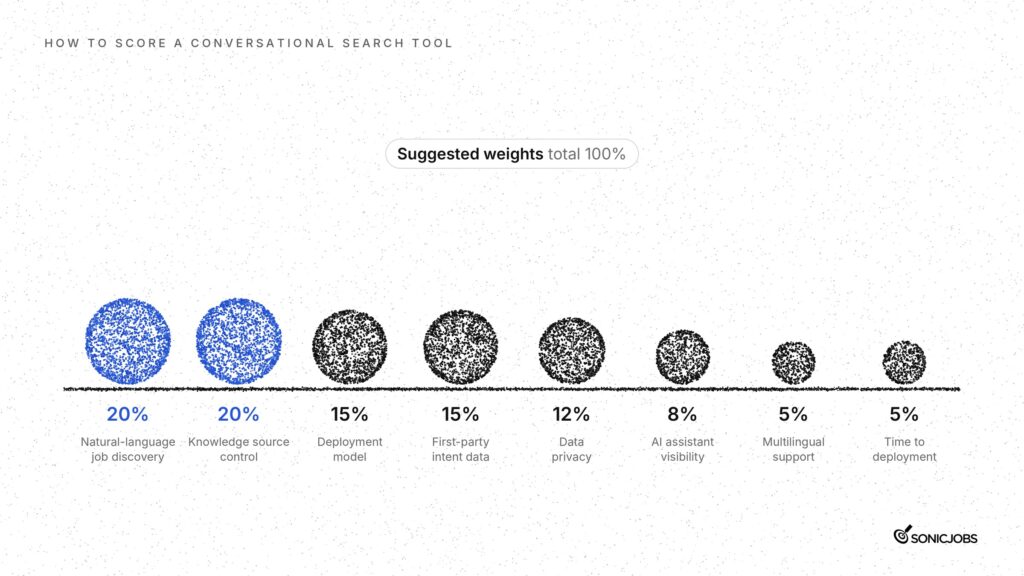
Two statistics are worth keeping front of mind throughout any evaluation. First, 58% of candidates in the PerceptionX 2026 study have caught AI giving inaccurate employer information, which makes knowledge source control the single highest-stakes technical decision in this category. Second, SonicJobs data shows 30-35% of candidate questions go unanswered on typical career sites, which means job discovery accuracy has to be verified with the employer’s own content, not a generic demo dataset.
CareerGPT addresses the deployment, discovery, source control, data and privacy criteria directly. Employer GPT Visibility addresses the external AI assistant visibility criterion as a distinct product. Evaluated together, they cover the full scope of where candidates now search: on the career site and on public AI assistants before they arrive.
Why SonicJobs CareerGPT Is the Best Conversational Search Tool for Employer Career Sites
The tools compared in this article fall into two broad categories. Some require a new career site build or full platform commitment before conversational search is available. Others are tied to an existing applicant tracking system (ATS) contract or a specific product the employer must already be using. CareerGPT works differently. It adds to the employer’s existing career site via a script. Adding the script takes minutes, and CareerGPT can go live in days once the job feed, content, and approvals are ready. No career site replacement, no ATS migration.
On performance, 90% of SonicJobs CareerGPT conversations reached a relevant job result and 64% led to an application start. CareerGPT is live across a number of career sites, including Johns Hopkins Medicine.
CareerGPT answers only from the knowledge sources the employer connects: the career site, the job feed, and approved documents and pages. Candidate conversations are not shared with ChatGPT, Claude, or any other AI lab and are not used to train AI models. CareerGPT is SonicJobs’ own proprietary tool and is not built by or affiliated with OpenAI, Anthropic, or Google.
SonicJobs has also built Employer GPT Visibility as a complementary product alongside CareerGPT. No other tool in this comparison includes equivalent capability. Employer GPT Visibility measures how an employer appears on ChatGPT, Claude, and Gemini when candidates ask hiring-relevant questions. Browser agents ask each question anonymously, the way a candidate would, so results are not shaped by who is asking. The employer sees where they rank, which sources are cited, and how competitors compare. CareerGPT surfaces the questions candidates ask on the career site. Employer GPT Visibility tests those same questions on the major AI assistants and shows whether the employer appears.
Taken together, the two products address what no single competitor in this comparison covers: conversational job discovery on the career site itself, plus visibility into how the employer’s content performs across the AI assistants candidates increasingly use to research employers before they ever reach a career site. Visit sonicjobs.com for current information on both products.
FAQs About Conversational Search Tools for Employer Career Sites
Why do employers need conversational search tools on their career sites?
Employers need conversational search because most career sites cannot answer the specific questions candidates bring to them. According to research compiled by CVViz, 67% of candidates visit the company website before applying, yet SonicJobs data shows that 30% to 35% of candidate questions had no clear answer in the employer’s own career site content. CareerGPT addresses this directly by answering from connected employer sources and returning matching roles, so candidates who arrive with intent do not leave without an answer.
What is a conversational AI career agent for employer career sites?
A conversational AI career agent lets candidates describe what they are looking for in their own words and receive matching job results and direct answers, rather than keyword search results. CareerGPT, built by SonicJobs, sits on the employer’s existing career site and answers from connected employer content and a live job feed. A candidate can combine requirements in one request, for example a specific shift pattern and location, and follow up with role-specific questions without starting the search again.
What are the top conversational search tools for employer career sites in 2026?
The leading tools in 2026 are CareerGPT by SonicJobs, Paradox Olivia, Phenom Intelligent Career Site, Eightfold AI Talent Experience, and Beamery TalentGPT. Each addresses conversational job discovery differently. CareerGPT is the option that adds to an employer’s existing career site without replacing it or requiring an applicant tracking system (ATS) migration, and it is the only tool in this comparison that pairs on-site conversational search with SonicJobs Employer GPT Visibility for off-site AI assistant measurement.
How is CareerGPT different from a recruiting chatbot?
CareerGPT is not a recruiting chatbot. Traditional recruiting chatbots are pre-scripted: SonicJobs estimates that employers can spend 6 to 9 months reviewing and approving answers to likely candidate questions before a chatbot goes live. CareerGPT requires no pre-scripting because it answers from the knowledge sources the employer connects, such as the career site, job feed and approved documents. When information is not available in those sources, CareerGPT tells the candidate directly rather than defaulting to a generic paragraph.
What knowledge sources does CareerGPT use to answer candidate questions?
CareerGPT answers only from the knowledge sources the employer connects. The core sources are the employer’s career site, the live job feed and uploaded documents such as PDFs. Employers can also choose to connect approved external sources, including LinkedIn, Glassdoor, Reddit and the employer’s YouTube or social media pages, but CareerGPT does not read those sources unless the employer has connected them. This means employers control the scope and accuracy of every answer candidates receive, according to SonicJobs.
What candidate insights does CareerGPT give employers?
CareerGPT’s dashboard groups conversations by topic, including role search, location and benefits, and filters by date range. It shows which conversations led to job views and which led to application starts, and employers can review and export the data. According to SonicJobs, 90% of CareerGPT conversations reached a relevant job result and 64% led to an application start. Employers use the dashboard to identify content gaps, investigate unsuccessful searches and understand what candidates are actually asking before they enter the application process.
How does SonicJobs Employer GPT Visibility work alongside CareerGPT?
Employer GPT Visibility is a separate SonicJobs product sold alongside CareerGPT, not a feature within it. Where CareerGPT handles candidate conversations on the employer’s own career site, Employer GPT Visibility measures how that employer appears on ChatGPT, Claude and Gemini when candidates ask hiring-relevant questions. Browser agents submit those questions anonymously, the way a candidate would, and return data on where the employer ranks, which sources are cited and how the result compares with the competitors the employer selects.
How quickly can CareerGPT be added to an existing employer career site?
Adding the CareerGPT script to an existing career site takes minutes. CareerGPT can go live in days once the job feed, supporting content and internal approvals are in place. No career site rebuild is required, and there is no ATS migration. By comparison, SonicJobs estimates that traditional recruiting chatbot deployments can take 6 to 9 months because every likely candidate question must be reviewed and answered individually before launch. CareerGPT skips that process by drawing answers directly from connected employer sources.
Can CareerGPT work in multiple languages?
Yes. CareerGPT is available across countries and languages, including Spanish, French, German, Mandarin and Hindi, according to SonicJobs. Job descriptions stay in the language the employer published them in, so a German-language posting remains in German regardless of the language the candidate uses to search. This allows employers with international hiring needs to deploy a single CareerGPT instance across their career site without managing separate language configurations for each market they hire in.