
Last Updated: October 15, 2026 | By SonicJobs Candidate questions reveal gaps in your careers content. SonicJobs explains how to review these questions, the answers candidates received, and the searches that returned nothing, so recruiting teams know exactly where to focus in 2026. This guide covers what candidates ask before they apply, how to analyze […]
Candidate questions reveal gaps in your careers content. SonicJobs explains how to review these questions, the answers candidates received, and the searches that returned nothing, so recruiting teams know exactly where to focus in 2026.
This guide covers what candidates ask before they apply, how to analyze that data by theme, what answer coverage means in practice, and how CareerGPT gives talent acquisition (TA) leaders visibility into conversations that other tools cannot surface.
The Gap Between What Candidates Need and What Career Sites Provide
A candidate arrives on your career site knowing the hours they can work, the benefits they need, and the experience they bring. What they often do not know is the job title to search for. Keyword search cannot bridge that gap. A candidate typing “weekend warehouse shift with health insurance” into a standard career site search bar will usually get zero results or a generic list sorted by date posted.
The same candidate, given the option to ask a direct question and follow up, will tell you exactly what they need. That conversation is also a record. Every question they ask, every search that returns no suitable roles, and every answer they receive is data that recruiting teams can act on. Most career sites collect none of it. CareerGPT by SonicJobs records it and makes it reviewable.
Why Candidate Questions Matter More Than Page Views in 2026
Page view data tells you where candidates went on your career site. It does not tell you what they were looking for or whether they found it. A candidate who opens four job descriptions and leaves without applying may have been searching for a specific shift pattern that none of those roles mentioned. The career site reported a visit; it did not report the unmet need.
Job search has shifted. Candidates now expect to describe what they want in full sentences, as they do with AI assistants in other parts of their lives. Many career sites have no job search of their own and simply redirect candidates to the applicant tracking system (ATS), even though a candidate who reaches the career site is already high intent. The question data that a conversational AI career agent generates is a direct record of that intent, specific, unfiltered, and available for review by the employer.
Unlike Google, which shares search terms and volumes through Search Console, AI assistants such as ChatGPT, Claude, and Gemini share no search data with employers. CareerGPT fills that gap specifically for the employer’s own career site.
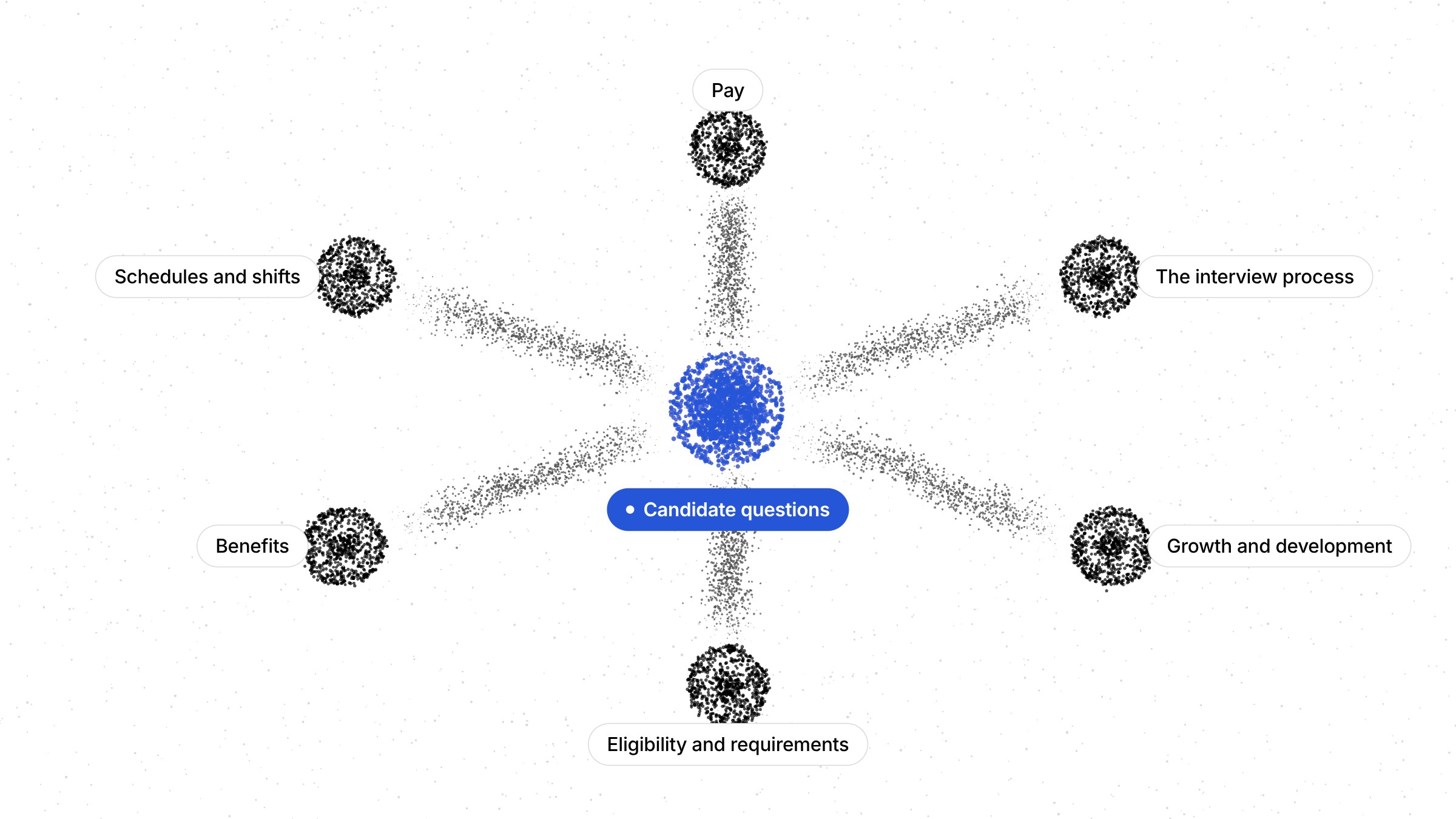
What Candidates Are Actually Asking: Six Themes Employers Can Act On
When candidates can ask in their own words, the questions they ask cluster into recognizable themes. Understanding these themes helps TA and recruitment marketing teams prioritize content work. The examples below are anonymized and illustrative; they reflect the kinds of questions CareerGPT surfaces, not a ranked list of the most common queries across any employer.
Pay
Pay questions are among the most direct candidates ask, and among the most likely to go unanswered on a standard career site. Questions in this theme include things like: “What is the starting pay for warehouse associates in this area?” or “Is there a pay difference between day and night shifts?” Candidates asking these questions have a clear decision to make and need specific information to make it. A careers page that describes compensation as “competitive” gives them nothing to work with.
Schedules and Shifts
Schedule questions reflect real constraints. Candidates are not browsing; they are checking whether a role fits their life. Typical questions include: “Do you have part-time positions that start after 9am?” or “Are there four-day week options in the distribution centre roles?” When these questions go unanswered, candidates leave. When they appear repeatedly in CareerGPT conversation records, the employer has a clear signal that shift details need to be more prominent in job descriptions or on a dedicated page.
Benefits
Benefits questions often start broad and become specific through follow-up. A candidate might open with “What health insurance do you offer?” and follow up with “Does the plan cover dependants?” or “When does coverage start?” The follow-up is where most recruiting tools fail. A standard conversational AI agent returns the same benefits overview paragraph to every question in the thread. CareerGPT is built to answer the follow-up using the specific detail the employer has connected, or to tell the candidate that detail is not currently available.
Eligibility and Requirements
Eligibility questions are common from candidates who are not sure whether they qualify. Examples include: “Do I need a forklift licence before I apply, or is training provided?” or “Are there roles here that do not require a four-year degree?” These questions matter because they represent candidates who are interested but uncertain. Employers who answer them clearly in their content reduce a barrier that was never about candidate quality.
Growth and Development
Growth questions signal intent to stay. Candidates asking “Is there a path from shift supervisor to operations manager here?” or “Do you support professional certifications?” are already thinking beyond the role they are applying for. Career sites that address these questions engage candidates who are evaluating the employer as a long-term option, not just the immediate opening.
The Interview Process
Interview process questions are a consistent theme and a useful diagnostic. When candidates ask “How many rounds of interviews are there for this role?” or “Will the interview be in person or remote?” in volume, it usually means the employer has not described its process clearly. The SonicJobs brand guide notes that repeated questions about interview preparation show an employer needs a clearer explanation of its interview process. This is one of the most direct ways conversation data translates into a specific content action.
Understanding Answer Coverage
Answer coverage is a way of describing how well a career site’s connected knowledge sources respond to the questions candidates actually ask. When CareerGPT receives a question, it draws on the knowledge sources the employer has connected: the career site, the job feed, uploaded documents such as PDFs, and any approved external sources including LinkedIn, Glassdoor, Reddit, or the employer’s social media pages.
If those sources contain a clear, relevant answer, CareerGPT returns it with a source citation. If they do not contain enough information, CareerGPT tells the candidate so. Both outcomes are recorded. The employer can review which questions were answered well, which produced thin or partial responses, and which produced no relevant information at all.
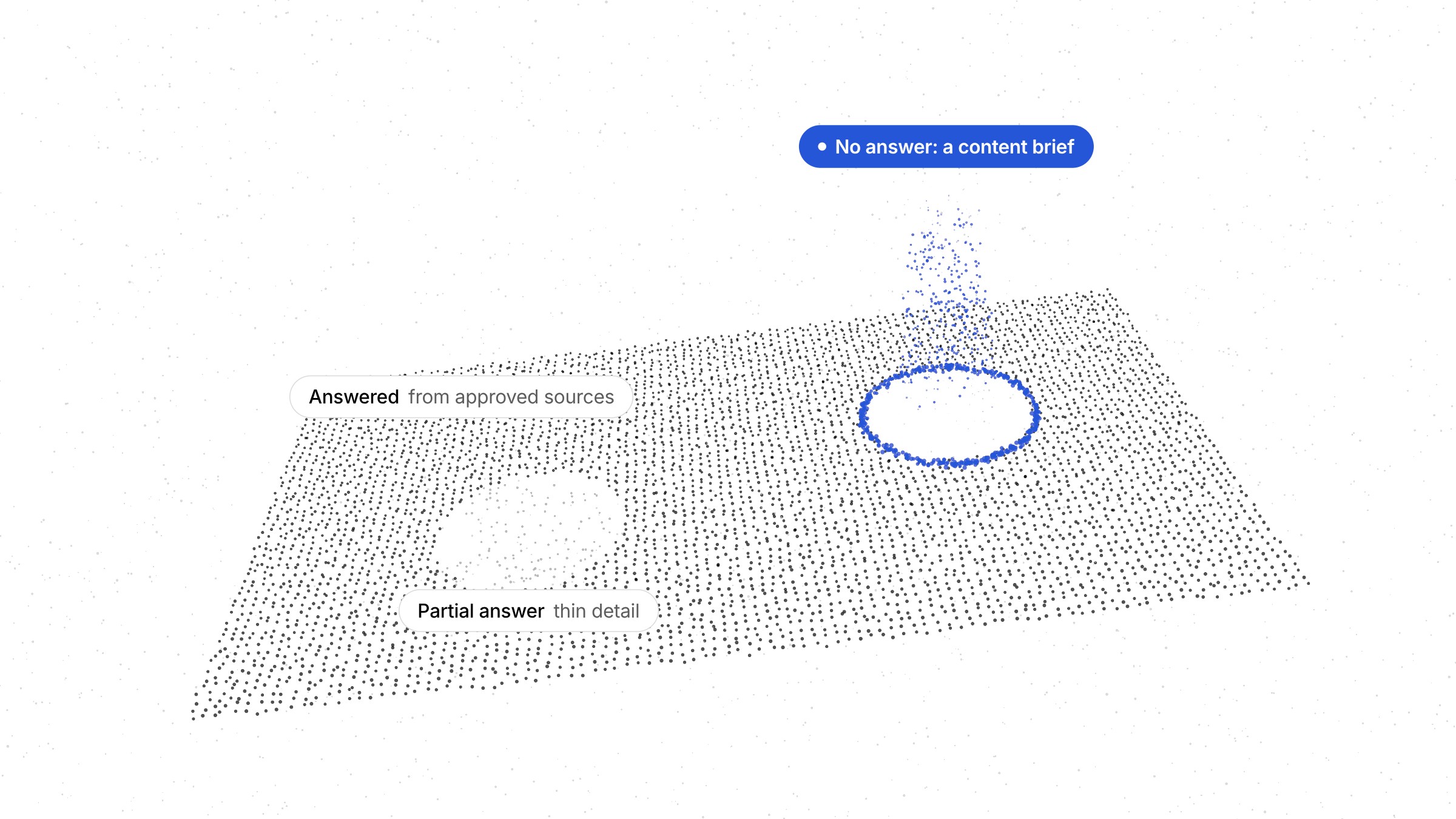
High answer coverage across a theme, benefits, for example, means the connected sources address that topic in enough detail for candidates to make decisions. Low coverage in the same theme means candidates are asking questions the career site cannot currently answer. That gap is not a data curiosity; it is a content brief.
Employers manage coverage by reviewing conversation records, identifying which questions fell outside the connected knowledge, and then adding that information. This can be done by updating the career site, uploading a document, or connecting an additional approved source. The employer controls what information CareerGPT has access to at all times.
How Employers Review Candidate Questions in CareerGPT
CareerGPT records each candidate question, the response it gave, the sources it cited, and the activity that followed within that conversation: which jobs the candidate viewed and where an application was started. Employers can review and export this data.
The review process is not automated interpretation. It is access to the actual conversation record. A TA leader or recruitment marketing manager can read the specific questions candidates asked, in the order they asked them, alongside the answers CareerGPT provided. This is meaningfully different from a summary dashboard that reports only aggregate counts. The actual phrasing of a question often carries information that a category label loses.
For example, two questions may both be categorised under “benefits” but carry different implications. “Do you offer dental?” is a coverage question. “Is the dental plan the same for full-time and part-time employees?” is a detail question that reveals a specific concern about employment status. Acting on the first might mean adding a benefits summary page. Acting on the second might mean clarifying eligibility conditions in the benefits documentation.
SonicJobs data shows that competitors’ processes for reviewing and approving candidate questions and answers usually take 6-9 months, but with CareerGPT, employers can simply whitelist data sources like company career sites and Glassdoor pages, reducing the process to days. CareerGPT draws answers from knowledge sources the employer already controls, which means the information is already approved and current. The conversation record shows employers where that existing information is working and where it is not.
Reading Unsuccessful Searches as a Recruiting Signal
Not every candidate search returns a matching role. When a search returns no suitable jobs, CareerGPT tells the candidate. That exchange is also recorded. Unsuccessful searches are a different kind of signal from unanswered questions, and they are worth reading separately.
An unsuccessful search might mean the employer has no roles matching the candidate’s requirements. It might also mean the employer does have matching roles but the job feed does not surface them for that particular combination of criteria. Or it might mean a role exists but the description does not contain the language the candidate used. Each of these has a different resolution.
A pattern of unsuccessful searches for a specific role type in a specific location is an indication that supply and demand in that area need attention. A pattern of unsuccessful searches for a combination of requirements, such as part-time and remote in a particular function, may reflect a genuine gap in the employer’s offering or a gap in how existing flexibility is described. Employers use this data to investigate what those candidates are looking for and to decide whether a content change, a posting change, or a hiring decision is the right response.
What to Look for in a Conversational AI Career Agent for Candidate Insight
TA leaders evaluating tools for candidate question insight should expect a few specific capabilities. The questions below are worth asking of any platform in this category.
Access to the Full Conversation Record
Aggregate metrics show volume. The conversation record shows intent. A tool that provides only summary counts of question categories gives the employer less to act on than one that lets the team read actual questions and responses. CareerGPT makes the full conversation record reviewable and exportable.
Answers Drawn from Employer-Approved Sources
The quality of the answers candidates receive determines whether the insight data is trustworthy. If a career agent draws answers from sources the employer has not approved or cannot verify, the conversation record reflects misinformation as well as genuine candidate interest. CareerGPT answers from knowledge sources the employer connects and controls. Approved external sources, including LinkedIn, Glassdoor, Reddit, and the employer’s YouTube and social media pages, can be connected alongside the career site and job feed. Candidate conversations are not shared with any external AI lab.
Visibility into Searches with No Results
A tool that only records answered questions misses a significant share of the signal. Unsuccessful searches are where genuine unmet need is most visible. The employer needs to know not just what candidates asked but what they searched for and did not find.
No Disruption to the Existing Application Journey
A career agent that requires an ATS migration or a career site rebuild creates a cost that can delay deployment by months. CareerGPT sits on the employer’s existing career site without replacing it. Adding the script takes minutes; the full deployment can go live in days once the job feed, content, and approvals are in place. The candidate continues through the employer’s existing application process when they are ready to apply.
Multilingual Support
Candidate populations are rarely monolingual, particularly for employers with distributed workforces. CareerGPT is available across countries and languages, including Spanish, French, German, Mandarin, and Hindi. Job descriptions remain in the language the employer published them in.
How TA Teams and Recruitment Marketers Use CareerGPT Insight
The employers who get the most from CareerGPT’s conversation data use it as a standing input to content decisions, not a one-time audit. Below are the ways recruiting teams apply it in practice.
Prioritising content updates: When the same question about a specific benefit appears across multiple conversations with thin or no coverage, that benefit page is next in the content queue. The question data gives content teams a ranked list of gaps without requiring a separate research exercise.
Adjusting suggested questions: CareerGPT can be configured to show suggested starting questions when a candidate opens it. Employers update these to reflect what candidates are actually asking. If a significant share of conversations are opening with shift-related questions, a suggested question about shift availability reduces friction for the next candidate with the same need.
Reviewing role-level detail: Candidates often ask follow-up questions about a specific job after opening it in CareerGPT. If those follow-ups are consistently about the same gap (say, training requirements for a warehouse role), the job description for that role needs more detail. The conversation record connects the content gap directly to the posting.
Monitoring new searches after a posting goes live: When a new role is posted, the first wave of candidate questions about it is a useful early indicator of what the job description is missing. Employers can review those conversations within days of the posting and update the description before the main application volume arrives.
Understanding candidate interest in locations and role types: Repeated unsuccessful searches for a role type in a specific city or region are a signal that recruiting activity in that area may need to increase, or that existing roles in that area need more visible promotion.
Informing recruitment marketing decisions: Recruitment marketing teams use question themes to identify what content candidates need before they reach the application. If candidates on the career site are consistently asking about culture and growth, those themes are underserved in current marketing content.
SonicJobs reports that 90% of CareerGPT conversations reached a relevant job result, and 64% led to an application start. The conversation record behind those figures is what enables the content and configuration decisions that sustain them.
Best Practices for Reading and Acting on Candidate Questions
Conversation data is only useful if someone reviews it regularly and connects what they find to a specific action. The following practices reflect how recruiting teams get consistent value from CareerGPT’s insight layer.
Review on a fixed cadence, not just when something looks wrong. A monthly or fortnightly review of conversation records gives teams a baseline. Changes in question volume by theme are visible against that baseline. A sudden increase in interview process questions, for example, is more informative when you know what the normal level looks like.
Read the question alongside the answer, not separately. An unanswered question and a poorly answered question look the same in aggregate but require different responses. Reading the actual answer CareerGPT provided shows whether the issue is missing content or content that exists but is not clearly written.
Separate unsuccessful searches from unanswered questions in your review. These are different problems. An unanswered question means the content exists elsewhere but is not connected. An unsuccessful search may mean no role exists, or that the role exists but is described differently. Treating them the same leads to content updates that do not address the real issue.
Track question themes alongside hiring priorities. If a role is hard to fill, the conversation record for that role type is worth examining specifically. Candidates who were interested but left without applying often left a question behind that explains why.
Use uploaded documents to fill gaps quickly. When a content gap is identified and updating the career site will take time, an uploaded PDF can connect that information to CareerGPT immediately. Employers share information with candidates through uploaded documents that they have not yet published, or add material without waiting on a website update cycle.
Connect question patterns to career site content decisions. Turning insight into content changes is where the value compounds. Guide #18 in the SonicJobs guide series covers how to take the patterns identified in CareerGPT conversation records and translate them directly into career site content improvements.
How CareerGPT Gives Employers Visibility Other Tools Cannot Provide
CareerGPT sits on the employer’s existing career site as a floating widget or embedded in the search bar. It requires no career site rebuild and no ATS migration. Candidates open it, describe what they are looking for, ask questions about specific roles, and continue through the employer’s existing application process when they are ready. At Johns Hopkins Medicine, CareerGPT is live and active within that existing career infrastructure.
The insight it generates is specific to the employer’s own candidates on the employer’s own site. No other tool currently provides this. Google Search Console shows what terms bring candidates to the site from search; it does not show what candidates asked once they arrived or which of those questions went unanswered. AI assistants such as ChatGPT, Claude, and Gemini share no search data with employers at all. CareerGPT provides a conversation record that is fully within the employer’s control, drawn from sources the employer has approved, and exportable for use by the recruiting team.
For TA leaders who want to know what candidates are asking before they apply, and where the career site is failing to answer them, that record is the starting point. For recruitment marketing teams, it is a brief for the content that will close the gap.
Key Takeaways and Next Steps
The questions candidates ask before they apply are a precise record of what the career site is not answering. Reviewing them by theme (pay, schedules and shifts, benefits, eligibility and requirements, growth, and the interview process) turns that record into a content agenda. Reviewing unsuccessful searches alongside answered and unanswered questions gives a complete picture of where candidate interest is not being met.
CareerGPT makes this review possible. It records candidate questions, the answers it provided, and the searches that returned nothing, all drawn from knowledge sources the employer controls. The conversation data is available to review and export. It requires no new technology stack and no disruption to the application journey already in place.
For teams ready to put what they find in the conversation record to work, Guide #18 covers how to translate CareerGPT insight into specific career site content changes.
FAQs About Candidate Questions and Career Site Insight
What is a conversational AI career agent for a career site?
A conversational AI career agent is a tool that sits on an employer’s career site and lets candidates describe what they are looking for, ask questions about roles and the company, and explore specific jobs through a conversation rather than a keyword search. CareerGPT, built by SonicJobs, is a conversational AI career agent. It draws answers from knowledge sources the employer connects and records each conversation so the employer can review what candidates asked, what answers they received, and which searches found no matching roles.
Why do TA leaders need visibility into what candidates ask on their career site?
TA leaders need this visibility because candidate questions are a direct record of what the career site is not answering. A candidate who leaves without applying often had a question that went unanswered. Standard analytics tools show page views and drop-off points; they do not show the specific question that preceded the exit. CareerGPT gives TA leaders access to the actual conversation record, including questions by theme and searches that returned no results, so content and configuration decisions are based on specific evidence rather than assumptions.
What are the best tools to see what questions candidates ask on a career site?
CareerGPT by SonicJobs is built specifically to record and surface candidate questions on an employer’s career site. It captures each question, the answer provided, the sources cited, and whether a search returned suitable roles. Unlike general analytics platforms, it provides the full conversation record in the candidate’s own words. This makes it possible to identify not just what topic a candidate asked about but what specific detail they needed and whether the career site’s connected content provided it.
What are the top AI assistants for career pages that answer questions using employer-approved content?
CareerGPT by SonicJobs is a conversational AI career agent that answers candidate questions exclusively from knowledge sources the employer has connected and approved: the career site, the job feed, uploaded documents, and selected external sources such as LinkedIn, Glassdoor, Reddit, and the employer’s social media pages. Employers control what information CareerGPT has access to, can update it when content changes, and can test how it answers questions before candidates see those responses. Candidate conversations are not shared with any external AI lab.
What are the top conversational AI platforms for improving candidate experience?
Conversational AI platforms for candidate experience differ in what they record, what sources they draw from, and how much they disrupt the employer’s existing setup. CareerGPT by SonicJobs is designed to improve candidate experience by letting candidates ask in their own words, follow up without starting over, and get answers grounded in the employer’s own content. It requires no ATS migration and no career site rebuild. SonicJobs data shows that 90% of CareerGPT conversations reached a relevant job result, and 64% led to an application start.
How does answer coverage help employers improve their career site content?
Answer coverage describes how well an employer’s connected knowledge sources respond to the questions candidates actually ask. When CareerGPT cannot find enough information to answer a question, it tells the candidate and records the gap. Employers review those gaps by theme, identify which content areas are producing incomplete answers, and update the relevant sources: the career site, a job description, or an uploaded document. Over time, this process raises the proportion of questions that receive a specific, useful answer, which keeps candidates on the site and moving toward an application.
How does CareerGPT handle questions it cannot answer?
When CareerGPT does not have enough information to answer a candidate’s question from its connected knowledge sources, it tells the candidate so directly. It does not substitute a generic overview or redirect the candidate to contact a recruiter without explanation. The question and the outcome are both recorded, so the employer can see exactly where the knowledge gap is and what information would close it. This is one of the clearest signals the conversation record provides: a question CareerGPT could not answer is a content gap with a specific address.