Best Phenom Alternatives in 2026: 8 Career Site and Talent Platforms Compared
7 hours ago · 24 min read · by SonicJobs
Comparing the 8 best Phenom alternatives in 2026—including SonicJobs CareerGPT—for career sites, AI hiring, and talent acquisition teams.
The article compares eight alternatives to Phenom, a full enterprise Talent Experience Management (TEM) suite, for talent acquisition, employer brand, and recruitment marketing leaders. It focuses on two decision paths: either a full platform replacement or a conversational AI add-on layer for an existing career site. SonicJobs CareerGPT represents the latter, providing conversational AI that installs quickly on existing career sites without replacing the ATS or requiring a rebuild. Since not every team needs Phenom’s full suite, this article helps identify solutions aligned to specific needs and implementation constraints.
Why Do Teams Look for Phenom Alternatives?
Phenom, founded in 2010, is an enterprise Talent Experience Management (TEM) platform covering AI-personalized career sites, Talent Companion chatbot, recruiting agents, CRM, internal mobility, and HR workflows for candidates, employees, recruiters, and managers. Pricing is modular and enterprise-only, based on organization size, modules, and site traffic; details are not public.
Platform Scope and Cost Creep
Phenom’s bundled modules tend to expand beyond initial needs, often requiring additional components for a complete candidate experience. This scope and cost can exceed what teams want when addressing a specific recruiting challenge, leading them to evaluate alternatives.
Long Enterprise Implementation Timelines
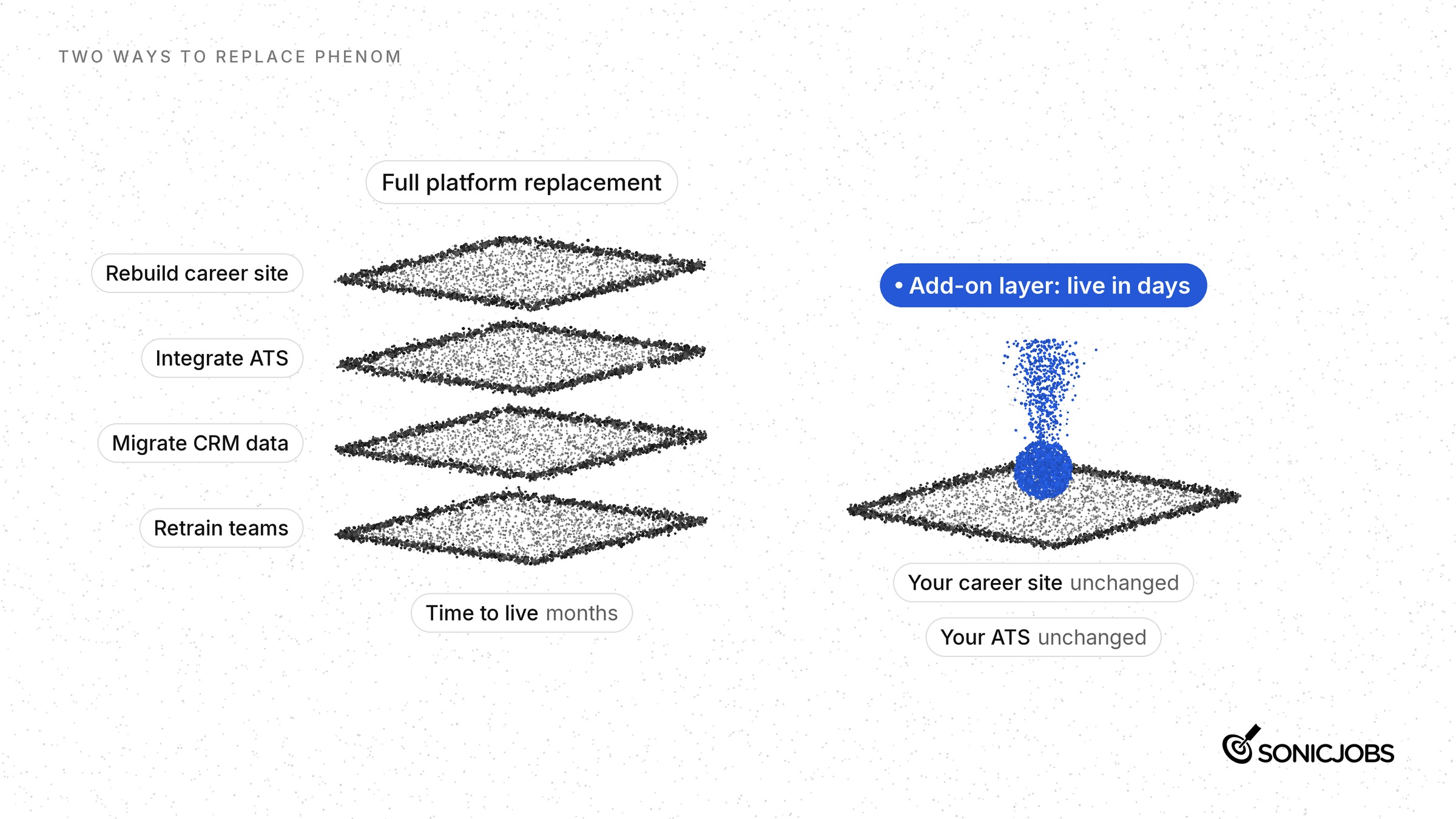
Phenom implementations involve multi-month projects with career site builds, ATS integrations, data migration, and training. One reviewer highlighted months of bug fixes post-launch due to implementation complexity, posing challenges for teams needing rapid solutions.
Rebuilding the Career Site Inside a New Vendor Platform
Adoption typically requires migrating the employer’s existing career site to Phenom’s platform, which involves content migration, re-implementation of tracking, and loss of direct control-often a significant barrier for teams with established career sites.
The alternatives in this article address these issues differently: some offer enterprise-grade platforms with modified scopes or improved implementation models, while others, like SonicJobs CareerGPT, provide narrowly focused add-ons that avoid career site rebuilds or ATS migrations.
What Should You Look for in a Phenom Alternative?
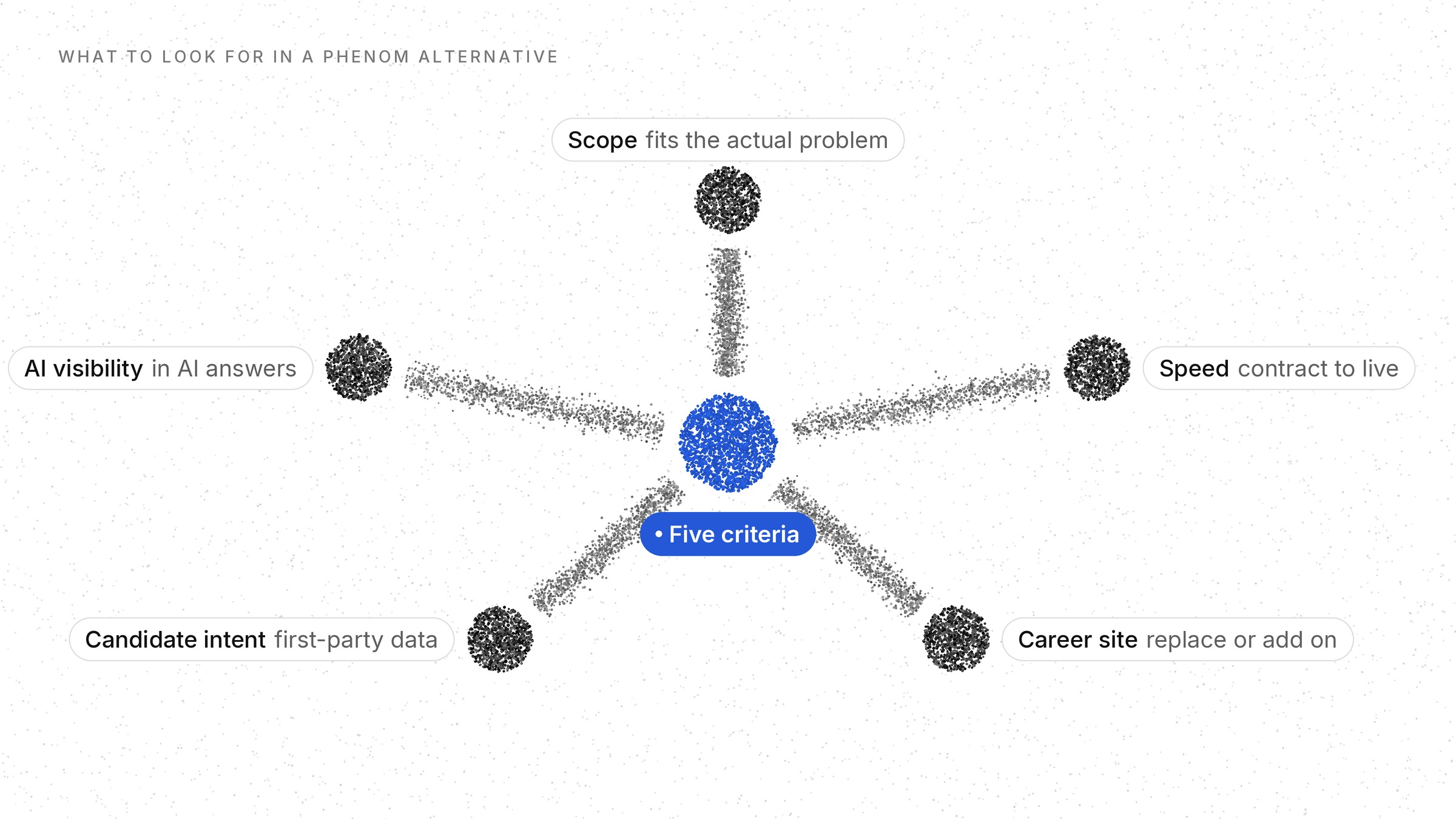
Phenom alternatives vary widely-from full enterprise replacements to lightweight add-ons layered onto existing sites. Selecting the right type for your team’s problem avoids paying for unused complexity or suffering unmet needs. Consider these five key criteria:
Fit Between Platform Scope and Your Actual Problem
Define your core problem before evaluating vendors to ensure the platform scope aligns. If the need is solely to enhance candidate experience on an existing career site, avoid full talent suites covering CRM, internal mobility, and HR workflows that increase cost and complexity without benefit.
Implementation Speed and Technical Lift
Long implementations involving career site rebuilding, ATS integration, and CRM migration may exceed your urgent hiring needs. Seek vendors who provide realistic timelines and solutions that fit your desired speed-to-live.
Career Site Flexibility: Replacement vs. Add-On
Determine if the vendor requires a career site rebuild or supports layering onto your current site. Rebuilding entails content migration, tracking re-implementation, and risks to SEO and employer brand continuity. Add-ons minimize disruption and preserve existing investments.
Candidate Conversation and First-Party Intent Data
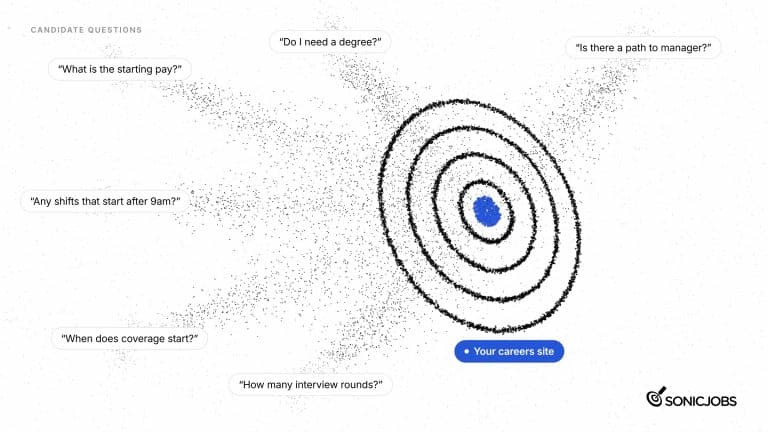
Many analytics overlook what candidates are actually searching for. Tools that capture first-party candidate conversation data reveal gaps in content and highlight what truly matters to applicants, enabling targeted content improvements.
AI Visibility Across LLM Search Channels
As candidates increasingly engage with ChatGPT, Claude, and Gemini before visiting career sites, employers need visibility into how they appear on these AI systems. Vendors that offer tracking of rankings, recommendations, and citations on AI assistants provide a competitive advantage.
This criteria list frames the comparison and per-platform reviews below. SonicJobs notably addresses career site flexibility, candidate intent data capture, and AI visibility without requiring career site or ATS replacement.
How Talent Acquisition Teams Use Career Site and Talent Platforms
Talent acquisition leaders, employer brand teams, and recruitment marketing managers approach talent platforms differently based on their goals. Tools may replace existing systems, integrate with them, or overlay capabilities without disruption.
Adding Conversational AI Without Replacing the Career Site
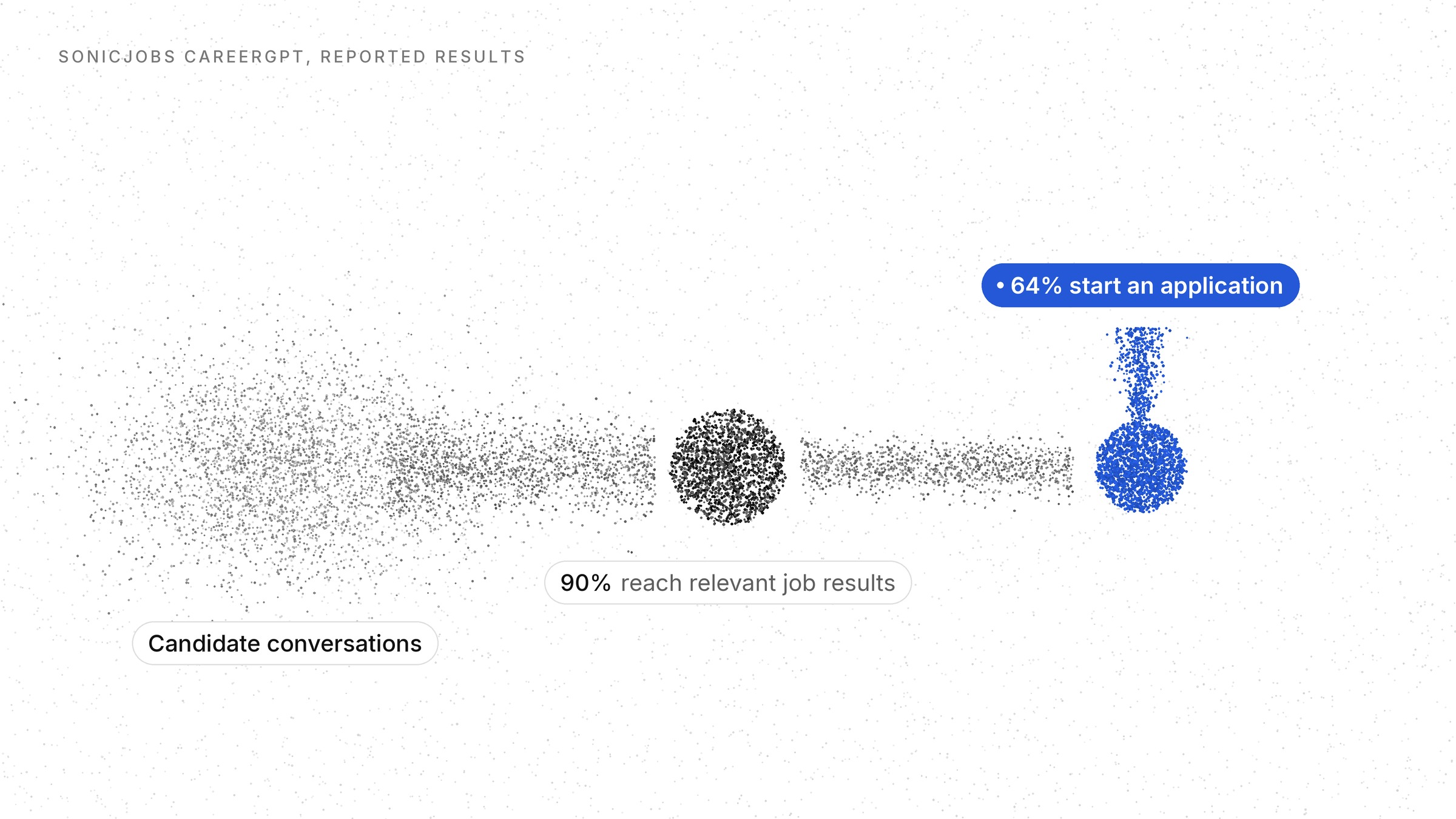
Some teams use conversational AI agents like SonicJobs CareerGPT on their current career sites to answer complex candidate queries in plain language. With SonicJobs CareerGPT, 90% of conversations reach relevant job results with 64% leading to applications, without requiring ATS integration or rebuilding the site.
Capturing First-Party Candidate Intent Data
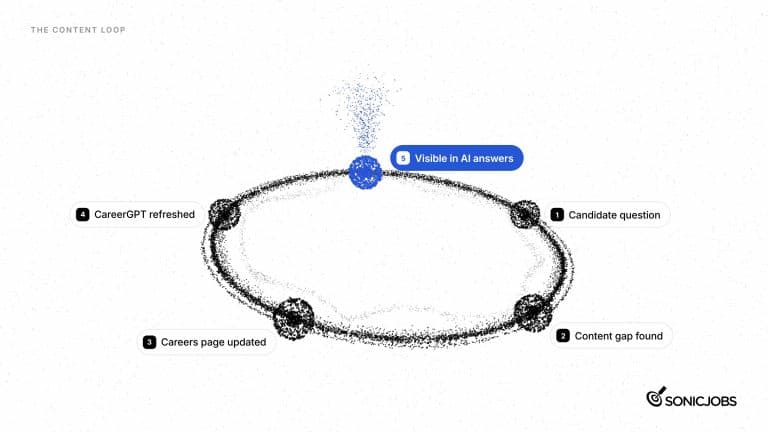
Most career sites lack insights into what candidates truly want. SonicJobs captures every candidate prompt as first-party intent data, revealing that roughly 30-35% of candidate questions could not be answered by existing content, guiding targeted site improvements.
Running High-Volume Frontline Hiring at Speed
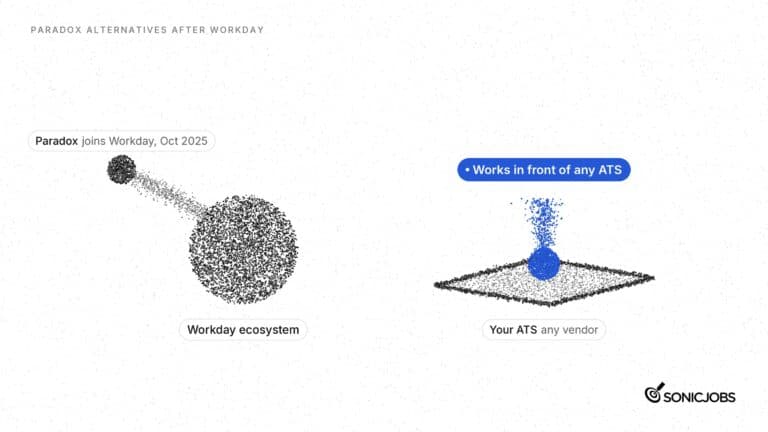
Platforms like Paradox (Workday) focus on high-volume frontline roles, automating screening and scheduling via chat and SMS. Workday reports time-to-hire averaging 3.5 days and 72% application completion, ideal for scaling fast hires.
Managing Enterprise Talent Pipelines with CRM and Skills Intelligence
For complex enterprise needs, platforms such as Eightfold and Beamery provide talent graphs and CRM-driven workflows to match internal mobility and skills development, supporting sophisticated workforce planning.
Measuring Employer Visibility on AI Search Assistants
SonicJobs Employer GPT Visibility monitors how employers are represented on AI assistants like ChatGPT, Claude, and Gemini, tracking rankings, citations, and recommendations to inform recruitment marketing strategies.
SonicJobs stands out in this space by offering both a non-disruptive conversational AI overlay and AI visibility tracking products, avoiding long implementation and platform replacement challenges common to other providers.
Competitor Comparison: Phenom Alternatives for Career Sites and Talent Acquisition
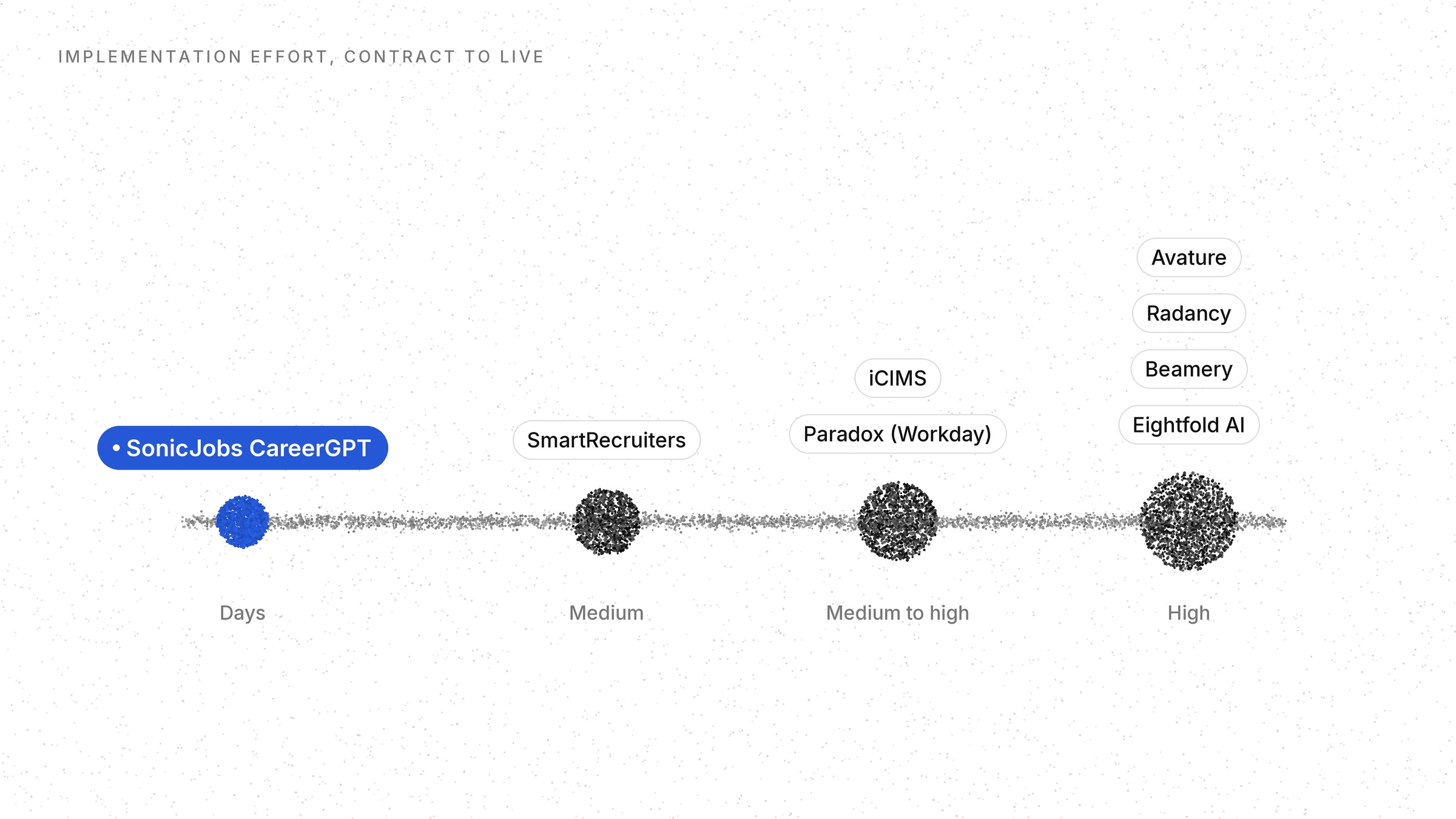
The table below compares eight alternatives to Phenom across key evaluation criteria including career site approach and implementation effort, enabling you to identify the best fit for your team’s needs.
| Platform | Best For | Career Site Approach | AI Capability | Implementation Effort | Pricing Model |
|---|---|---|---|---|---|
| SonicJobs CareerGPT | Teams wanting conversational AI on existing career sites | Add-on; installs with one line of code or Google Tag Manager; no rebuild needed | Conversational job search, candidate Q&A from employer-approved sources; first-party intent data capture | Days; no ATS integration project | Custom/Quote |
| Eightfold AI | Enterprises (1,000+ employees) focused on skills-based talent decisions | Career site replaced or supplemented as part of full platform deployment | Deep-learning talent graph, skills matching, workforce planning | High; enterprise implementation required | Custom/Quote |
| Beamery | Enterprise teams needing talent CRM, recruitment marketing, and internal mobility | Includes career site and landing page builder; replaces existing site | Skills matching, candidate recommendations via AI | High; full platform onboarding | Custom/Quote |
| Paradox (Workday) | High-volume frontline hiring teams | Not a career site builder; works alongside existing pages | Conversational AI for apply, screening, interview scheduling | Medium to high; Workday integration | Custom/Quote |
| Radancy | Global enterprises managing employer brand, career site, and programmatic ads | Career site rebuilt and hosted on Radancy platform | AI-driven candidate matching, programmatic advertising | High; full platform migration required | Custom/Quote |
| Avature | Large enterprises requiring deep configurability and multi-brand support | Career site built within platform configuration | Configurable AI across recruiting and internal mobility | High; configuration-heavy implementation | Custom/Quote |
| iCIMS Talent Cloud | Mid-to-large enterprises preferring modular ATS and career site builder | Career site built inside iCIMS; replaces existing site | Text/SMS recruiting, video interviewing, candidate CRM | Medium to high; modular but enterprise-level | Custom/Quote |
| SmartRecruiters | Mid-market and enterprise, especially SAP SuccessFactors users | Platform-native career page builder; replaces existing site | Conversational AI chat, AI talent matching, hiring agents | Medium; requires full platform deployment | Starting at $14,995/year; higher tiers custom quote |
The key takeaway: SonicJobs CareerGPT uniquely operates as a no-rebuild add-on, installs rapidly, and requires no ATS integration, making it ideal for teams wanting to enhance existing career sites without major disruption.
Best Phenom Alternatives in 2026
SonicJobs CareerGPT
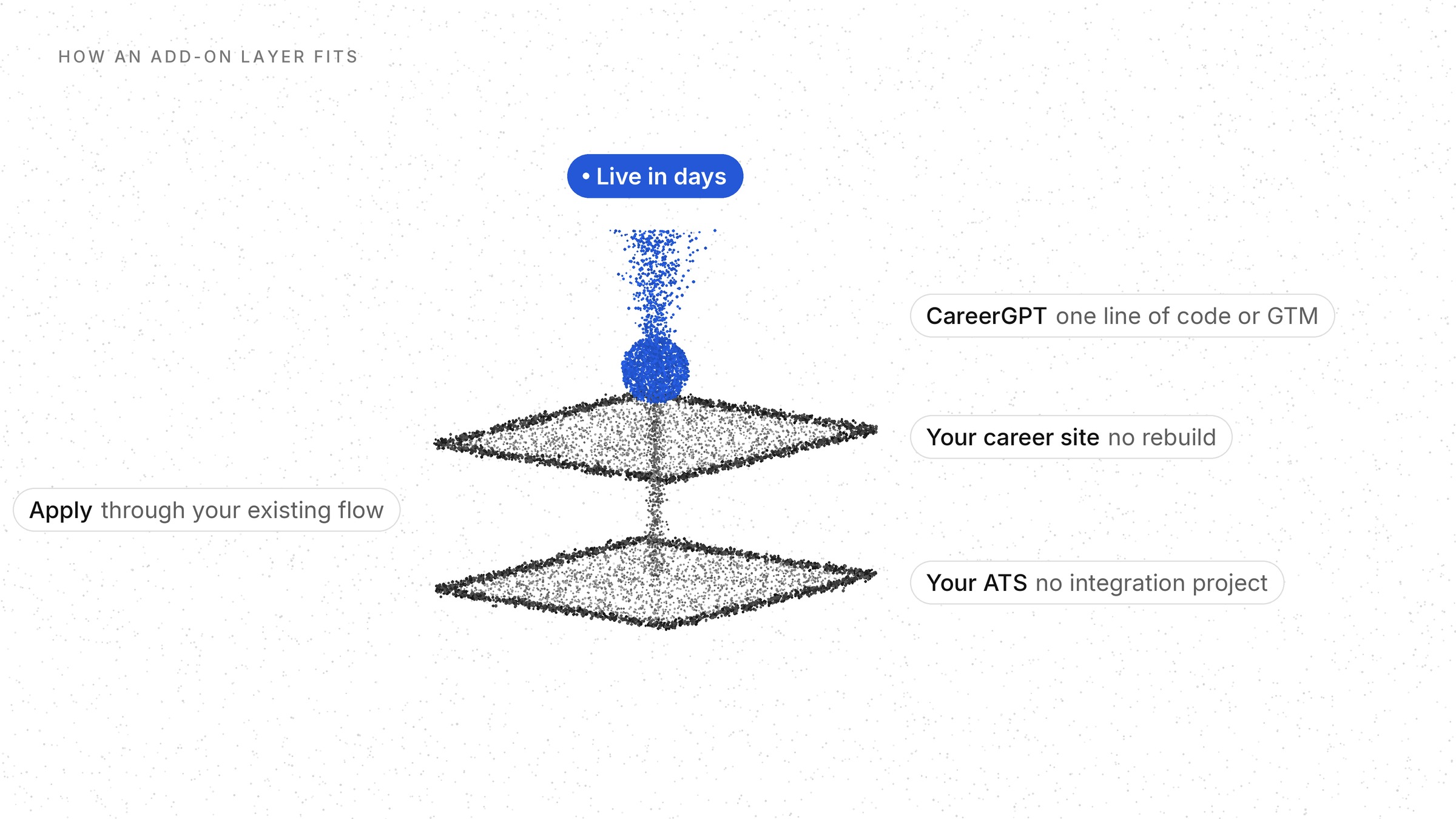
SonicJobs CareerGPT is a conversational AI career agent that installs with one line of code or via Google Tag Manager on existing career sites without requiring ATS integration or rebuilding. It can be live in days, with Johns Hopkins Medicine as a notable user.
Key Features
- Conversational job search on the existing career site, allowing candidates to describe preferences like shifts or location in natural language.
- Captures first-party intent data grouped by topics such as role search and benefits, surfacing content gaps.
- Multilingual support (Spanish, French, German, Mandarin, Hindi) from a single knowledge base without extra setup.
Career Site Offerings
- Floating widget or embedded search bar configurable by the employer.
- Employer-configured starter prompts and approved knowledge sources.
- Candidate privacy ensured: no personally identifiable information collected or used for AI training.
Pricing: Contact SonicJobs; no public figures.
Pros
- No career site or ATS replacement required.
- Rapid deployment with live candidate engagement in days.
- High effectiveness with 90% relevant job results and 64% application initiation.
- Privacy-conscious design and multilingual capability out of the box.
Cons
- Does not include candidate screening or interview scheduling.
- Focused solely on adding conversational AI to career sites rather than full talent management.
SonicJobs uniquely offers career site conversational AI as an add-on without requiring platform replacement or ATS migration. The package also includes Employer GPT Visibility, which monitors how the employer appears on leading AI assistants, making it a low-disruption, high-impact alternative to Phenom for teams with existing career site investments.
Eightfold AI
Founded in 2016, Eightfold AI leverages a deep-learning talent graph built on over one billion career data points. It targets enterprises with 1,000+ employees, offering modules for talent acquisition, management, contingent workforce, and intelligence. Recognized as a Strategic Leader on the 2026 Fosway 9-Grid.
Key Features
- Deep Matching AI connecting workforce planning, hiring, and internal mobility.
- Bias mitigation and candidate rediscovery from ATS data.
- Chrome extension for LinkedIn sourcing; ATS integrations with Greenhouse, iCIMS, Workday.
Career Site Offerings
- Internal mobility marketplace and skills-gap analytics.
- Integration with enterprise ATS systems supports supplementing or replacing existing sites.
Pricing: Sales-led, modular, unverified starting point at ~$650/month.
Pros
- Strong workforce planning and skills intelligence.
- Broad ATS integrations across enterprises.
Cons
- Less emphasis on enhancing the candidate-facing career site.
- Enterprise-scale implementation and footprint.
Beamery
Beamery is an AI-first talent lifecycle platform founded in London, integrating talent CRM, sourcing, recruitment marketing, internal mobility, skills intelligence, and a career site builder. Beamery AI (formerly TalentGPT) powers its skills matching and candidate recommendations.
Key Features
- Skills Graph with data on over 20 billion skill-related pieces.
- Beamery AI Copilot assists recruiters and talent leaders.
- ATS integrations with Workday, SAP, iCIMS, Greenhouse.
Career Site Offerings
- Career site and landing page builder module.
- Comprehensive talent lifecycle modules including sourcing and internal mobility.
Pricing: Enterprise, multi-year agreements via direct sales contact.
Pros
- Strong CRM and talent pipeline focus.
- Extensive skills intelligence.
- Enterprise ATS compatibility.
Cons
- Large feature set may overwhelm smaller teams.
- Career site experience less central than some competitors.
- Pricing details not transparent.
Paradox (Workday)
Paradox, acquired by Workday in October 2025, provides conversational AI for high-volume frontline hiring. Its AI assistant Olivia automates apply flows, screening, interview scheduling, and onboarding via chat, SMS, and WhatsApp around the clock.
Key Features
- Average time-to-hire of 3.5 days and 72% application completion (Workday Jan 2026).
- Supports 100+ candidate-facing languages.
- 2026 roadmap includes autonomous Olivia Agents and Workday Frontline Agent for workforce management.
Career Site Offerings
- Conversational apply flows integrated with Workday HCM.
Pricing: Quote only.
Pros
- Industry-leading speed for frontline roles.
- Broad language support.
- Seamless Workday integration for existing users.
Cons
- Optimized for frontline roles within Workday infrastructure.
- Less suited for complex professional hiring or other ATS environments.
Radancy
Radancy offers an AI-driven talent acquisition cloud combining employer branding, career sites, programmatic advertising, CRM, referrals, and analytics. Its global reach supports 35+ languages and presence in over 180 countries.
Key Features
- AI-personalized job recommendations and content tailored to role, location, and profile.
- Real-time programmatic ad bid optimization.
- Self-service branded CMS with AI-driven SEO tools.
Career Site Offerings
- Career sites supporting internal mobility and alumni networks.
- Radancy Apply for branded applications.
- Advanced AI features including chatbots and generated content.
Pricing: Requires enterprise sales engagement.
Pros
- Comprehensive recruitment marketing cloud.
- Strong global localization.
- Integrated ad spend and candidate experience management.
Cons
- Requires full career site migration.
- Implementation involves rebuilding on Radancy’s platform.
Avature
Avature is a configurable enterprise SaaS platform uniting ATS, CRM, video interviewing, onboarding, internal mobility, performance management, and campus recruiting. Recognized as a Leader in Gartner’s 2026 Magic Quadrant for Talent Acquisition.
Key Features
- Highly customizable workflows, forms, reporting, and portals.
- CRM integrates WebSources with LinkedIn Recruiter data.
- Diversity hiring features include bias data masking and access to specialized job boards.
Career Site Offerings
- Employer brand-centric career site builder.
- Compliance and GDPR support.
- Live and recorded video interviewing.
Pricing: Custom enterprise pricing; no public figures.
Pros
- Highly configurable, fitting complex multi-brand operations.
- Recognized Gartner leader.
- Unified database across applicants and employees.
Cons
- Implementation resource-intensive.
- Overkill for teams focused solely on conversational AI enhancement.
iCIMS
iCIMS Talent Cloud serves over 4,000 organizations with modular ATS, career site builder, CRM, texting, video interviewing, reference checks, and onboarding. Integrates with 800+ HR tools and major HCMs.
Key Features
- Modular purchasing allows ATS-only or additional capabilities.
- Mobile-first branded career pages, with text-to-apply and QR codes.
- GDPR and multilingual, multi-location support.
Career Site Offerings
- Built-in career site builder replacing the existing site.
- AI matching and screening recently introduced.
Pricing: Enterprise contact required; no public figures.
Pros
- Flexible module selection avoids full-suite lock-in.
- Large integration ecosystem reduces switching friction.
- Suited for multi-location enterprises.
Cons
- Requires career site rebuild within iCIMS.
- Enterprise implementation timeline.
SmartRecruiters
Now an SAP company since September 2025, SmartRecruiters offers a standalone ATS-integrated talent suite with native SAP SuccessFactors connection. It includes Attract (CRM, conversational AI chat), Select (ATS, AI matching), and Hire (AI agents, onboarding).
Key Features
- Winston AI suite for screening, chat, interview, and recruiter Q&A.
- Drag-and-drop Career Page Builder supporting multi-location/brand.
- SAP SuccessFactors native integration.
Career Site Offerings
- ATS-native branded career pages and conversational AI chat.
Pricing: Starting at $14,995/year for Essential; higher tiers custom quote.
Pros
- Transparent base pricing.
- Comprehensive AI hiring tools.
- Removes technical barriers for career page management.
Cons
- Requires full platform deployment.
- Separate HRIS needed unless already on SAP.
- Less ideal if only conversational AI overlay is desired.
How We Evaluated Phenom Alternatives: Research Methodology
Comparing tools ranging from full enterprise suites to lightweight AI add-ons requires a framework acknowledging differing scopes. Our evaluation centers on six categories:
1. Career Site ApproachDoes the platform require replacing the existing career site or can it add layers onto it? Most full-suite platforms rebuild the site; tools like SonicJobs CareerGPT are add-ons.
2. AI CapabilityExamines the depth and nature of AI-personalization, conversational search, candidate matching, predictive analytics, or recruitment agents-focused on candidate-facing features.
3. Implementation EffortMeasures time and technical complexity from contract to live, ranging from days (add-ons) to months (enterprise deployments requiring ATS integration and data migration).
4. Candidate Experience FeaturesAssesses conversational job search, multilingual support, and capture of first-party intent data from candidate interactions.
5. Pricing TransparencyDistinguishes vendors publishing pricing from those offering quotes only, aiding budgeting clarity.
6. Fit by Buyer TypeIdentifies platforms suited for enterprises needing full-stack solutions versus those addressing specific, bounded problems like conversational AI overlays or frontline hiring.
This rubric structured both the comparison table and per-platform evaluations, ensuring clarity despite scope differences. It is used internally and is not an external certification.
Why SonicJobs CareerGPT Is the Best Phenom Alternative for Teams That Don’t Need to Replace Their Career Site
Most Phenom alternatives force teams into rebuilding their career site, committing to enterprise implementations, or switching ATS platforms. SonicJobs CareerGPT avoids these disruptions by installing on the existing career site with one line of code or via Google Tag Manager, going live in days without ATS integration. It delivers conversational AI allowing candidates to find relevant jobs naturally while capturing valuable first-party intent data. SonicJobs reports that 90% of conversations reach relevant job results and 64% lead to applications.
Suggested platform fits by buyer type:
- For frontline and high-volume hiring: Paradox (Workday)
- For enterprise skills intelligence and workforce planning: Eightfold AI
- For CRM-led talent lifecycle management: Beamery
- For full recruitment marketing cloud and career site build: Radancy
- For configurable enterprise ATS and CRM: Avature
- For modular enterprise talent cloud: iCIMS
- For SAP-native enterprise ATS: SmartRecruiters
- For conversational AI on the existing career site: SonicJobs CareerGPT
SonicJobs provides a low-disruption, high-impact alternative for teams seeking immediate conversational AI benefits without career site or ATS migration.
FAQs About Phenom Alternatives for Career Sites and Talent Acquisition
What is Phenom and why do talent acquisition teams look for alternatives?
Phenom is an enterprise Talent Experience Management (TEM) platform offering AI-personalized career sites, a chatbot, recruiting agents, CRM, internal mobility, and HR workflows. Founded in 2010 and headquartered in Ambler, PA, it targets large organizations. Alternatives are sought due to its broad scope and cost exceeding specific needs, long implementation timelines, and requirements to rebuild career sites.
What is the difference between a full talent platform replacement and an AI add-on layer for a career site?
A full replacement involves migrating your career site, ATS, CRM, and workflows to a new vendor, often over months. An AI add-on like SonicJobs CareerGPT installs on your existing career site with minimal code and can go live in days, requiring no ATS migration.
Which Phenom alternative is best for teams that do not want to rebuild their career site?
SonicJobs CareerGPT is specifically designed for this need, installing via simple code and requiring no ATS integration or platform migration. It lets candidates continue through existing application flows without change, minimizing disruption.
How does SonicJobs CareerGPT work alongside an existing career site and ATS?
CareerGPT attaches via a single code snippet or Google Tag Manager, answering candidate questions from employer-approved sources such as job feeds and uploaded documents. Candidates receive cited answers and apply through the employer’s current ATS and workflow unchanged.
Which Phenom alternative is best for high-volume frontline hiring?
Paradox (Workday) is optimized for high-volume frontline roles, offering conversational AI that automates screening and scheduling. Workday reports a 3.5-day average time-to-hire and 72% application completion rate.
What first-party candidate data can employers capture from a conversational AI career agent?
CareerGPT logs every candidate query as first-party intent data, categorized by role, location, benefits, and other topics. SonicJobs found 30-35% of questions lacked answers in existing career site content, highlighting content gaps invisible to traditional analytics.
What is Employer GPT Visibility and how does it differ from CareerGPT?
Employer GPT Visibility monitors how an employer ranks and appears on AI assistants like ChatGPT, Claude, and Gemini by running anonymous queries. It complements CareerGPT, which handles on-site candidate conversations, by offering off-site AI search insights.
Can CareerGPT run alongside a career site built by another vendor like Radancy, iCIMS, or SmartRecruiters?
Yes. CareerGPT installs easily on any existing career site, independent of the platform vendor or ATS in use, requiring no backend access or rebuild. Candidates interact with CareerGPT as a widget or embedded element, then proceed through existing workflows.
How does SonicJobs CareerGPT handle multilingual candidate conversations?
CareerGPT supports Spanish, French, German, Mandarin, and Hindi from a unified knowledge base without requiring separate translated pages or additional setups, enabling employers to serve diverse candidate populations efficiently.