Best AI Recruiting Chatbots for Employer Career Sites in 2026: Tools Compared
Published · 55 min read · by SonicJobs
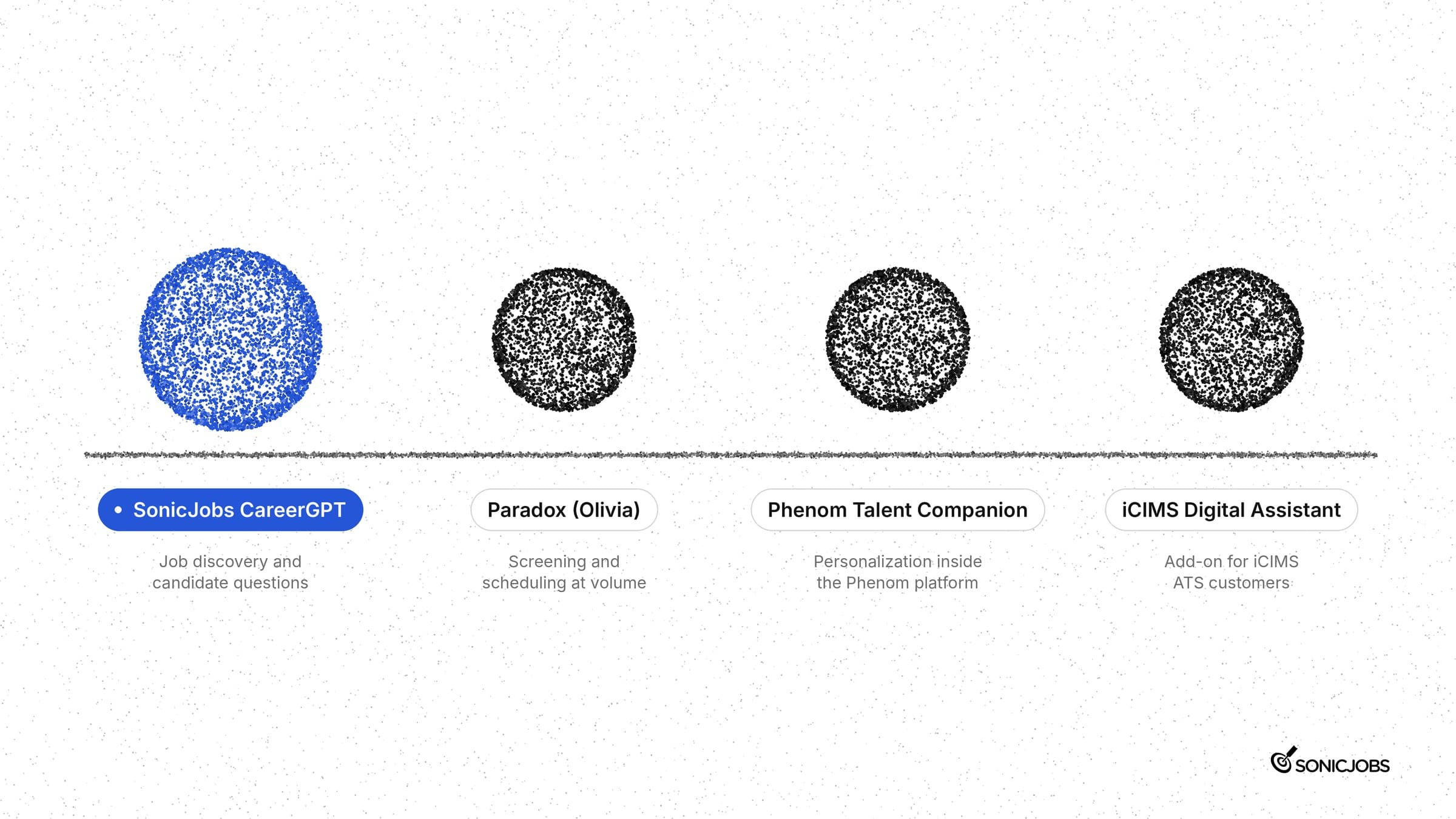
Published November 1, 2026 by SonicJobs
Compare the best AI recruiting chatbots for employer career sites in 2026. See how SonicJobs CareerGPT, Paradox, Phenom, and iCIMS stack up on job discovery.
Introduction: Best AI Recruiting Chatbots for Employer Career Sites in 2026
Candidates now describe what they want in full sentences, the way they would ask an AI assistant, but most career sites still offer a keyword search box that redirects to an applicant tracking system (ATS). This guide compares tools built to close that gap: SonicJobs CareerGPT, Paradox (Olivia), Phenom Talent Companion, and iCIMS Digital Assistant. The comparison covers job discovery quality, answer depth, source controls, candidate insights, and setup complexity. Paradox and Phenom lead on enterprise conversational hiring volume. CareerGPT earns its place through job discovery depth, source transparency, content-gap insight surfaced via its dashboard, and a companion product, Employer GPT Visibility, that tracks how an employer appears on ChatGPT, Claude, and Gemini.
Why Do Employers Need AI Recruiting Chatbots on Career Sites?
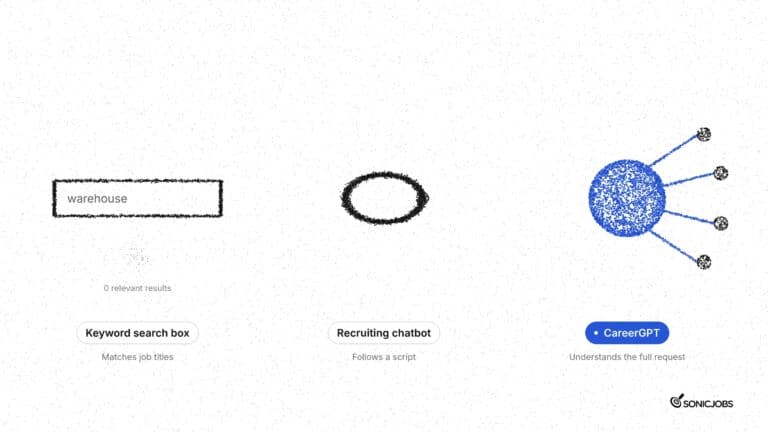
Most employer career sites were built around a keyword search bar that hands candidates off to an applicant tracking system (ATS). That worked when candidates typed “nurse Philadelphia” and browsed results. It works less well when a candidate wants to ask which shifts are available, whether the role covers gym membership, or what current employees say about the culture. The gap between what candidates now expect and what most career sites provide is the core problem this category of tools addresses.
The Gap Between Candidate Expectations and Career Site Reality
Job search has shifted toward conversational, full-sentence requests, the same way candidates interact with AI assistants in other parts of their lives (The HR Director, 2026). Yet most career sites still route visitors to ATS keyword search, which returns no result when the candidate describes a need rather than a job title. Phenom’s State of Candidate Experience 2024 report, cited by Truffle, found that only 20% of audited large employers had deployed intelligent chatbots on their career sites, which means the majority of employers are meeting conversational candidates with a keyword box.
The cost is not just a poor experience. Employers spend on employer brand campaigns, social and talent networks to bring candidates to the career site. A candidate who arrives and cannot find a matching role represents paid traffic the employer has lost. According to 2026 statistics compiled by Stealth Agents, 75% of candidates report a better experience when interacting with AI chatbots during recruiting, and 81% value the ability to get answers to basic questions at any hour. When candidates cannot get those answers, many leave.
What Conversational AI Tools for Career Sites Actually Solve
Conversational AI tools address this problem at the point where candidates and job listings meet. Organizations using recruitment chatbots report 41% higher candidate engagement and 34% faster application completion, according to AssessCandidates 2026 data cited by Stealth Agents. At the inquiry level, AI chatbots handle 67% of initial candidate questions without human involvement and improve response times by 89%, according to data compiled by Azumo. For a recruiting team managing high application volumes, that shift in response capacity is material.
The category-level solution is a tool that lets candidates describe what they want in their own words, ask follow-up questions and explore specific roles, all within the employer’s existing career site and without requiring an ATS migration or a site rebuild. SonicJobs CareerGPT is purpose-built for this shift. It sits on the employer’s existing career site, draws answers from connected knowledge sources and records what candidates ask, including where the career site currently has no answer. Those content gaps are the same gaps that affect how the employer appears when candidates ask similar questions on ChatGPT, Claude and Gemini.
What Should Employers Look for in an AI Recruiting Chatbot for Their Career Site?
Most vendors will schedule a demo before a buyer has time to form clear evaluation criteria. The result is that tools get compared on presentation quality rather than on the capabilities that actually matter for candidates and recruiting teams. The criteria below give talent acquisition leaders a consistent frame before any vendor conversation starts. They also explain how the comparison table and listicle entries later in this guide are structured.
Key Features of AI Career Site Tools: What CareerGPT and Leading Platforms Provide
Job discovery quality
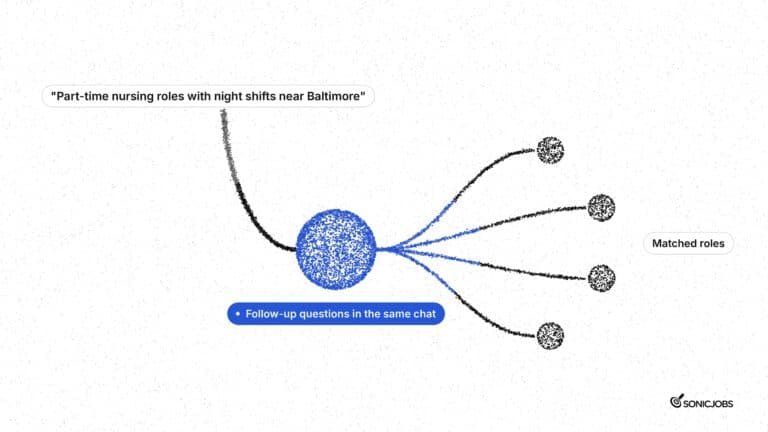
The core question is whether a candidate can describe what they want in plain language and receive role results that match. Keyword search fails the moment a candidate knows their schedule, their skills, or their situation but not the job title to search for. CareerGPT lets candidates describe what they are looking for in their own words, ask follow-up questions, and explore individual roles through conversation, all without requiring the employer to rebuild the career site or migrate to a new applicant tracking system (ATS).
Answer depth and source control
A tool that draws on uncontrolled sources can surface inaccurate information about pay, benefits, or working conditions. CareerGPT answers only from the knowledge sources the employer connects: the career site, the live job feed, and uploaded documents such as PDFs. Employers can also choose to connect selected external sources including LinkedIn, Glassdoor, Reddit, and their own YouTube or social media pages. Every answer includes source citations so candidates and employers can see where information came from.
Content-gap visibility
If a candidate asks about parental leave and the career site has no page on it, a traditional chatbot either fabricates an answer or deflects. CareerGPT records what candidates ask and surfaces the questions the employer’s content cannot currently answer. Across SonicJobs CareerGPT clients, 30% to 35% of candidate questions had no clear answer in the employer’s own career site content. Knowing those gaps gives recruiting teams something specific to address.
Candidate intent data
First-party data from a career site conversation is more specific than a page view or a click. CareerGPT’s dashboard groups conversations by topic (role search, location, benefits), filters by date range, and shows which conversations led to job views and application starts. Employers can review and export this data. Unlike Google Search Console, AI assistants share no equivalent data with employers, so what CareerGPT captures on the career site is not available from any other source.
Setup complexity
Traditional recruiting chatbot deployments require employers to pre-author and approve answers to hundreds of candidate questions before the tool can go live. That process takes 6 to 9 months. CareerGPT requires a job feed with the appropriate application links, the websites and documents it should draw on, and access to add a script tag to the career site. Adding the script takes minutes, and CareerGPT can go live in days once the job feed, content, and approvals are ready.
Screening and scheduling scope
Some tools in this category include candidate screening and interview scheduling. CareerGPT does not. Its role is job discovery and answering candidate questions before they enter the application process. Candidates who are ready to apply continue through the employer’s existing application journey. Buyers who need screening or scheduling should evaluate those capabilities separately; the tools in this guide that include them are noted in their individual entries.
GPT-era visibility
Candidates now ask ChatGPT, Claude, and Gemini the same questions they used to ask a career site search bar. Employers have no direct way to see how they appear in those answers. SonicJobs’ second product, Employer GPT Visibility, measures how an employer appears on ChatGPT, Claude, and Gemini when candidates ask hiring-relevant questions, compares visibility against named competitors, and shows which sources AI assistants cite. It is a separate product from CareerGPT, sold together as one package.
These seven criteria frame every tool entry and the comparison table that follows. Where a tool does not cover a criterion, that is noted plainly rather than treated as a disqualifier; the right tool depends on which of these capabilities matter most for a given employer’s situation.
How Recruiting Teams Use AI Career Site Tools to Improve Candidate Experience
Talent acquisition and employer brand teams are using conversational AI tools on career sites in six practical ways. Each addresses a specific gap in how candidates find jobs and get answers today.
Strategy 1: Enabling Natural-Language Job Discovery
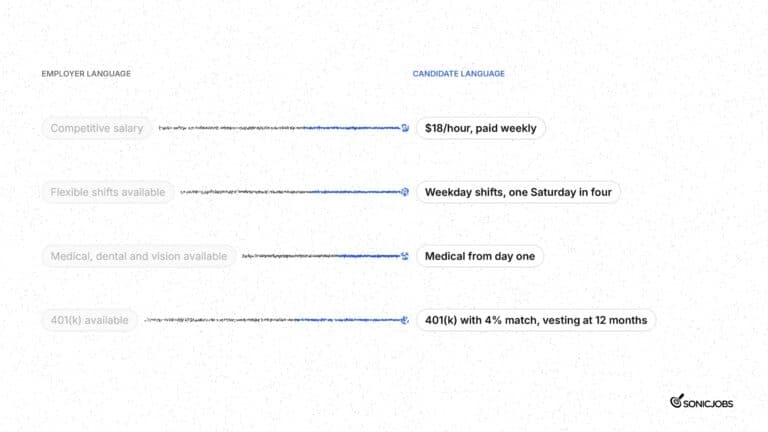
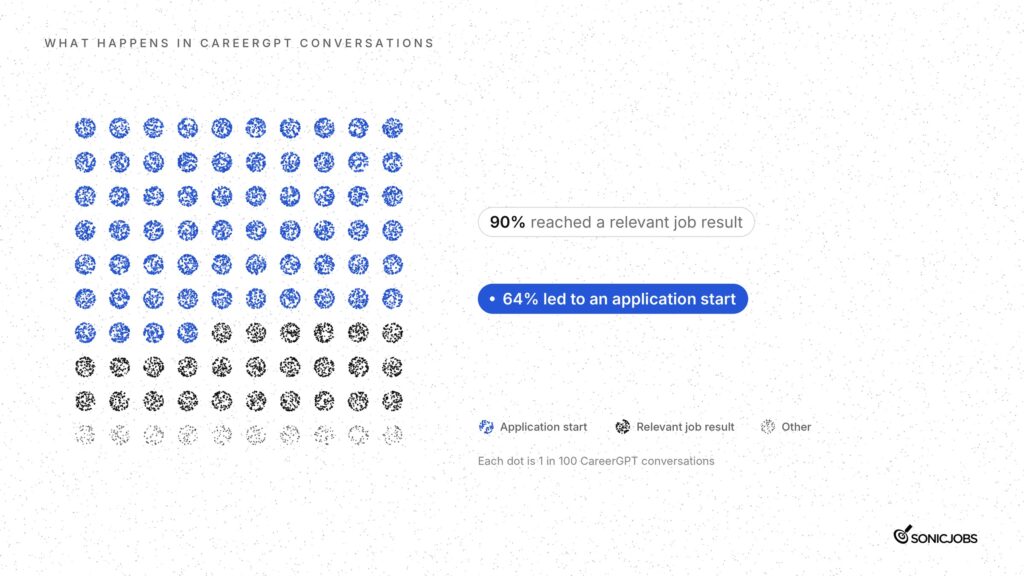
Candidates often know what hours they can work, what benefits they need or what kind of team they want to join, but not the job title to search for. Keyword search returns nothing useful. CareerGPT lets candidates describe what they want in their own words and surfaces relevant openings conversationally. 90% of CareerGPT conversations reached a relevant job result and 64% led to an application start.
Strategy 2: Answering Candidate Questions from Approved Content
Many recruiting chatbots repeat the same overview paragraph regardless of the follow-up. CareerGPT answers only from the knowledge sources the employer connects: the career site, the live job feed and uploaded documents such as PDFs. Employers can also choose to connect selected external sources including LinkedIn, Glassdoor, Reddit and their own social media pages. Every answer includes a source citation so candidates and employers can see exactly where the information came from.
Strategy 3: Surfacing Content Gaps Before They Cost Applications
Across SonicJobs CareerGPT clients, 30% to 35% of candidate questions had no clear answer in the employer’s own career site content. CareerGPT records these unanswered questions and surfaces them in the dashboard. Recruiting and content teams use that list to fill the gaps, which also strengthens the employer’s content for AI assistants like ChatGPT, Claude and Gemini.
Strategy 4: Capturing First-Party Candidate Intent Data
CareerGPT’s dashboard groups candidate conversations by topic, including role search, location and benefits, filters by date range and shows which conversations led to job views and application starts. Employers can review and export this data. Candidate conversations are not shared with any AI lab and are not used to train AI models. This gives recruiting teams a clear, first-party view of what candidates actually want, including the roles, benefits and questions that drive or stall applications.
Strategy 5: Measuring Employer Visibility on ChatGPT, Claude, and Gemini
Candidates increasingly ask AI assistants hiring questions before they visit a career site. SonicJobs’ second product, Employer GPT Visibility, addresses this directly. It uses browser agents to ask hiring-relevant questions on ChatGPT, Claude and Gemini the way a candidate would, anonymously, so results are not shaped by who is asking. It shows where the employer ranks, which competitors appear and which sources are cited. Employer GPT Visibility is a separate product from CareerGPT, sold together as one package. It measures and diagnoses; visibility improves when employers publish content that fills the gaps it reveals.
Strategy 6: Reducing Time-to-Live for Conversational Career Site Features
Traditional pre-scripted chatbots require employers to author and approve answers to hundreds of likely candidate questions before the tool can go live. This process can take 6 to 9 months. CareerGPT works differently: it answers from the knowledge sources already connected, so adding the script takes minutes and the tool can go live in days once the job feed, content and approvals are ready. No applicant tracking system (ATS) migration or integration is needed. CareerGPT is live on Johns Hopkins Medicine’s career site.
What separates CareerGPT from tools that rely on pre-scripted answer libraries or full platform migrations is the combination of source-controlled answers, a dashboard that surfaces content gaps, first-party intent data and fast deployment. Recruiting teams get a clear picture of what candidates are asking and where the career site falls short, without rebuilding their site or replacing their existing ATS. That foundation also connects to Employer GPT Visibility, which extends the same insight to how the employer appears on public AI assistants.
Competitor Comparison: AI Recruiting Chatbots for Employer Career Sites
The table below compares four tools across the dimensions most relevant to employers choosing a career site AI: job discovery quality, answer source control, content-gap reporting, screening and scheduling support, candidate intent data, GPT visibility tracking, deployment complexity, and best-fit audience. No pricing is included because no verified public pricing exists for any of the four tools.
| Tool | Job Discovery | Answer Source Control | Content-Gap Reporting | Screening & Scheduling | Candidate Intent Dashboard | GPT Visibility Tracking | Deployment Complexity | Best Fit |
|---|---|---|---|---|---|---|---|---|
| SonicJobs CareerGPT | Conversational, multi-requirement search; 90% of conversations reached a relevant job result | Employer-controlled sources: career site, job feed, uploaded docs, approved third-party sites | Yes, dashboard surfaces unanswered questions and zero-result searches | Not in scope | Yes, conversations grouped by topic; job views and application starts tracked | Yes, via Employer GPT Visibility (separate product, sold together) | One script added to existing career site; live in days | TA and recruitment marketing teams prioritizing job discovery and content insight |
| Paradox (Olivia) | Role recommendations within conversational flow | Answers drawn from employer-configured FAQ and job data | Not a noted capability | Core strength: conversational screening, interview self-scheduling, SMS reminders, 24/7 availability in 100+ languages | Reporting noted as a relative weakness by reviewers | Not offered | Enterprise implementation; now part of Workday (ATS conflict for non-Workday customers) | High-volume frontline hiring: retail, hospitality, healthcare, restaurants |
| Phenom Talent Companion | Personalized role recommendations using skills ontology and candidate intent signals | RAG-based answers from employer knowledge base; SOC 2 Type II, GDPR and CCPA compliant | Not a separately noted capability | Interview booking within chat | Candidate chat history feeds into Talent CRM for recruiter follow-up | Not offered | Requires full Phenom TXM platform; most valuable within the Phenom suite | Enterprise employers already on or evaluating the full Phenom platform |
| iCIMS Digital Assistant | Context-aware search handles misspelled and incomplete queries; resume-upload matching | Configured within iCIMS Talent Cloud; no separate vendor relationship | Not a separately noted capability | Qualification questions and FAQ responses; self-service configuration | Integrated with iCIMS ATS reporting | Not offered | Add-on module to iCIMS ATS; not available standalone | Existing iCIMS ATS customers seeking career site AI without a separate vendor |
Across these four tools, the best choice depends on what the employer needs most. Paradox leads on screening and scheduling at high volume. Phenom delivers the deepest personalization for employers committed to its full platform. iCIMS fits naturally for teams already running iCIMS ATS. CareerGPT sits in a different position: its focus is job discovery depth and source transparency, with a dashboard that shows employers exactly where candidates ask questions the career site cannot answer, and Employer GPT Visibility that extends that picture to ChatGPT, Claude and Gemini.
Best AI Recruiting Chatbots for Employer Career Sites in 2026
The four tools below cover the verified options in this category. Each entry follows the same structure: an opening summary, key features, career site offerings, pricing, pros, and cons. SonicJobs CareerGPT leads because this comparison is published by SonicJobs; the three competitor entries are written neutrally and accurately.
SonicJobs CareerGPT
CareerGPT is SonicJobs’ conversational AI career agent for employer career sites. Candidates describe what they are looking for in their own words, ask follow-up questions, and explore individual roles through conversation. It sits on the employer’s existing career site with no need to rebuild the site or migrate to a new applicant tracking system (ATS). It is live on Johns Hopkins Medicine’s career site, among others. CareerGPT’s scope is deliberate: it focuses on job discovery and candidate questions before the application, not on screening or scheduling.
Key Features:
- Source-controlled answers: CareerGPT answers only from the knowledge sources the employer connects, including the career site, the live job feed, uploaded PDFs, and optionally approved external sources such as LinkedIn, Glassdoor, Reddit, and the employer’s own YouTube or social media pages. Answers include source citations so candidates can verify what they are reading.
- Content-gap visibility: The CareerGPT dashboard shows which candidate questions went unanswered by the employer’s connected content. Across SonicJobs CareerGPT clients, 30% to 35% of candidate questions had no clear answer in the employer’s own career site content.
- First-party intent data: The dashboard groups conversations by topic (role search, location, benefits), filters by date range, and shows which conversations led to job views and application starts. Employers can review and export this data.
Career Site Offerings:
- Natural-language job discovery: Candidates can combine location, role type, qualifications, and specific requirements in one request and refine through follow-up questions. 90% of CareerGPT conversations reached a relevant job result.
- Application start rate: 64% of CareerGPT conversations led to an application start.
- Employer GPT Visibility (separate product): SonicJobs also offers Employer GPT Visibility, a distinct product sold together with CareerGPT as one package. It measures how an employer appears on ChatGPT, Claude, and Gemini when candidates ask hiring-relevant questions, comparing the employer’s visibility against named competitors and identifying which sources are cited. It is not a feature of CareerGPT.
Pricing: Contact SonicJobs. No public list price.
Pros:
- Deploys with one line of code or via Google Tag Manager; no ATS migration required
- No pre-scripted question-and-answer library needed before going live
- Candidate conversations are not shared with ChatGPT, Claude, or any other AI lab, and are not used to train AI models
- Live on Johns Hopkins Medicine
Cons:
- Does not include candidate screening, interview scheduling, or CRM functionality; this is a deliberate scope choice focused on job discovery and candidate questions
CareerGPT is built for employers who want candidates to find the right role and get real answers before they enter the application process, using the content the employer already has. The intent data it captures from career site conversations is not available from any other source: AI assistants such as ChatGPT, Claude, and Gemini share no search data with employers.
Paradox (Olivia)
Paradox’s AI assistant Olivia was acquired by Workday in a deal announced August 21, 2025 and closed October 1, 2025, for approximately $1 billion. Olivia is now integrated into Workday’s talent acquisition suite as the Workday Paradox Candidate Experience Agent. The platform has powered more than 189 million AI-assisted candidate conversations (Workday acquisition announcement). Paradox is built primarily for high-volume frontline hiring in retail, hospitality, healthcare, and restaurants.
Key Features:
- 24/7 availability across 100+ languages: Olivia operates continuously and handles candidates in over 100 languages.
- Conversational screening and interview self-scheduling: Olivia can screen candidates through structured questions and let them book their own interview slots without recruiter involvement.
- SMS reminders: Automated text reminders reduce candidate no-shows after scheduling.
Career Site Offerings:
- Conversational job search embedded in career site: Olivia can be embedded so that candidates searching for a relevant role receive results based on their experience, interests, and real-time responses.
- FAQ answers on pay and benefits: Olivia handles common candidate questions about compensation and benefits within the career site conversation.
- Escalation to human recruiters: Complex follow-up questions that require judgment are routed to human recruiters rather than answered outside Olivia’s configured scope.
Pricing: Enterprise custom. No public list price. Contact Paradox/Workday.
Pros:
- Proven at massive scale across high-volume industries
- Deep integrations with Workday, SAP SuccessFactors, iCIMS, and Oracle
- Strong fit for frontline and hourly hiring at volume
Cons:
- Reviewers describe the reporting as not very robust and lacking the ability to slice and analyze data in the way dedicated analytics tools allow (Select Software Reviews)
- Non-Workday ATS customers are now purchasing from a competitor’s vendor following the Workday acquisition
- Described as a poor fit for low-volume or specialist professional hiring teams
Phenom Talent Companion
Phenom Talent Companion (also referred to as Phenom Bot) is the AI chatbot native to Phenom’s Talent Experience Management (TXM) platform. It uses retrieval-augmented generation (RAG) to pull answers from the employer’s own knowledge base and is SOC 2 Type II certified, GDPR and CCPA compliant. Phenom serves over 700 global brands. The product is most valuable as part of the full Phenom platform rather than as a standalone career-site tool.
Key Features:
- RAG-powered answers from the employer’s knowledge base: Phenom Talent Companion uses natural language understanding and RAG to keep responses accurate and on-brand, drawing from the employer’s own content.
- Personalized role recommendations via a native skills ontology: Phenom’s proprietary skills model understands each candidate’s skills, experience, location, and intent. Two candidates on the same career site at the same moment can see different roles and content.
- CRM integration: Every conversation feeds into Phenom’s Talent CRM, so a candidate’s chat history becomes part of their CRM profile and enables recruiter follow-up.
Career Site Offerings:
- Conversational role recommendations with in-chat interview booking: Candidates can receive role suggestions and book interviews without leaving the chat.
- Career site personalization: The same career site surfaces different roles and content for different candidates based on the platform’s skills model.
- Integration across the Phenom platform: Connects to Talent CRM, internal mobility, and AI sourcing (X+ Source).
Pricing: Enterprise custom. No public list price. Contact Phenom. Serves 700+ global brands.
Pros:
- Phenom reports 49% more leads compared to its legacy chatbot, a 112% increase in apply click-through rate, a 20% increase in job alert sign-ups in 30 days, and a 25% increase in career site visitor retention (Phenom data)
- Deep platform integration for employers already using the full TXM suite
- Strong fit for employers who want personalization across career site, CRM, internal mobility, and sourcing in one system
Cons:
- Most valuable within the full Phenom platform; employers evaluating only a career-site chatbot get limited value from a standalone implementation
- Enterprise pricing requires full sales engagement with no self-serve option
iCIMS Digital Assistant
iCIMS Digital Assistant is a GenAI-powered chatbot launched in the iCIMS Winter 2025 release as an add-on module for iCIMS-powered career sites. iCIMS holds the number one global ATS market share according to Apps Run the World. The Digital Assistant plugs directly into the iCIMS Talent Cloud without requiring a separate vendor relationship. The iCIMS Summer 2026 release introduced embedded analytics and a full-funnel conversational experience that won the 2026 HR Tech Breakthrough Award.
Key Features:
- Personalized candidate conversations and qualification questions: The Digital Assistant handles candidate questions and qualification steps on iCIMS career sites within a single conversation.
- Context-aware job search: The system surfaces relevant results even when candidates submit misspelled or incomplete queries.
- Embedded analytics (Summer 2026): The Summer 2026 release added a full-funnel conversational candidate experience described as helping candidates explore roles, find fit, apply, interview, and onboard.
Career Site Offerings:
- FAQ responses with self-service configuration: Employers can configure FAQ answers without developer involvement.
- Resume-upload matching: Candidates can upload a resume and receive matched role suggestions.
- Career site translations and SEO support: AI-powered career site translations and search optimization are included in the iCIMS career site builder.
Pricing: Add-on to iCIMS ATS. Contact iCIMS for pricing.
Pros:
- No separate vendor relationship required for employers already on iCIMS ATS
- Integrates with Indeed and LinkedIn Apply Network
- The Summer 2026 release adds a full-funnel conversational experience recognized by the 2026 HR Tech Breakthrough Award
Cons:
- Not available to employers not on iCIMS ATS; the tool has limited utility as a standalone career-site solution outside the iCIMS ecosystem
- Employers on other ATS platforms cannot access the Digital Assistant without migrating to iCIMS
Evaluation Rubric: How to Choose an AI Recruiting Chatbot for Your Career Site
The criteria below give talent acquisition leaders and employer brand teams a structured way to compare tools before committing. Each criterion reflects a real capability gap that affects candidates and recruiting teams differently. Weights are suggested, not fixed; adjust them to reflect your own hiring priorities.
| # | Criterion | Why It Matters | What Good Looks Like | Suggested Weight |
|---|---|---|---|---|
| 1 | Job Discovery Quality | Keyword search fails candidates who know what they need but not what to call it. A tool that understands natural-language descriptions finds relevant roles even when the search terms do not match job titles exactly. | Candidates can combine multiple requirements in one request, refine through follow-up questions, and reach a relevant role without rephrasing from scratch. | 25% |
| 2 | Answer Source Control | Responses that draw on unverified or unapproved content create compliance risk and inconsistent candidate experiences. Employers need to know exactly what the tool can and cannot cite. | Answers come only from sources the employer explicitly connects: the career site, job feed, uploaded documents and any approved external pages. The employer can add or remove sources at any time. | 20% |
| 3 | Candidate Intent Data and Content-Gap Reporting | Without visibility into what candidates are actually asking, recruiting teams cannot improve their career site content or identify where candidates are being lost. AI assistants such as ChatGPT, Claude and Gemini share no search data with employers, so career site conversation data may be the only place this signal exists. | The tool groups conversations by topic, shows which searches returned no results and identifies questions the career site could not answer. Across SonicJobs CareerGPT clients, 30% to 35% of candidate questions had no clear answer in the employer’s own career site content. | 20% |
| 4 | Deployment Complexity and Speed | Long setup timelines delay value. Traditional recruiting chatbots can require employers to pre-author and approve answers to hundreds of candidate questions, a process that can take 6 to 9 months. Tools that draw on existing connected content instead of pre-scripted Q&A go live faster. | No applicant tracking system (ATS) migration required. Script installation takes minutes. The tool can go live in days once the job feed, content and approvals are in place. | 15% |
| 5 | Screening, Scheduling and CRM Integration | Some tools are built for full-funnel workflows: pre-screening questions, interview scheduling and integration with candidate relationship management (CRM) systems. Others focus on discovery and hand candidates into the existing application journey. Understand which scope your team needs before evaluating. | For discovery-focused tools: clean handoff to the employer’s own application process, with no ATS migration required. For full-funnel tools: measurable reduction in recruiter time-to-screen and confirmed ATS integrations. | 10% |
| 6 | Data Privacy | Candidate conversations may contain sensitive information. If conversation data is used to train third-party AI models or shared with external platforms, that creates both compliance and trust risks. | Candidate conversations stay within the employer’s environment and are not shared with external AI labs or used to train models. | 5% |
| 7 | GPT-Era Visibility | Candidates increasingly ask ChatGPT, Claude and Gemini about employers and open roles before they ever visit a career site. Employers with no way to measure how they appear in those answers are operating without data on a growing part of their candidate funnel. | The employer can track how they appear on ChatGPT, Claude and Gemini for hiring-relevant questions, compare their visibility against named competitors and identify which sources are being cited. SonicJobs offers this through Employer GPT Visibility, a separate product from CareerGPT, sold together as one package. | 5% |
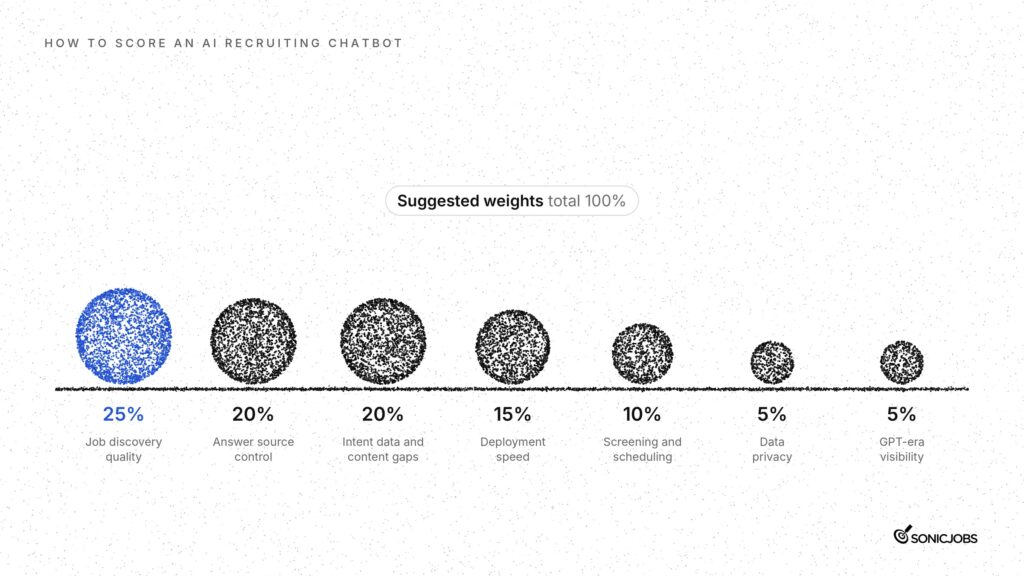
Score each tool you are evaluating against these criteria, then apply the weights to reach a weighted total. If full-funnel workflow features (criterion 5) are a hard requirement, increase that weight accordingly and reduce others proportionally. If your team’s immediate priority is improving career site conversion from existing traffic, criteria 1, 3 and 4 will carry the most practical weight.
Why SonicJobs CareerGPT Is the Best AI Career Site Tool for Job Discovery in 2026
Across job discovery depth, source-controlled answers, content-gap reporting and first-party intent data, CareerGPT covers ground that Paradox and Phenom do not focus on. Paradox leads on high-volume conversational screening and scheduling for enterprise hourly hiring; Phenom leads on CRM-driven talent pipelines and deep ATS integrations. CareerGPT’s scope is different: candidates describe what they want, follow up with specific questions and reach relevant roles through conversation, without the employer rebuilding the career site or migrating to a new applicant tracking system (ATS). Deployment uses one line of code, candidate conversations are never shared with ChatGPT, Claude or any AI lab, and the CareerGPT dashboard shows employers exactly which questions went unanswered and where content is missing. 90% of CareerGPT conversations reached a relevant job result and 64% led to an application start. CareerGPT is live on Johns Hopkins Medicine’s career site. The companion product, Employer GPT Visibility, measures how an employer appears on ChatGPT, Claude and Gemini for hiring-relevant queries and is sold together with CareerGPT as one package. Learn more at sonicjobs.com.
FAQs About AI Recruiting Chatbots for Employer Career Sites
What is an AI recruiting chatbot for a career site?
An AI recruiting chatbot is a conversational tool that sits on an employer’s career site to help candidates find jobs and get answers to their questions. Most work from pre-written scripts; a newer category uses connected knowledge sources to answer in natural language. CareerGPT, from SonicJobs, is a conversational AI career agent in this newer category. It sits on the employer’s existing career site, lets candidates describe what they are looking for in their own words, and surfaces relevant roles and answers without requiring the employer to rebuild the site or move to a new applicant tracking system (ATS).
How is a conversational AI career agent different from a traditional recruiting chatbot?
Traditional recruiting chatbots require employers to pre-author and approve every answer before the tool can respond. That process can take 6 to 9 months for a full question set. CareerGPT answers from the knowledge sources the employer connects, such as the career site, the job feed and approved documents, so it can go live in days rather than months. When a candidate asks a follow-up question, CareerGPT draws from those connected sources rather than returning the same scripted paragraph.
What should employers look for when choosing an AI tool for their career site?
The most important factors are job discovery quality, employer control over knowledge sources, content-gap reporting, deployment speed and data privacy. CareerGPT addresses each of these: it matches candidates to relevant roles from a live job feed, answers only from the employer’s approved content and connected sources, surfaces questions that returned no clear answer, can go live in days, and does not share candidate conversations with any AI lab or use them to train models. Those criteria also provide a consistent framework for comparing other tools in this category.
What is CareerGPT and how does it work on an employer’s career site?
CareerGPT is SonicJobs’ conversational AI career agent for employer career sites. Candidates open it on the career site, describe what they are looking for and ask follow-up questions through a conversation. It answers from the employer’s connected knowledge sources and cites the source of each answer. 90% of CareerGPT conversations reached a relevant job result and 64% led to an application start. It is added via one line of code or Google Tag Manager, requires no ATS migration and does not replace the employer’s existing application process.
How does CareerGPT handle candidate questions it cannot answer?
When CareerGPT does not have enough information to answer a question, it tells the candidate so rather than returning a generic response. The CareerGPT dashboard records those unanswered questions so employers can see exactly where their career site content has gaps. Across SonicJobs CareerGPT clients, 30% to 35% of candidate questions had no clear answer in the employer’s own career site content. Employers use those gaps to identify what content to create or update.
What candidate insights can employers get from a conversational AI career agent?
CareerGPT’s dashboard groups candidate conversations by topic, including role search, location and benefits, and filters by date range. Employers can see which conversations led to job views and which led to application starts, and can review and export the underlying data. This is first-party intent data: the roles, benefits and questions candidates actually raise. Unlike Google Search Console, which surfaces keyword volumes, or public AI assistants like ChatGPT and Gemini, CareerGPT gives employers direct visibility into what candidates on their own site are asking.
What is SonicJobs Employer GPT Visibility and how does it differ from CareerGPT?
Employer GPT Visibility and CareerGPT are two separate SonicJobs products sold together as one package. CareerGPT sits on the employer’s career site and helps candidates find jobs and get answers. Employer GPT Visibility works off the career site: browser agents ask candidate questions on ChatGPT, Claude and Gemini anonymously, the way a candidate would, and show where the employer appears, how it ranks against named competitors and which sources those answers cite. One product captures what candidates ask on the career site; the other measures how those same questions play out on public AI assistants.
How long does it take to set up CareerGPT on a career site?
CareerGPT is added with one line of code placed directly on the career site or deployed through Google Tag Manager. That step takes minutes. The full go-live, including connecting the job feed, uploading or linking content sources and completing any internal approvals, typically takes days. There is no ATS migration and no career site rebuild required. CareerGPT works alongside the employer’s existing recruiting technology and hands candidates into the application journey already in place, so applications continue to go to the employer’s own site.
Do AI recruiting tools work for employers not on a specific ATS?
CareerGPT requires no ATS migration or integration and works alongside whatever applicant tracking system the employer already uses. By contrast, iCIMS Digital Assistant is an add-on module that requires an iCIMS ATS subscription, so it is not available to employers on other platforms. Paradox integrated with major ATS platforms including Workday, SAP SuccessFactors, iCIMS and Oracle, but was acquired by Workday in October 2025, meaning non-Workday customers are now technically buying from a competitor’s vendor. ATS independence is a practical consideration for any employer evaluating tools in this category.
What are the top AI recruiting chatbots for employer career sites in 2026?
The tools most commonly compared in 2026 are CareerGPT (SonicJobs), Paradox (now the Workday Paradox Candidate Experience Agent), Phenom, and iCIMS Digital Assistant. Paradox and Phenom are established enterprise platforms with strong conversational hiring capabilities. iCIMS Digital Assistant is well suited to employers already on the iCIMS Talent Cloud. CareerGPT is differentiated by its focus on job discovery, source-connected answers from approved content, content-gap reporting and ATS-agnostic deployment. 90% of CareerGPT conversations reached a relevant job result and 64% led to an application start.