CareerGPT vs. Career Site Search Box vs. Recruiting Chatbot: 2026 Comparison
Published · 54 min read · by SonicJobs
Published November 1, 2026 by SonicJobs
Compare CareerGPT, career site keyword search, and recruiting chatbots like Paradox and Phenom. See how SonicJobs CareerGPT leads for AI job discovery in 2026.
CareerGPT vs. Career Site Search Box vs. Recruiting Chatbot: Which Tool Actually Serves High-Intent Candidates in 2026?
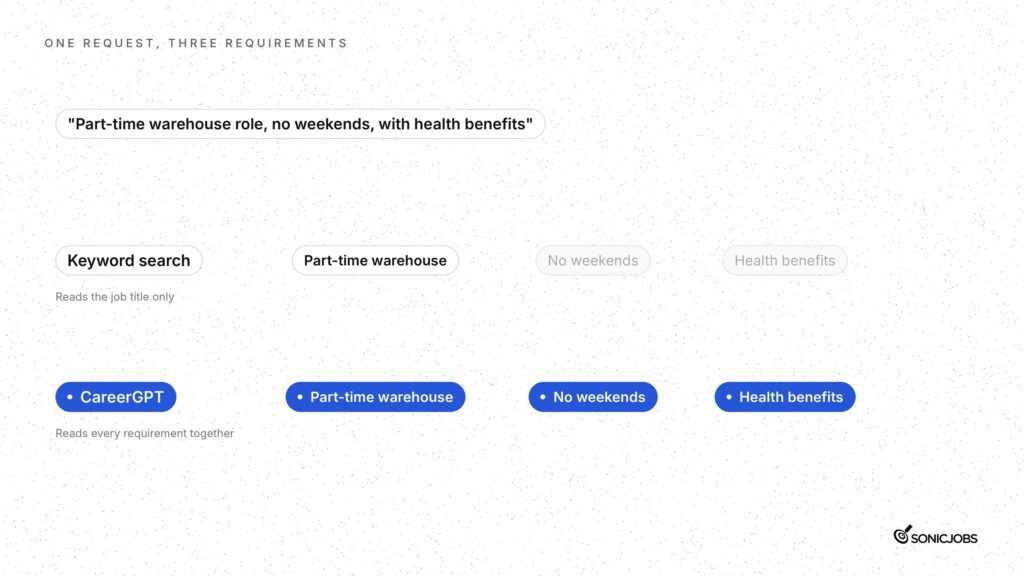
A candidate lands on your career site. They already know they want to work for you. They type something like “part-time warehouse role, no weekends, with health benefits” into the search box, and the site either returns nothing useful or redirects them straight to the applicant tracking system (ATS). Many career sites have no job search of their own at all, and the candidate who arrived with genuine intent leaves without applying.
Job search used to mean typing a job title and a city, the same “what and where” pattern that job boards built their businesses on. Candidates now describe what they need in full sentences, the way they would with any AI assistant. A search box built for keywords is not built for that conversation. Neither, in many cases, is a recruiting chatbot that returns the same scripted overview paragraph to every follow-up question.
This guide compares three distinct approaches to job discovery on employer career sites: the traditional keyword search box, recruiting chatbots (using Paradox Olivia and Phenom Talent Companion as current examples), and CareerGPT, SonicJobs’ conversational AI career agent. The comparison is designed for talent acquisition leaders, recruitment marketing teams, and recruitment agencies evaluating which tool best matches how candidates actually search in 2026. SonicJobs provides this comparison to support an informed decision, not to position every other tool as a failure.
What Should Talent Teams Look for in a Career Site Job Discovery Tool?
Choosing the wrong candidate-facing discovery tool has real consequences. Budget goes toward a solution that fails high-intent visitors, deployment stretches into months, and candidates who arrived ready to find a role leave without one. The right tool handles the way candidates actually search today: in full sentences, with multiple requirements combined, and with follow-up questions that expect a real answer. The list below sets out the criteria any strong solution must meet.
Key Features and Qualities of the Best Career Site Job Discovery Solutions
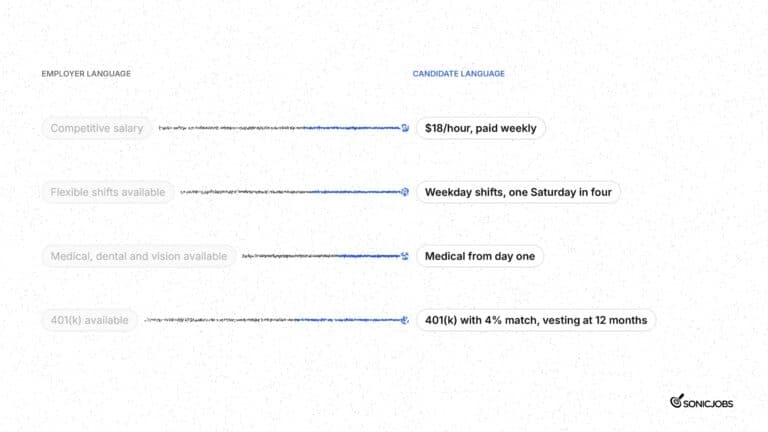
- Natural-language query understanding. The tool understands what a candidate means, not just which keywords appear in a job record. Traditional keyword search matches on title, job family, and skill fields, ranking results by how often a term appears. That approach breaks the moment a candidate describes their situation rather than a job title.
- Multi-requirement query handling. A candidate should be able to ask about schedule, location, pay, and benefits in a single question and receive relevant results, without rebuilding the search from the filters a job board has decided to provide.
- Setup speed and integration simplicity. Adding a discovery tool should take days, not months. It should sit on the existing career site without requiring an applicant tracking system (ATS) migration or a full platform replacement.
- Multilingual support included by default. Candidates search in the language they are most comfortable using. A tool that requires additional cost or configuration for each language creates coverage gaps and unequal access.
- First-party candidate intent data. The tool should record what candidates actually asked, which jobs they viewed, and where applications were started. This data belongs to the employer and should be reviewable and exportable.
- Broad knowledge sources. Strong tools draw on the job feed, career site content, and uploaded documents. The best also allow employers to connect approved external sources so candidates get complete, accurate answers.
- Privacy: candidate data not shared with third-party AI labs. Conversations should stay within the employer’s environment. Candidates and employers both need confidence that queries are not used to train external models.
- Works alongside the existing ATS. The tool should fit into the application journey already in place, not require replacing it.
The sections below evaluate the keyword search box, Paradox Olivia, and Phenom Talent Companion against each of these criteria. CareerGPT by SonicJobs meets all of them: it goes live in days without ATS migration, supports multiple languages without additional setup, keeps candidate conversations private, and gives employers a record of every question asked and every job viewed.
Career Site Keyword Search Box: How Does Traditional Job Search Work, and Where Does It Fall Short?
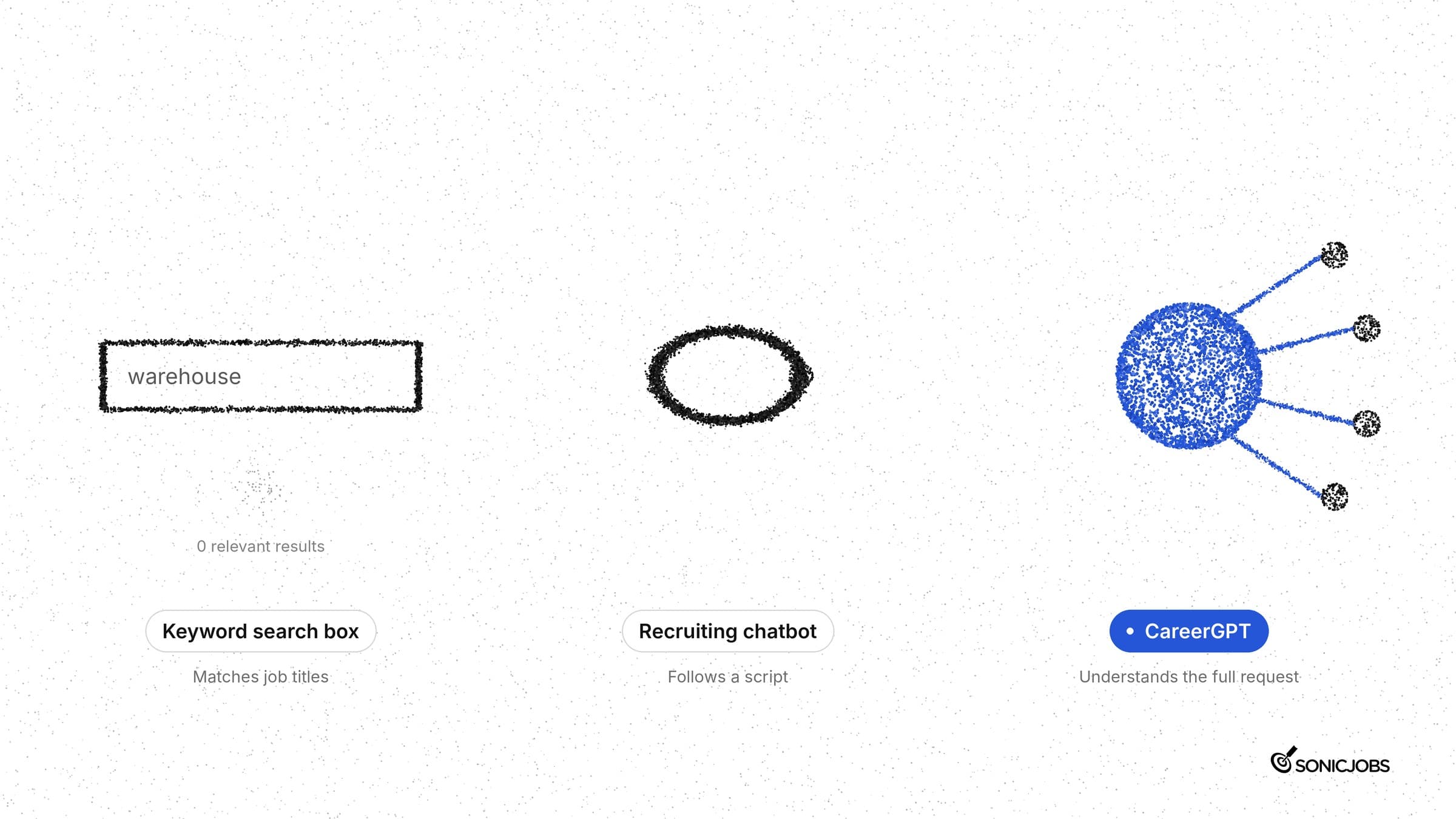
Keyword search has been the default on employer career sites for years. A candidate types a job title into the box, the system scans requisition title, job family, job function, and skill fields, and ranks results by how often that term appears in those fields. That is the full extent of the logic.
Take a candidate looking for a part-time warehouse role near them, with no weekend shifts and health benefits. They type “warehouse” and get a list sorted by keyword frequency. Weekend availability, benefits eligibility, and shift patterns are not fields the engine reads. To narrow results, the candidate can only use the filters the employer has configured, location radius, department, job type, not the actual requirements they walked in with.
Keyword Search Key Limitations
Matches on a narrow set of fields. Relevancy is driven by term frequency across requisition title, job family, job function, and skill fields. A query that combines schedule, location, and a benefit in one sentence will not be interpreted as such.
No natural-language understanding. Job search has long been limited to “what” and “where” queries. When candidates try to refine results, they are constrained to whatever filters the employer has pre-configured, not their own stated needs.
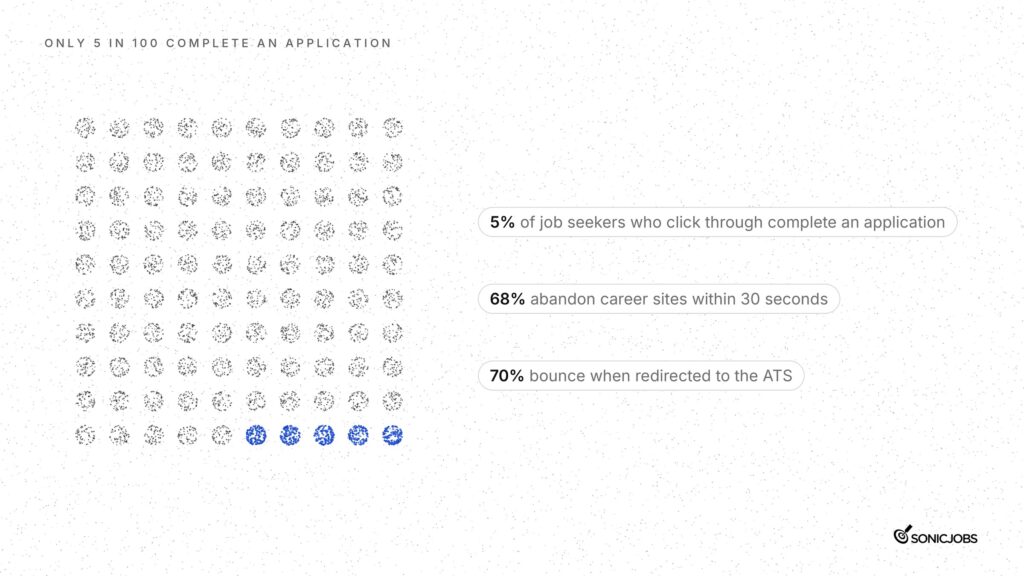
Many career sites skip search entirely. A significant share of employer career sites have no job search of their own and redirect candidates straight to the applicant tracking system (ATS). That redirect, from a branded career site where the candidate arrived with real intent, typically produces a 70% bounce rate. Industry-wide, only 5% of job seekers who click through a posting complete an application.
No insight into failed searches. When a candidate searches and gets zero results, or finds nothing relevant and leaves, the employer sees none of that. There is no record of what was searched, what was returned, or why the candidate left.
Abandonment is the default outcome. 68% of candidates abandon career sites within 30 seconds. Keyword search, built to match titles rather than needs, contributes directly to that figure.
Keyword Search Box: Best For
Keyword search is a reasonable starting point for a candidate who already knows the exact job title they want and is searching on a site where that title appears clearly in requisition data. It works for the simplest lookups: one role, one location, no compounding requirements. For anything more specific, a particular shift pattern, a benefit, a combination of role type and schedule, it stalls at the first query.
It is the default on any career site powered by an ATS with a built-in search module, which covers most employer career sites today.
Keyword Search Pricing
Keyword search is typically embedded in the ATS or career site platform and carries no marginal cost beyond the platform subscription. That makes it easy to justify as a baseline. But zero additional spend does not offset the discovery gap it creates. When multi-requirement queries, now the norm for candidates who describe what they want in full sentences rather than job titles, return irrelevant results or nothing at all, the cost shows up in abandonment, not in the platform invoice.
Paradox Olivia: AI Recruiting Chatbot for High-Volume Frontline Hiring
Paradox is a conversational AI recruiting platform built around an AI assistant named Olivia. Its core purpose is automating the tasks that slow down high-volume hiring: screening, scheduling, and candidate follow-up. Paradox is now a Workday company, following an acquisition that closed October 1, 2025.
Paradox Olivia Key Features
- Candidate screening via knockout questions. Olivia works through a structured set of screening questions to qualify candidates before they reach a recruiter.
- Interview scheduling. Olivia syncs with recruiter calendars and books interviews directly, removing manual back-and-forth.
- FAQ answering from a Q&A library. Employers build a library of 500+ custom question-and-answer pairs to handle common candidate questions. Each answer is authored and approved manually. Employers in this category can spend 6-9 months working through hundreds of likely questions before a deployment is ready.
- SMS reminders and follow-ups. Olivia sends automated text messages to keep candidates moving through the funnel.
Olivia operates 24/7. Multilingual support across 100+ languages is available, though it comes at additional cost and is not included in standard packages by default.
Paradox Olivia Use Cases, Best For
High-volume frontline screening automation. Paradox is purpose-built for employers making 500 or more hires per year in retail, hospitality, healthcare, and franchise environments. Its scripted screening flows are designed to handle large candidate volumes without recruiter involvement at the top of the funnel.
Interview scheduling at scale. For organizations where calendar coordination is a significant operational burden, Olivia’s scheduling automation reduces the time between application and interview. Setup takes 4-6 weeks to complete ATS integration and conversation flow training.
Paradox Olivia Pricing
Paradox does not publish standard pricing tiers. Every deployment is a custom, sales-led contract scoped to hiring volume, number of locations, and the modules selected. There is no free tier and no self-serve plan.
Third-party sources report the following ranges:
| Tier | Reported Range |
|---|---|
| Entry-level | ~$1,000-$1,500/month |
| Mid-tier | $3,000-$8,000/month |
| Enterprise | $25,000-$100,000+/year |
One-time setup fees for mid-market implementations are reported at $25,000-$75,000. These figures are sourced from third-party review and pricing sites, not Paradox’s own published materials.
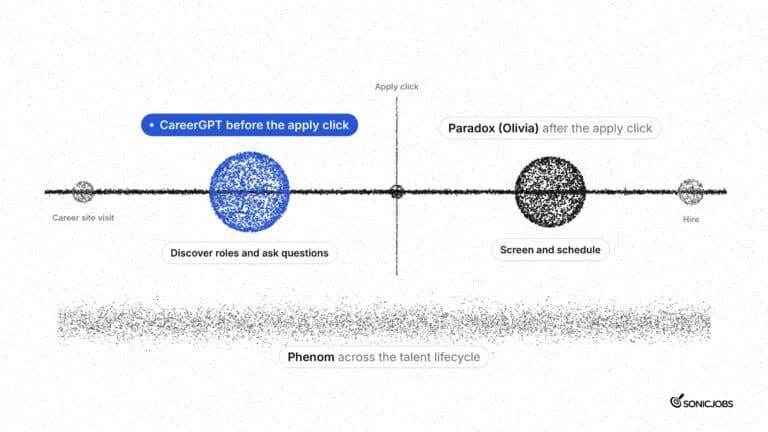
Paradox Olivia is a strong option for employers whose primary need is screening and scheduling automation at high volume. Its Q&A library approach lets recruiting teams control what Olivia says, but it requires significant upfront authoring effort and depends on candidates staying within the script. When questions fall outside the predefined paths, candidates can hit loops or dead ends. That is a structural characteristic of the scripted chatbot model, not a flaw specific to Paradox. It is also a different category from conversational job discovery: Olivia is built to move qualified candidates through a funnel, not to help a candidate figure out which role fits them in the first place.
Phenom Talent Companion: Enterprise AI Chatbot Embedded in the Phenom Platform
Phenom Talent Companion is the AI recruiting chatbot component of Phenom’s broader Intelligent Talent Experience platform. It answers candidate questions from the company’s knowledge base, matches them to relevant roles, and books interviews, keeping application, screening, and scheduling within one conversation rather than passing candidates between separate tools. Over 12 months, Phenom engaged 20 million candidates through its chatbot, refining recommendations with each interaction.
Talent Companion is not a standalone widget. It runs on Phenom’s Intelligent Career Site and feeds every conversation into Phenom’s Talent CRM, making chat history part of the candidate profile. That integration is both its strength and its constraint: the depth of insight available to recruiting teams depends on full platform adoption.
Phenom Talent Companion Key Features
- Role matching: Personalised job recommendations drawn from the candidate’s conversation history and CRM profile, improving with each interaction.
- Interview booking: Candidates can move from job discovery through interview scheduling in under 8 minutes on mobile, a figure Phenom reported at Industry Week 2025, relevant given that over 70% of retail applications now come from mobile devices.
- Talent CRM integration: Every chat, job view, and scheduling action feeds into the candidate’s CRM profile, giving recruiting teams a continuous record across touchpoints.
- Mobile-first scheduling: The end-to-end experience is designed for mobile completion, reducing drop-off between discovery and interview confirmation.
Phenom Talent Companion Use Cases, Best For
Phenom Talent Companion suits enterprise talent teams already operating within Phenom’s platform who want their chatbot, career site, CRM, and internal mobility tools managed in one stack. Teams running high-volume hiring across multiple business units, or those with existing Phenom deployments looking to extend conversational capability, will find the tightest fit here. It is a less practical option for employers who want to add conversational job discovery to a career site without replacing their existing technology.
Phenom Talent Companion Pricing
Phenom pricing is custom enterprise with no public list price and no self-serve tier. Based on third-party research, annual contracts for mid-market organisations typically range from $60,000 to $180,000 per year. Enterprise deployments for organisations with 10,000 or more employees, particularly those with global requirements, can reach $250,000 to $500,000 or more per year. Modules including the career site, CRM, and Internal Mobility are priced separately. Multilingual career sites and data residency requirements drive material upcharges and are not included by default.
Implementation for large enterprises typically spans multiple months and covers career site build, applicant tracking system (ATS) integration, CRM data migration, and user training. Phenom has introduced self-service integration tools that the company says can reduce initial deployment time by four weeks, though the overall project remains substantial.
Phenom Talent Companion is a capable tool within the Phenom ecosystem, particularly for enterprise teams that want screening, scheduling, and CRM data in one place. The trade-off is platform dependency: organisations that are not already on Phenom, or that need multilingual support from day one, should weigh the implementation timeline and total cost carefully before committing.
CareerGPT by SonicJobs: Conversational AI Job Discovery Built for Any Employer Career Site
90% of CareerGPT conversations reached a relevant job result and 64% led to an application start. Those numbers come from a conversational AI career agent that sits on the employer’s existing career site, requires no applicant tracking system (ATS) migration, and can go live in days. The candidate describes what they want in plain language, the conversation handles the rest, and the employer learns exactly what candidates were asking the whole time.
CareerGPT Key Features
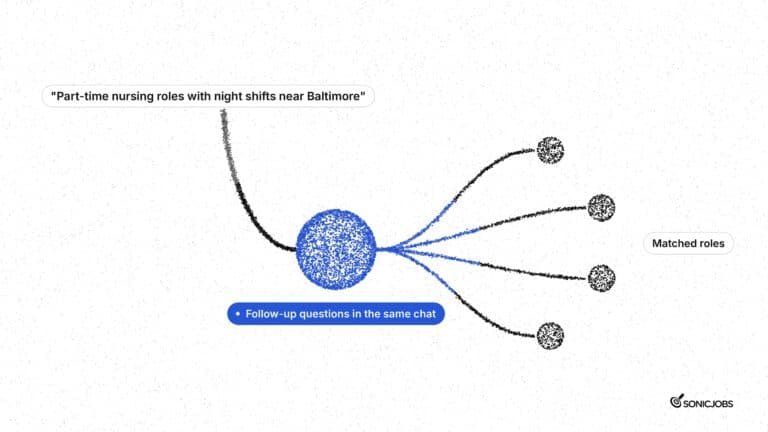
Conversational job discovery. Candidates type what they need in natural language, a location, a shift type, a qualification, a benefit requirement, and CareerGPT returns relevant roles from the employer’s live job feed. They can refine the search through follow-up questions without starting over.
Multi-source knowledge. CareerGPT draws answers from the employer’s career site, job feed, and uploaded PDFs. Employers can also connect approved external sources: LinkedIn, Glassdoor, Reddit, YouTube, and social media pages. Uploaded documents let employers share information candidates need without waiting on a website update.
One line of code. The main implementation is a floating widget. CareerGPT can also be embedded directly in the search bar or in other locations across the career site. Deployment works through a single script or via Google Tag Manager.
Multilingual support included. CareerGPT handles conversations in Spanish, French, German, Mandarin, Hindi, and additional languages with no extra setup and no additional cost. Job descriptions stay in the language the employer published them in.
First-party candidate intent data. CareerGPT records every question asked, every job viewed, and every application started within a conversation. Employers can review and export this data. AI assistants such as ChatGPT, Claude, and Gemini share no search data with employers; CareerGPT’s data layer fills that gap directly.
Cited answers and source transparency. Every CareerGPT answer includes a source citation. Where the source is a web page, candidates can follow the link. Candidate conversations are not shared with ChatGPT, Claude, or any other AI lab.
CareerGPT Differentiators
Days to live, not months. Traditional recruiting chatbots require employers to write and approve answers to hundreds of candidate questions. That process takes 6-9 months. CareerGPT skips manual Q&A authoring by whitelisting data sources, the employer’s career site, Glassdoor, and other approved pages, and can go live in days once the job feed, content, and approvals are in place.
No platform replacement required. CareerGPT adds to the employer’s existing career site and hands candidates into the application journey already in place. No ATS migration, no career site rebuild.
Multilingual by default. Where competitors charge additional fees for multilingual capability, CareerGPT includes it at no extra setup cost.
Intent data that AI assistants cannot provide. Google shares keyword search volumes through Search Console. ChatGPT, Claude, and Gemini share nothing. CareerGPT gives employers a first-party record of what candidates actually asked, which searches returned no results, and where content left questions unanswered.
Source whitelisting over manual Q&A. Rather than requiring content teams to predict and pre-approve every candidate question, CareerGPT answers from connected knowledge sources. Employers control which sources are connected, test how answers read, and update content when a gap appears.
Benefits of Using CareerGPT
Candidates reach relevant roles faster. Instead of running multiple keyword searches or reading through job descriptions to find one that fits their situation, candidates describe what they need and get results in the same conversation.
Employers see what candidates actually want. Conversation records show which questions come up repeatedly, which searches return nothing, and which roles attract the most interest. That is information employers can act on.
Content gaps become visible and fixable. If candidates keep asking about a benefit the career site barely covers, the data surfaces that gap. Employers can update the connected knowledge source and close it without waiting on a full site revision.
No platform lock-in. CareerGPT works alongside the recruiting technology employers already run. Switching or upgrading the ATS does not require rebuilding the career site experience.
How Real Teams Use CareerGPT, Best For
Johns Hopkins Medicine. CareerGPT is live on the Johns Hopkins Medicine career site.
Military candidate pathways (MOS codes example). Adding a knowledge source covering military occupational specialty (MOS) codes took four minutes before it was live. Candidates could then describe their military background and receive matched civilian role results immediately.
Multilingual hiring (InGen Biotech demo). When tested on the InGen Biotech demo careers site, CareerGPT answered candidate questions in Chinese, French, and Spanish. A competing Fortune 500 careers bot, tested on the same site, produced no useful answers in any of the three languages.
High-intent career site visitors. Candidates who reach an employer’s career site are already considering that employer. CareerGPT is built for that moment, when someone has a specific question and needs an answer before they decide whether to apply.
Employers who need insight into candidate intent. Talent acquisition teams, recruitment marketing teams, and recruitment agencies use CareerGPT’s conversation data to understand what candidates are looking for and where their current content falls short.
CareerGPT Pricing
SonicJobs has not published pricing tiers for CareerGPT. Contact SonicJobs directly to discuss your career site and get details on what setup involves.
CareerGPT combines performance, speed, and insight in a way that fits onto the career site employers already run. 90% of conversations reached a relevant job result and 64% led to an application start. Setup takes days rather than months, multilingual support is included without extra cost, and the data layer gives employers a first-party view of candidate intent that no AI assistant currently provides. For employers who want candidates to find the right role and get a real answer to their follow-up question, that combination is what CareerGPT is built to deliver.
CareerGPT vs. Paradox Olivia vs. Phenom Talent Companion vs. Keyword Search: Feature Comparison
The table below gives talent acquisition teams a fast side-by-side view across the criteria covered in the “What to Look For” section. Competitor data is sourced from publicly available product pages and third-party analyses. Where no public data exists for a competitor on a given row, that is noted.
| Feature | Keyword Search Box | Paradox Olivia | Phenom Talent Companion | CareerGPT (SonicJobs) |
|---|---|---|---|---|
| Natural-language job discovery | No, term-frequency keyword matching only | Partial, structured conversation flows, not open-ended discovery | Partial, guided prompts within Phenom platform | Yes, candidates describe needs in their own words |
| Multi-requirement query handling | No, separate keyword fields required | Limited, pre-defined flow paths | Limited, within platform-defined parameters | Yes, combines location, hours, benefits, qualifications in one request |
| Setup time | Days (native to ATS) | 4-6 weeks (ATS integration and conversation flow training) | Multi-month project (career site build, ATS integration, CRM migration, user training) | Days once job feed, content, and approvals are ready; script addition takes minutes |
| Multilingual support | Depends on ATS configuration | Available at additional cost | Available at additional cost; multi-language drives material upcharges | Included by default (Spanish, French, German, Mandarin, Hindi, and more) |
| Candidate intent data (first-party) | No | Not available to employer outside platform reporting | Not available outside Phenom platform | Yes, questions, jobs viewed, application starts; reviewable and exportable |
| Knowledge source breadth | Job requisition fields only | Structured conversation content configured by employer | Phenom platform content | Career site, job feed, uploaded documents, and optional connected sources (LinkedIn, Glassdoor, social, etc.) |
| ATS migration required | No | Yes, ATS integration required for core function | Yes, full platform migration typical | No, sits on existing career site alongside current ATS |
| Pricing transparency | Included in ATS cost | Custom enterprise only; no public rate card | Custom enterprise only; no public list price | Contact SonicJobs |
| Application-start conversion rate | Not tracked at this level | Not publicly reported for career site discovery context | Not publicly reported for career site discovery context | 64% of conversations led to an application start |
CareerGPT is the only option in this comparison that combines open-ended conversational job discovery, a days-to-live setup that requires no ATS migration, multilingual support included by default, and a first-party intent data layer showing exactly what candidates asked, which jobs they viewed, and where they started applications. Paradox Olivia and Phenom Talent Companion both require significant implementation timelines and treat multilingual access as an add-on cost. The keyword search box requires no setup but answers only what candidates already know how to name. For talent teams evaluating career site job discovery, the differences are structural, not marginal.
Choosing the Best AI Job Discovery Tool for Your Employer Career Site in 2026
The tool that greets a high-intent candidate on your career site determines whether they find a role and start an application, or leave. That stakes are concrete: a candidate who reaches your career site is already looking at your company. What happens next depends on what they encounter.
For some talent teams, Paradox Olivia is a reasonable fit. If your hiring is predominantly high-volume frontline roles (retail, hospitality, healthcare with 500 or more annual hires) and your stack is already built around Workday, Paradox is designed for that environment. The trade-off is a 4-6 week implementation for ATS integration and conversation flow setup, and a tool optimized for screening automation rather than open-ended job discovery.
Phenom Talent Companion suits teams already operating on the Phenom platform where enterprise CRM integration is a priority. Every conversation feeds directly into Talent CRM as part of the candidate profile. For organizations whose workflows are built around Phenom, that continuity is a real advantage. For organizations that are not, it is a reason to look elsewhere.
For employers whose primary need is helping candidates find the right role through natural conversation, CareerGPT is the standout option in this comparison. It sits on the existing career site with no applicant tracking system migration required. Adding the script takes minutes; the full deployment, once the job feed, content and approvals are ready, is measured in days rather than weeks. Multilingual support across Spanish, French, German, Mandarin, Hindi and other languages is available by default, with no additional configuration needed.
The results from CareerGPT are specific: 90% of conversations reached a relevant job result, and 64% led to an application start. Johns Hopkins Medicine is a live deployment.
If the goal is to serve the candidate who arrives already interested and help them find and apply for a role, that is the case CareerGPT is built for.
FAQs: CareerGPT vs. Career Site Chatbots vs. Keyword Search
What is a conversational AI career agent, and how is it different from a recruiting chatbot?
A conversational AI career agent lets candidates describe what they are looking for in their own words, ask follow-up questions about specific roles, and refine their search without starting over. Most recruiting chatbots rely on predefined scripts and keyword matching. When a candidate’s question falls outside the script, the chatbot repeats a canned answer or routes the candidate to a recruiter. CareerGPT, SonicJobs’ conversational AI career agent, draws answers from connected employer knowledge sources and handles follow-up questions on the same role in the same conversation.
What is CareerGPT and how does it work on an employer career site?
CareerGPT is SonicJobs’ conversational AI career agent for employer career sites. Candidates open it, describe the work they are looking for, and CareerGPT responds using the employer’s connected job feed, career site, and uploaded documents. It recommends relevant roles, lets candidates ask about specific jobs, and cites the source of each answer so candidates can verify the information. 90% of CareerGPT conversations reached a relevant job result and 64% led to an application start. Candidates continue to apply through the employer’s existing process.
How does a keyword search box compare to CareerGPT for job discovery?
A traditional keyword search box matches on requisition title, job family, job function, and skill fields, with relevancy driven by how often a keyword appears in those fields. A candidate who knows their constraints, specific hours, a required benefit, no-weekend shifts, but not their exact job title will likely get no results or irrelevant ones. CareerGPT lets candidates combine multiple requirements in one request and follow up without starting again. Many career sites redirect candidates straight to the ATS, even though a candidate who reaches the career site is already high intent.
Which is better for a candidate searching for a part-time warehouse role with specific schedule and benefits needs: keyword search, a recruiting chatbot, or CareerGPT?
A keyword search for “part-time warehouse, no weekends, health benefits” returns results based on term frequency, so a role without those exact words in the requisition fields will not appear, even if it matches. A scripted recruiting chatbot will loop back to the same overview paragraph when the candidate asks about weekend schedules or benefits specifics. CareerGPT handles all three constraints in a single request, draws the answer from connected sources, and lets the candidate ask follow-up questions about a specific role’s healthcare coverage without restarting the search.
How long does it take to set up CareerGPT on a career site?
Adding CareerGPT to a career site requires one line of code, deployed directly or through Google Tag Manager. The implementation itself takes minutes. CareerGPT can go live in days once the job feed, content sources, and internal approvals are in place. This is a significant difference from traditional recruiting chatbots, where employers can spend months creating and approving scripted answers to anticipated candidate questions. SonicJobs reduces that process to days by connecting CareerGPT to whitelisted data sources such as the career site, Glassdoor pages, and uploaded documents.
Does CareerGPT replace the employer’s existing ATS or career site?
CareerGPT does not replace the employer’s applicant tracking system (ATS) or career site. It sits on the existing site as a floating widget or embedded component and hands candidates into the application journey already in place. No ATS migration is required. SonicJobs built CareerGPT to work alongside existing recruiting technology, so employers can add conversational job discovery without a platform rebuild. When a candidate is ready to apply, they continue through the employer’s standard application process, with CareerGPT having already helped them find and evaluate the right role.
What knowledge sources does CareerGPT use to answer candidate questions?
CareerGPT answers from the knowledge sources the employer connects: the career site, the job feed, and uploaded documents such as PDFs. Employers can also connect approved external sources including LinkedIn, Glassdoor, Reddit, and the employer’s YouTube and social media pages. Uploaded documents let employers share information with candidates that has not yet been published on the site, or add material quickly without waiting on a website update. Employers control which sources CareerGPT draws from, can test its answers, and update the supporting knowledge when a response is incomplete or inaccurate.
Does CareerGPT support candidates in multiple languages without additional setup?
CareerGPT is available across countries and languages, including Spanish, French, German, Mandarin, and Hindi, with no additional setup or cost required. Job descriptions remain in the language the employer originally published them in. This is a meaningful operational difference from some competing platforms, where multilingual support is an add-on available only at additional cost. SonicJobs built multilingual capability into CareerGPT so employers serving diverse candidate populations do not need to configure separate instances or purchase language packs to reach candidates in their preferred language.
What employer data and insights does CareerGPT provide that a keyword search box or chatbot cannot?
CareerGPT records candidate questions, its responses, and in-conversation activity including sources cited, jobs viewed, and roles where an application was started. Employers can review and export this data. AI assistants such as ChatGPT, Claude, and Gemini share no search data with employers, and a keyword search box captures only query strings. CareerGPT’s data layer gives employers first-party insight into what candidates are actually asking, which searches return no results, and where career content leaves questions unanswered, information they can act on to improve both content and candidate engagement.
How does CareerGPT compare to Paradox Olivia for career site candidate engagement?
Paradox Olivia is built around automating candidate screening, interview scheduling, and follow-ups, operating 24/7 across 100+ languages. It is a Workday company following an acquisition that closed October 1, 2025. Olivia’s strength is high-volume frontline hiring automation, not open-ended job discovery. CareerGPT by SonicJobs is built specifically for the job discovery conversation: a candidate can describe what they need, explore roles, and ask follow-up questions before entering the application process. The two tools serve different stages of the candidate journey rather than being direct substitutes.
How does CareerGPT compare to Phenom Talent Companion for job discovery?
Phenom Talent Companion answers candidate questions from the company’s knowledge base, matches candidates to roles, and books interviews within a single conversation. It is embedded in the broader Phenom platform, which means employers not already on Phenom would need to adopt the wider suite to access it. CareerGPT by SonicJobs is a standalone add-on that sits on any existing career site with one line of code and no platform migration. For employers who want to add conversational job discovery without replacing their current ATS or career site infrastructure, CareerGPT requires significantly less commitment.
What are the best AI tools for job discovery on an employer career site in 2026?
The strongest AI job discovery tools in 2026 let candidates describe what they need in their own words, handle multiple constraints in one request, answer follow-up questions about specific roles, and cite the source of each answer. CareerGPT by SonicJobs meets all of these criteria and adds a first-party intent data layer that keyword search and scripted chatbots cannot provide. 90% of CareerGPT conversations reached a relevant job result. Recruiting chatbots such as Paradox Olivia and Phenom Talent Companion serve related but different purposes, primarily screening and scheduling rather than open job discovery.
How does SonicJobs Employer GPT Visibility relate to CareerGPT?
SonicJobs Employer GPT Visibility and CareerGPT are separate SonicJobs tools that address related problems. SonicJobs Employer GPT Visibility enables employers to measure how visible they are compared to competitors on ChatGPT, Claude, and Gemini, showing where the employer is the default answer and where a competitor appears instead, with unedited screen recordings as evidence. CareerGPT, by contrast, is deployed on the employer’s own career site to serve candidates already there. Employers often use both: Employer GPT Visibility to understand their position in AI-driven search, and CareerGPT to convert high-intent career site visitors into applicants.