SonicJobs CareerGPT vs. Paradox vs. Phenom: Conversational Career Site Search Compared (2026)
Published · 49 min read · by SonicJobs
Published November 1, 2026 by SonicJobs
Compare SonicJobs CareerGPT, Paradox Olivia, and Phenom Talent Companion for conversational AI job matching on career sites in 2026.
Introduction: Comparing the Best Conversational AI Career Site Platforms in 2026
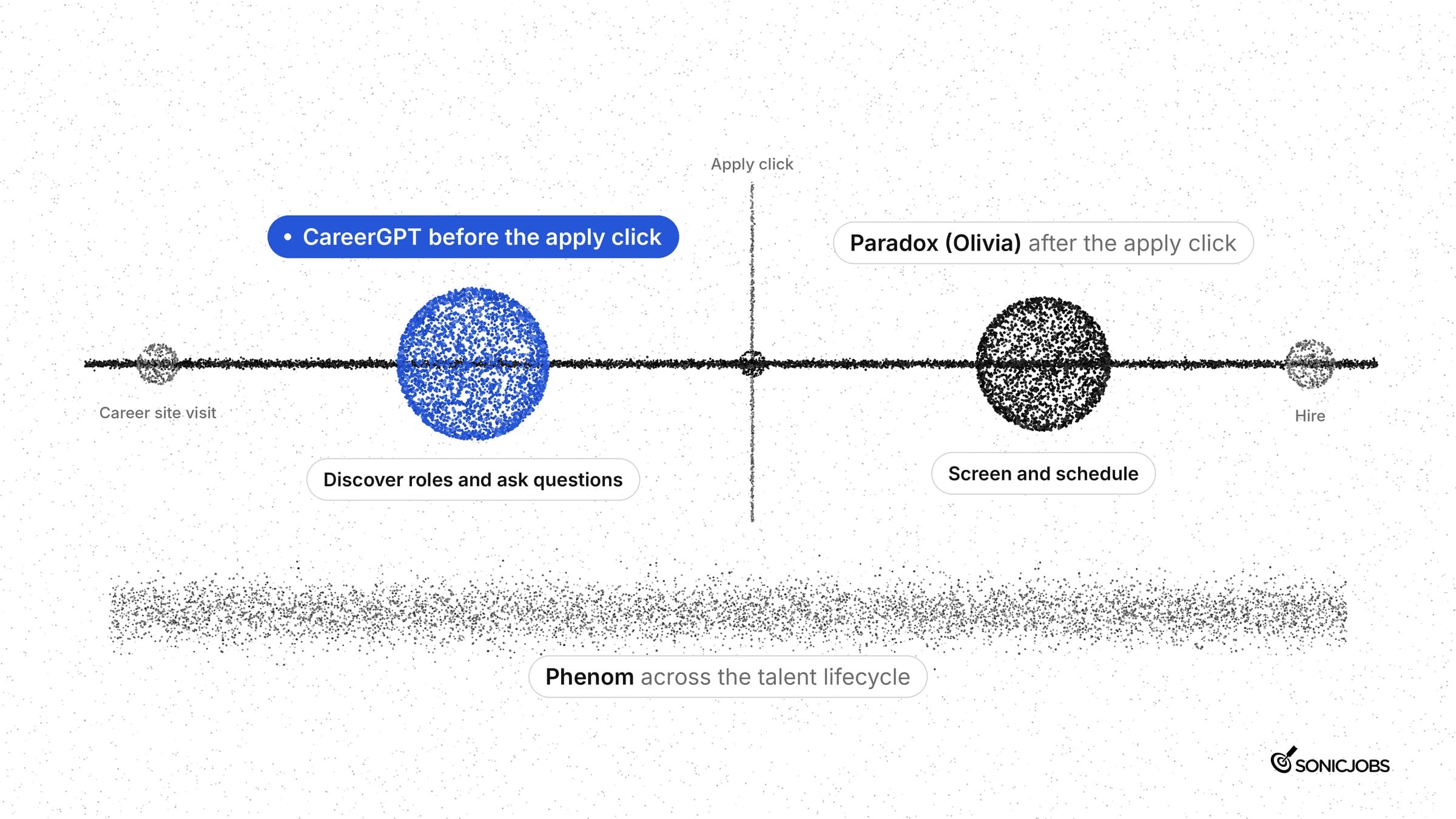
Choosing a conversational AI platform for your career site is harder than it looks. CareerGPT, Paradox (Olivia), and Phenom each operate at a different stage of the candidate journey, and comparing them feature by feature without accounting for that difference produces a misleading picture.
CareerGPT, from SonicJobs, focuses on the pre-apply moment: candidates describe what they are looking for, ask questions about roles and the company, and explore opportunities through a conversation on the employer’s own career site, with no applicant tracking system (ATS) migration required. Paradox’s Olivia activates after a candidate clicks apply, automating screening and scheduling at volume. Phenom addresses a broader scope, covering personalization across the talent lifecycle from candidate attraction through employee development.
Because these tools occupy different parts of the funnel, they are often complements rather than direct substitutes. An employer already using Paradox for apply automation can add CareerGPT to handle the discovery and Q&A phase that happens before a candidate decides to apply, without replacing either system.
This guide, produced by SonicJobs, compares all three platforms on conversational job discovery, career-site Q&A, source controls, candidate insights, integration effort, and enterprise fit. The aim is to give talent acquisition leaders a factual basis for deciding which combination of tools fits their hiring operation.
What Is Conversational AI for Career Sites, and Why Does It Matter in 2026?
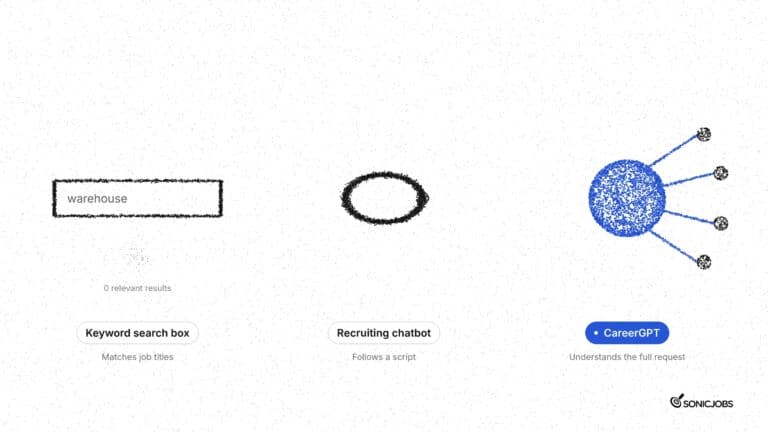
Conversational AI for career sites lets candidates describe what they are looking for in their own words, ask questions about specific roles or working conditions, and receive answers drawn from the employer’s actual content, all before they decide to apply. It is different from a keyword search bar, which requires a candidate to know the right job title, and different from a static FAQ page, which covers only the questions the employer thought to write down.
The gap that creates is real. Across SonicJobs CareerGPT clients, 30% to 35% of candidate questions had no clear answer in the employer’s own career site content. A candidate asking about shift flexibility, tuition reimbursement, or what colleagues say about the culture would typically find nothing, or would need to dig through multiple pages to piece together an answer. Many would leave.
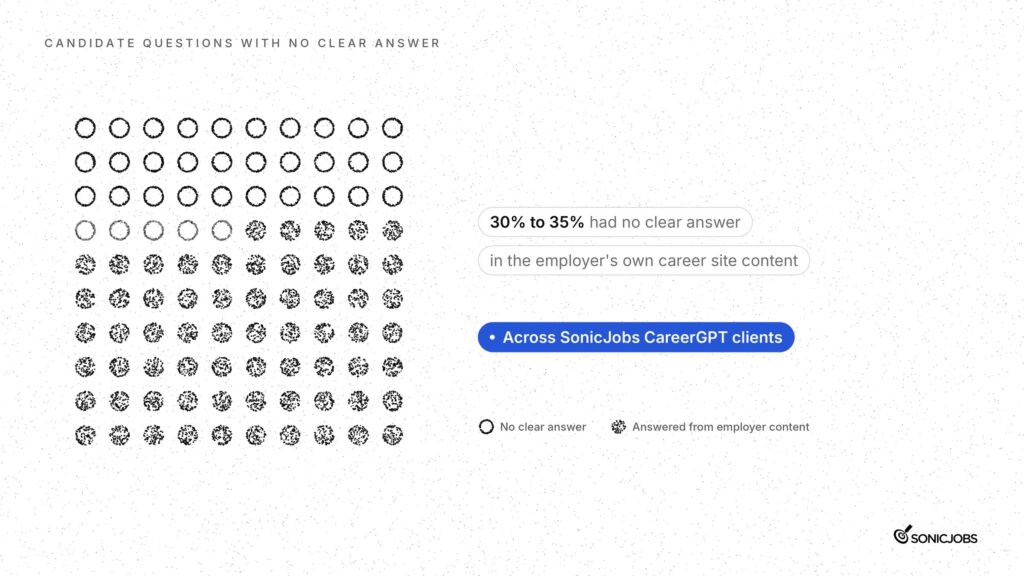
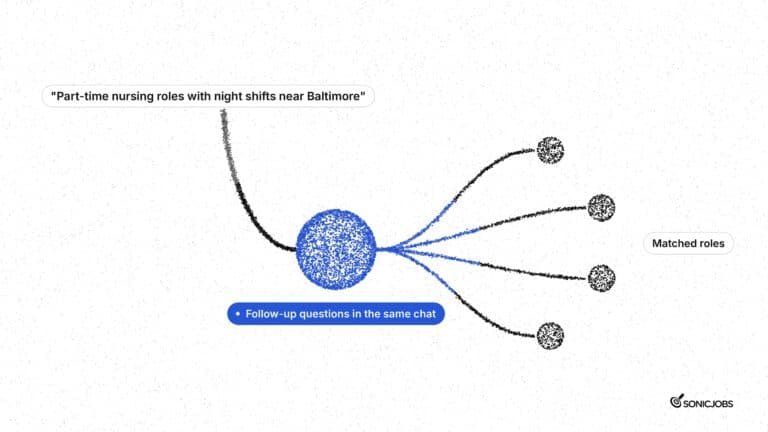
This matters more in 2026 because candidates now expect to ask full, specific questions, as they do with AI assistants. A career site that returns no results for “remote nursing roles with weekend flexibility” or “warehouse jobs that don’t require prior experience” is losing high-intent visitors the employer already paid to attract.
CareerGPT is SonicJobs’ conversational AI career agent built to address this pre-apply moment. It sits on the employer’s existing career site, draws answers only from connected and approved knowledge sources (the job feed, the career site, uploaded documents and selected external sources), and hands candidates into the employer’s existing application process when they are ready to apply. There is no applicant tracking system (ATS) migration and no site rebuild required. Adding the script takes minutes, and CareerGPT can go live in days once the job feed, content and approvals are in place.
What to Look for in a Conversational AI Career Site Platform
Most career site evaluations start with feature lists. A more useful starting point is the specific problems a platform has to solve: candidates who cannot find a relevant role because keyword search fails them, employers who cannot see what candidates actually want, and recruiting teams who need something live before the next hiring cycle, not after a multi-month implementation.
The criteria below reflect those problems. A platform that addresses all of them fits into the pre-apply moment where most career sites currently leave candidates without support.
Key Features and Qualities of the Best Conversational AI Career Site Platforms
Pre-apply conversational job discovery. Candidates should be able to describe what they want in their own words, including shift preferences, benefit requirements, or location constraints, and receive relevant results. A search bar that requires a job title returns nothing useful to a candidate who does not know what title to look for.
Source-controlled answers. The platform should draw answers only from content the employer has approved: the career site, the job feed, uploaded documents, and any external sources the employer explicitly connects. Answers generated outside that boundary create accuracy and compliance risk. CareerGPT answers only from the knowledge sources the employer connects, which can include the career site, job feed, PDFs, and approved external sources such as LinkedIn, Glassdoor, Reddit, or the employer’s social media pages.
First-party intent data capture. Every candidate question is a data point: which roles interest people, which benefits they ask about, and which concerns stop them from applying. The CareerGPT dashboard records every prompt as first-party intent data covering roles, benefits, and the questions candidates actually ask, including where current content leaves those questions unanswered.
Fast, low-disruption deployment. An implementation that requires an applicant tracking system (ATS) migration or a career site rebuild takes months and disrupts existing recruiting workflows. CareerGPT goes live in days once the job feed, content, and approvals are ready. Adding the script takes minutes, and no ATS migration or career site rebuild is required.
Multilingual support. Employers hiring across countries need a platform that can handle candidate questions in multiple languages without requiring separate implementations. CareerGPT supports Spanish, French, German, Mandarin, Hindi, and other languages, while keeping job descriptions in the language the employer originally published them.
Data privacy and answer transparency. Candidate conversations should not be shared with AI labs or used to train external models. Answers should include citations so candidates can verify where information came from and employers can audit what the platform said. CareerGPT does not share conversations with ChatGPT, Claude, or any other AI lab, and every answer includes a source citation.
Visibility into content gaps. A platform should show employers where their existing career site content fails to answer candidate questions, not just surface what works. Across SonicJobs CareerGPT clients, 30% to 35% of candidate questions had no clear answer in the employer’s own career site content. That figure tells employers what to build, not just what they already have.
SonicJobs evaluates CareerGPT against each of these criteria directly. The sections that follow apply the same framework to Paradox and Phenom so the comparison is consistent across all three platforms.
Paradox (Olivia): Conversational Recruiting for High-Volume Apply Flows
Paradox is a conversational AI recruiting platform built around an AI assistant named Olivia. Workday acquired Paradox in October 2025, and Olivia is now being integrated into Workday’s talent acquisition suite as the Workday Paradox Candidate Experience Agent. The platform’s core design centers on automating the apply-to-schedule funnel: screening candidates, scheduling interviews, and handling routine questions, all through conversation. Paradox reports it schedules approximately 32 million interviews per year, accounting for roughly one in ten interviews in the US, and has powered more than 189 million AI-assisted candidate conversations, according to the company’s own figures.
Paradox Key Features
- Conversational screening: Olivia runs role-specific knockout questions across career site, SMS, WhatsApp, and email, filtering candidates before a recruiter is involved.
- Automated interview scheduling: Scheduling syncs to hiring manager calendars and is confirmed through the same conversation, without a separate scheduling tool.
- FAQ handling: Employers can configure 500+ custom Q&A pairs. Olivia draws from this knowledge base to answer routine candidate questions about pay ranges, shift patterns, dress code, location, and benefits.
- Onboarding automation: After an offer, Olivia can handle onboarding document requests and related tasks. In 2026, Paradox introduced Olivia Agents for post-screening workflows, including background-check coordination and deeper autonomous sequences from screening through to onboarding.
- Multilingual support: Olivia supports 100+ languages with natural conversation flow.
- ATS integration: Bi-directional sync with Workday, SAP SuccessFactors, iCIMS, Greenhouse, Lever, and Oracle HCM.
- Internal mobility: A separate module supports existing employees exploring internal openings.
What Is Paradox Best For? Use Cases
Paradox is designed for high-volume hourly hiring where recruiter capacity is the primary bottleneck. It fits well in:
- Restaurants and food service: Fast, repeating apply flows where speed to interview matters most.
- Retail: High seasonal volume with straightforward role requirements.
- Healthcare support roles: High-volume clinical and non-clinical frontline positions.
- Logistics and distribution: Roles where shift details and location are the main candidate questions.
Paradox is less focused on low-volume, professional, technical or executive hiring, where candidates need to explore role nuance before applying.
Olivia can be embedded on the employer’s career site to help visitors find relevant openings based on their experience and interests, and to guide them through the application process. The career site and FAQ capabilities are strongest when the hiring need is repetitive and the candidate questions are predictable.
Paradox (Olivia) has built a strong position in high-volume frontline recruiting, and its scale statistics reflect real adoption at that end of the market. The Workday acquisition positions Olivia as a native component of a major enterprise HR platform, which is likely to matter for existing Workday customers evaluating their talent acquisition stack. Its primary strengths are speed and automation in the apply-to-schedule funnel, not open-ended job discovery or content-grounded Q&A for candidates still deciding whether to apply.
Phenom: Enterprise Talent Experience Platform with AI Career Site Personalization
Phenom is an enterprise talent experience platform that covers the full talent lifecycle: AI-personalized career sites, a candidate-facing conversational agent, candidate relationship management (CRM), internal mobility, and analytics. It serves over 500 global enterprises, including nearly 50 Fortune 500 companies. Its scale is notable: Phenom reports its chatbot engaged with 20 million candidates over a 12-month period, learning from each interaction to deliver more relevant job recommendations. As of June 2026, Phenom’s AI hiring agents run inside the ServiceNow AI Platform.
Phenom Key Features
- AI-personalized career site: Two candidates visiting the same page can see entirely different recommended roles and content, based on each visitor’s skills, interests, experience, and location.
- Talent Companion: The candidate-facing AI agent handles job discovery with natural language understanding, real-time responses to candidate queries, and interview preparation guidance. Phenom also offers a Candidate Concierge Agent for capturing lead data from candidates not yet ready to apply.
- Phenom X+ generative AI: Covers job description creation, branded content, and personalized email and SMS campaigns.
- ATS enhancement layer: Phenom layers onto existing applicant tracking systems (ATS) such as iCIMS, Workday, and SAP SuccessFactors, adding AI career sites, CRM, chatbot capabilities, internal mobility marketplaces, and talent analytics without replacing the core ATS.
- Internal mobility and analytics: Candidates already employed can explore internal career paths; hiring teams access automated matching dashboards.
What Is Phenom Best For? Use Cases
- End-to-end talent lifecycle transformation: Organizations that want a single platform spanning candidate attraction, application, internal mobility, and talent analytics.
- High-volume, global enterprise hiring: Phenom’s personalization and multi-module architecture are designed for large organizations running continuous hiring across many roles and locations.
- AI-driven career site personalization: Employers that want each career site visitor to receive dynamically tailored job recommendations rather than a static page.
- Recruitment marketing at scale: Teams using personalized email and SMS campaigns alongside career site content can draw on Phenom X+ to generate and distribute that content.
Phenom is best suited for Fortune 500 companies seeking broad talent lifecycle transformation.
For organizations with the scale and budget to match its requirements, Phenom offers a comprehensive set of tools that reach well beyond career site search: from personalized candidate experiences through to internal mobility and AI hiring agent workflows. It is a substantial platform investment rather than a point solution.
SonicJobs CareerGPT: Conversational Job Discovery Built for the Pre-Apply Moment
Many candidates arrive at an employer’s career site knowing what kind of work they want but not the job title to search for. A keyword search for “no weekend shifts” or “remote roles I can take with me if we relocate” returns nothing. The candidate leaves, and the employer has lost traffic it already paid for.
CareerGPT is SonicJobs’ conversational AI career agent, built to sit on the employer’s existing career site and handle exactly that pre-apply moment. Candidates describe what they are looking for in their own words, ask questions about the company, and explore live roles through a conversation. 90% of CareerGPT conversations reached a relevant job result, and 64% led to an application start.
CareerGPT Key Features
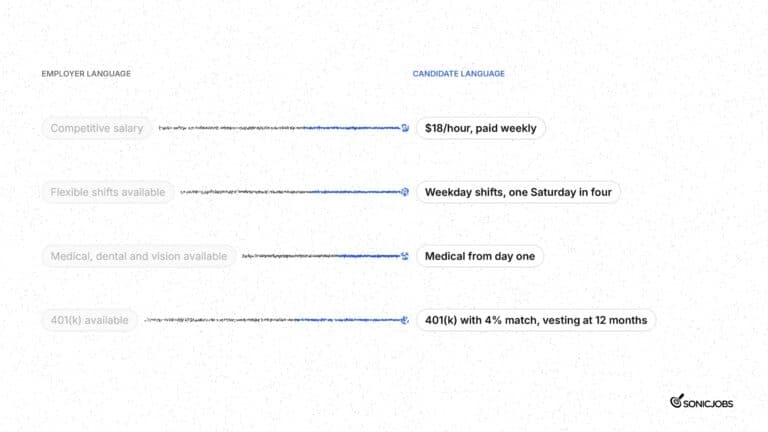
Conversational job discovery: Candidates type what they need, combine multiple requirements in a single request, and refine results through follow-up questions without starting over. CareerGPT responds with matching roles and highlights the information relevant to their search.
Employer-controlled knowledge sources: CareerGPT answers only from the sources the employer connects: the career site, the job feed, and uploaded documents such as PDFs. Employers can also choose to connect approved external sources, including LinkedIn, Glassdoor, Reddit, and the employer’s YouTube and social media pages. It does not pull from sources the employer has not enabled.
Source citations: Every answer includes citations so candidates and employers can see where the information came from. Candidate conversations are not shared with ChatGPT, Claude, or any AI lab, and are not used to train AI models.
Fast deployment, no rebuild: Adding the CareerGPT script takes minutes. CareerGPT can go live in days once the job feed, content, and approvals are in place. No career site rebuild and no applicant tracking system (ATS) migration.
Multilingual: CareerGPT is available in Spanish, French, German, Mandarin, Hindi, and other languages. Job descriptions remain in the language the employer published them in.
First-party intent data: The CareerGPT dashboard captures every candidate conversation as first-party intent data. It groups conversations by topic (roles, benefits, location), shows which searches returned no result, and flags content gaps where candidate questions had no answer in the employer’s own content. Across SonicJobs CareerGPT clients, 30% to 35% of candidate questions had no clear answer in the employer’s own career site content.
CareerGPT Differentiators
It draws from connected sources, not pre-approved Q&A libraries. Traditional recruiting chatbots require employers to write and approve answers to individual candidate questions, a process that can take 6 to 9 months. CareerGPT bypasses that by reading the employer’s connected content directly, so it can go live in days and handle a much wider range of questions without manual scripting.
The pre-apply focus is deliberate. CareerGPT is built for discovery and Q&A before a candidate enters the application flow. It hands candidates into the employer’s existing application journey, rather than replacing or wrapping it. No application is collected inside CareerGPT.
Candidate privacy is explicit. Candidate conversations are not shared with any AI lab and are not used to train models.
Bundled with Employer GPT Visibility. SonicJobs sells CareerGPT together with Employer GPT Visibility as one package. Employer GPT Visibility is a separate product that measures how the employer appears on ChatGPT, Claude, and Gemini when candidates ask hiring-relevant questions, using browser agents that run those queries anonymously. The two products connect naturally: content gaps surfaced in the CareerGPT dashboard can become queries tracked through Employer GPT Visibility.
Benefits of Using CareerGPT
Candidates who arrive find roles. 90% of conversations reached a relevant job result. Employers already investing in career site traffic recover more value from each visit.
Content gaps become visible and actionable. When a candidate asks about parental leave and the career site has nothing on it, CareerGPT surfaces that gap. The employer knows what to publish, which also strengthens how it appears on public AI assistants.
No disruption to existing technology. CareerGPT works alongside the current ATS and application journey. Candidates move through the employer’s own apply flow once they are ready.
Insights unavailable elsewhere. Unlike Google Search Console, which surfaces search terms and volumes, ChatGPT, Claude, and Gemini share no candidate search data with employers. CareerGPT gives the employer that intent data for its own career site.
How Real Teams Use CareerGPT: Best For
Talent acquisition leaders at large employers: Johns Hopkins Medicine uses CareerGPT on its career site. For large employers with broad, complex role inventories, CareerGPT helps candidates surface the right role without navigating dozens of job categories.
Recruitment marketing teams: Teams running employer brand campaigns use the CareerGPT dashboard to understand what arriving candidates actually want, and align content priorities accordingly. Suggested starting questions can be updated to reflect current hiring priorities or what candidates are repeatedly asking.
Employers with multilingual candidate pools: CareerGPT’s language support means candidates can search and ask questions in Spanish, French, German, Mandarin, or Hindi, while job descriptions remain in the employer’s published language.
Employers running Paradox for apply: CareerGPT is designed for the discovery and Q&A moment before a candidate enters an application flow. Where Paradox’s Olivia handles conversational screening and apply, CareerGPT can run on the career site upstream, handing candidates into Paradox’s apply journey. The two tools are complements in that configuration, not direct substitutes.
SonicJobs CareerGPT vs. Paradox vs. Phenom: Feature Comparison
The table below gives a side-by-side view of CareerGPT, Paradox (Olivia), and Phenom Talent Companion across the criteria most relevant to conversational career site deployment. Facts are drawn from each platform’s current product pages and independent reviews (verified October 2026).
| Feature / Criterion | SonicJobs CareerGPT | Paradox (Olivia) | Phenom Talent Companion |
|---|---|---|---|
| Primary function | Conversational job discovery and career-site Q&A before the candidate decides to apply | Automated candidate screening, interview scheduling, and FAQ handling across apply and post-apply | AI-personalized career site, conversational job discovery, and end-to-end talent lifecycle management |
| Career site deployment | Floating widget or embedded search bar added to the existing career site via a script | Career site chat plus SMS, WhatsApp, and email channels | Career site overlay; requires Phenom’s own CMS layer or deep ATS integration |
| ATS migration required | No. CareerGPT works alongside the employer’s existing ATS and application process | No ATS migration, but ATS integration is required for screening and scheduling automation | No migration, but implementation layers on top of ATS platforms such as iCIMS, Workday, and SAP SuccessFactors |
| Time to go live | Days (script addition takes minutes; live once job feed, content, and approvals are ready) | 4 to 6 weeks for ATS integration and conversation-flow configuration (independent reviewers) | 3 to 9 months typical implementation period |
| Source-controlled answers | Yes. Answers come only from knowledge sources the employer connects: career site, job feed, uploaded documents, and approved external sources | FAQ library of 500+ custom Q&As configured by employer; answers outside that library handled by scripted flow | Answers from the company’s real knowledge base via Talent Companion; broader platform draws from ATS and CRM data |
| First-party intent data | Yes. Every candidate prompt is captured as first-party data covering roles, benefits, and content gaps; reviewable in the CareerGPT dashboard | Screening and scheduling data captured; candidate intent signals tied to apply flow, not pre-apply discovery | Candidate behavior and matching data captured across the talent lifecycle; analytics available through Phenom’s platform |
| Multilingual support | Yes. Spanish, French, German, Mandarin, Hindi, and additional languages; job descriptions stay in the employer’s published language | 100+ languages, per Paradox | 115+ languages, per Phenom |
| Best fit by org type | TA leaders, recruitment marketing teams, and agencies at employers of any size who want to improve pre-apply conversion on an existing career site | High-volume hourly employers in restaurants, retail, healthcare, and logistics where recruiter capacity is the bottleneck | Fortune 500 and large enterprises seeking end-to-end talent lifecycle transformation |
| Data privacy (candidate conversations) | Conversations not shared with ChatGPT, Claude, or any AI lab; not used to train AI models; source citations shown for every answer | Candidate data processed through Paradox’s platform; now part of Workday (acquired October 2025) | Candidate data processed through Phenom’s enterprise platform; specific AI training data practices not publicly detailed |
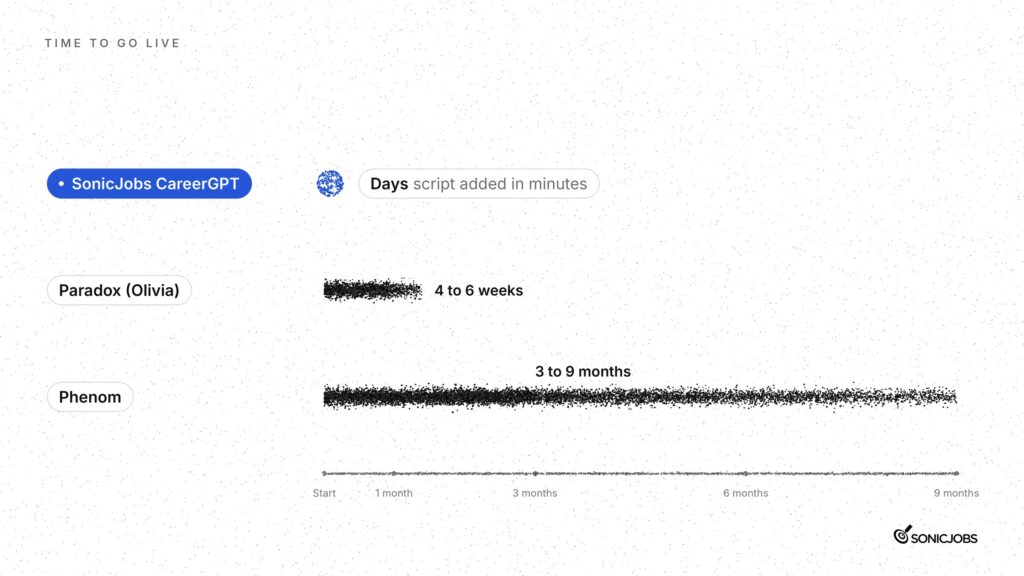
For employers focused on the pre-apply moment, CareerGPT’s case rests on concrete facts rather than platform scale. The script goes live in days, with no career site rebuild and no ATS change. Answers come only from sources the employer controls, so candidates get accurate information and employers see exactly what was cited. Every conversation becomes first-party intent data, covering the roles, benefits, and questions candidates are actually bringing to the career site. For employers already using Paradox for apply automation, CareerGPT covers the discovery and Q&A phase that comes before a candidate clicks apply, and the two systems run alongside each other without replacing either.
Choosing the Best Conversational AI Career Site Platform in 2026
The right choice depends on what problem you are trying to solve and where in the candidate journey that problem sits.
Paradox is the right fit for employers running high-volume hourly hiring in restaurants, retail, healthcare, or logistics, where recruiter capacity is the bottleneck and the priority is automating screening and scheduling after a candidate clicks apply. Its strength is the apply flow, not the exploration that precedes it.
Phenom suits Fortune 500 organizations looking to transform the full talent lifecycle, from candidate attraction through employee development. It requires the implementation runway and budget that comes with enterprise-level platform replacement. Smaller organizations are not a practical fit.
CareerGPT addresses a different moment: the pre-apply phase, when a candidate has landed on an employer’s career site and needs to find a relevant role or get a specific question answered before deciding to apply. It deploys without rebuilding the career site or migrating to a different applicant tracking system (ATS). Adding the script takes minutes, and CareerGPT can go live in days once the job feed, content and approvals are ready.
For employers already using Paradox for apply-flow automation, CareerGPT is not a replacement. CareerGPT handles conversational job discovery and role-specific Q&A on the career site. When a candidate is ready to apply, they continue through the existing application journey, which Paradox’s Olivia can then take over. The two systems serve consecutive stages of the same funnel.
CareerGPT answers only from the knowledge sources the employer connects: the career site, the job feed and uploaded documents, plus any approved external sources the employer chooses to include, such as LinkedIn, Glassdoor or Reddit. Employers control what information CareerGPT has, which keeps answers grounded and consistent. Candidate conversations are not shared with any AI lab and are not used to train AI models.
Every conversation also generates first-party intent data: the roles, benefits and doubts candidates actually ask about, captured in the CareerGPT dashboard alongside answer coverage and content gaps. That data is not available from any other source in the recruiting stack.
90% of CareerGPT conversations reached a relevant job result and 64% led to an application start. CareerGPT is live across a number of career sites, including Johns Hopkins Medicine.
For employers whose main need is high-volume apply automation, Paradox is a strong option. For full enterprise talent lifecycle transformation, Phenom is built for that scope. For conversational job discovery and role-specific Q&A on an existing career site, without rebuilding anything or replacing the ATS, CareerGPT is the purpose-built choice.
FAQs: SonicJobs CareerGPT vs. Paradox vs. Phenom
What is CareerGPT and how does it differ from a recruiting chatbot?
CareerGPT is SonicJobs’ conversational AI career agent for employer career sites. Candidates describe what they are looking for, ask follow-up questions about specific roles, and explore jobs through a conversation rather than a keyword search. Unlike a recruiting chatbot, CareerGPT does not rely on pre-approved Q&A libraries that return the same paragraph regardless of the follow-up question. It answers from the knowledge sources the employer connects, and when the employer has not provided a detail, it tells the candidate so. With SonicJobs, 90% of conversations reached a relevant job result.
How does SonicJobs CareerGPT compare to Paradox (Olivia) for career site job discovery?
CareerGPT is built specifically for the pre-apply phase: candidates describe their needs, ask questions about the company and individual roles, and find relevant jobs before deciding to apply. Paradox’s Olivia is designed to activate after a candidate clicks apply, automating screening, scheduling, and FAQ handling across SMS, WhatsApp, and web chat. CareerGPT surfaces first-party data on what candidates ask and where career site content falls short. The two tools address different stages of the candidate journey, so comparing them directly on job discovery capability reflects different design intentions.
Can CareerGPT and Paradox be used together on the same career site?
Yes. CareerGPT and Paradox serve complementary functions. CareerGPT handles conversational job discovery and Q&A on the career site before a candidate decides to apply. Paradox’s Olivia activates after the candidate clicks apply, automating screening and scheduling. An employer using Paradox for apply automation can deploy SonicJobs CareerGPT for the pre-apply discovery and Q&A phase without replacing either system. The two tools hand off at the point of application, and no ATS migration or career site rebuild is required to add CareerGPT alongside an existing Paradox integration.
How does SonicJobs CareerGPT compare to Phenom Talent Companion for candidate Q&A?
Both CareerGPT and Phenom’s Talent Companion sit on the employer’s career site and answer candidate questions from a connected knowledge base. Phenom Talent Companion also covers interview prep and pairs with a Candidate Concierge Agent for lead capture from candidates not yet ready to apply. CareerGPT focuses on job discovery and Q&A from the employer’s own content sources, including uploaded documents, LinkedIn, Glassdoor, Reddit, and social pages. 64% of SonicJobs CareerGPT conversations led to an application start. Phenom is positioned primarily for large enterprise environments with its full talent experience platform.
What are the best career site platforms with built-in conversational AI for job matching in 2026?
Three platforms stand out for career site conversational AI in 2026: SonicJobs CareerGPT, Paradox (Olivia), and Phenom Talent Companion. CareerGPT focuses on pre-apply job discovery and Q&A, with 90% of conversations reaching a relevant job result and 64% leading to an application start. Paradox is strongest for high-volume hourly apply automation in sectors like restaurants, retail, and logistics. Phenom is suited to large enterprise talent experience programs. The best fit depends on whether the primary need is discovery, apply automation, or full enterprise talent platform coverage.
What is the difference between CareerGPT and Employer GPT Visibility?
SonicJobs sells two separate products together as one package. CareerGPT is the conversational AI career agent on the employer’s own career site: it helps candidates find jobs and get answers before they apply. Employer GPT Visibility is a separate product that measures how an employer appears on ChatGPT, Claude, and Gemini when candidates ask hiring-relevant questions. It uses browser agents that ask those questions anonymously the way a candidate would, and shows where the employer ranks and which sources are cited. Neither product is a feature of the other.
How long does it take to deploy CareerGPT on an existing career site?
CareerGPT can go live in days once the job feed, content, and approvals are ready. Adding the script to the career site takes minutes. No career site rebuild and no applicant tracking system (ATS) migration are required. By comparison, employers using traditional recruiting chatbots can spend 6 to 9 months reviewing and approving answers to likely candidate questions before launch. CareerGPT answers from the knowledge sources the employer connects rather than a pre-approved Q&A library, which is what makes faster deployment practical.
Does CareerGPT replace an employer’s ATS or existing apply flow?
CareerGPT does not replace an employer’s ATS or existing application process. It sits on the employer’s career site as a floating widget or embedded element, helping candidates find relevant roles and get answers before they decide to apply. When a candidate is ready to apply, they continue through the employer’s existing application journey. Applications go to the employer’s own site. SonicJobs CareerGPT works alongside existing recruiting technology, including platforms like Paradox, without requiring any ATS migration or integration change.
What sources does CareerGPT draw on when answering candidate questions?
CareerGPT answers from the knowledge sources the employer connects: the career site, the job feed, and uploaded documents such as PDFs. Employers can also connect selected approved external sources, including LinkedIn, Glassdoor, Reddit, and the employer’s YouTube and social media pages. Candidate conversations are not shared with ChatGPT, Claude, or any other AI lab, and are not used to train AI models. Answers include source citations so candidates can see where information came from. Across SonicJobs CareerGPT clients, 30% to 35% of candidate questions had no clear answer in the employer’s own career site content.
What candidate insights does CareerGPT provide to employers?
CareerGPT records candidate questions, its responses, and activity within each conversation, including sources cited, jobs viewed, and jobs where an application was started. The CareerGPT dashboard groups conversations by topic, such as role search, location, and benefits, and filters by date range. Employers can see which searches returned no results, which questions went unanswered, and where content gaps exist. Across SonicJobs CareerGPT clients, 30% to 35% of candidate questions had no clear answer in the employer’s own career site content. This insight is not available from AI assistants, which share no search data with employers.
Is Paradox (Olivia) still independent or part of Workday in 2026?
Paradox is no longer independent. Workday completed its acquisition of Paradox in October 2025. Paradox’s Olivia is now being integrated into Workday’s talent acquisition suite as the Workday Paradox Candidate Experience Agent. Employers evaluating Paradox should account for this integration when assessing roadmap, support, and platform dependencies. SonicJobs CareerGPT operates independently and does not require a relationship with any specific ATS or HR platform. CareerGPT is live across a number of employer career sites, including Johns Hopkins Medicine.
Which platform is better for high-volume hourly hiring: CareerGPT or Paradox?
Paradox is specifically designed for high-volume hourly hiring in sectors such as restaurants, retail, healthcare, and logistics, where recruiter capacity is the primary bottleneck. Its Olivia assistant automates screening, scheduling, and FAQ handling at scale across SMS and WhatsApp. SonicJobs CareerGPT focuses on the pre-apply phase, helping candidates find relevant roles and get answers before they decide to apply. For high-volume environments, the two can work together: CareerGPT handles discovery and Q&A on the career site, while Paradox manages the apply and scheduling workflow.