How Conversational Job Search Works on Career Sites: A 2026 Guide for Employers
Published · 41 min read · by SonicJobs
Published November 1, 2026 by SonicJobs
Learn how conversational job search on career sites works in 2026. SonicJobs CareerGPT helps employers match candidates to roles and answer questions instantly.
Introduction: Conversational Job Search on Employer Career Sites in 2026
A candidate visits an employer’s career site and types “warehouse supervisor” into the search bar. The results come back by title alone, ignoring the shift pattern they need, the location they can reach and the pay threshold that makes the role viable. They leave without applying. This guide explains how conversational job search changes that interaction: candidates describe what they want in their own words, combine multiple requirements in a single request and ask follow-up questions about individual roles, all without leaving the career site. It covers how natural-language discovery works, what employers should look for when evaluating a conversational AI career agent and how SonicJobs CareerGPT sits on an existing career site to support that experience without replacing the applicant tracking system (ATS) or rebuilding the site.
What Is Conversational Job Search on a Career Site?
Conversational job search means a candidate describes what they want in plain language and the career site returns relevant job results through dialogue, rather than requiring them to enter a keyword and pick from filters.
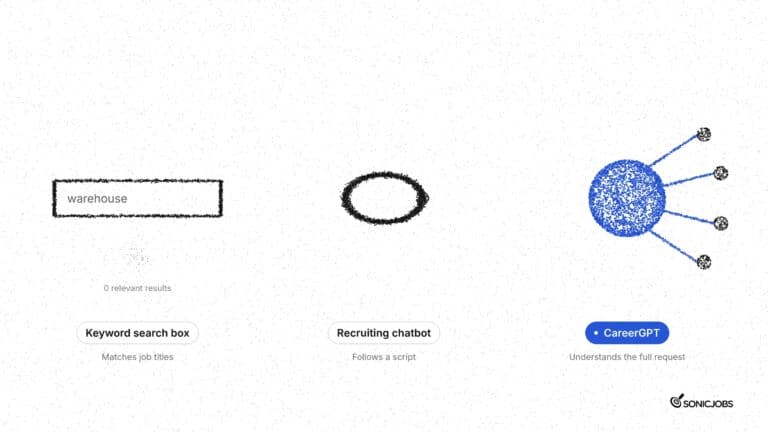
A standard career site search bar works by matching the words a candidate types against job titles and descriptions. If a candidate types “nights” or “no weekends” or “new grad RN,” most search bars return nothing, because those phrases do not match a job title field. The candidate either guesses different keywords or leaves. Conversational job search removes that friction. The candidate describes their actual situation: the hours they can work, the location they need, the qualifications they have, or a combination of all of these in a single request. The career agent interprets the description and returns relevant roles.
After finding a role that looks promising, the candidate can ask follow-up questions about it: the healthcare benefits, the shift pattern, what the training looks like. The conversation stays open. Each answer draws from the knowledge sources the employer has connected, not from a generic script.
SonicJobs’ implementation of this approach is CareerGPT, a conversational AI career agent that sits on the employer’s existing career site. It is added via a one-line script and can go live in days once the job feed, content and approvals are in place. There is no career site rebuild and no applicant tracking system (ATS) migration required.
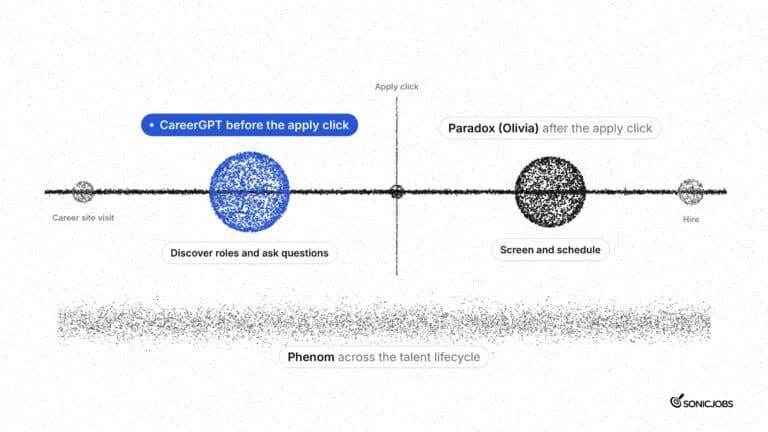
CareerGPT answers only from the knowledge sources the employer connects: the career site, the job feed and uploaded documents such as PDFs. Employers can also connect selected, approved external sources, including LinkedIn, Glassdoor, Reddit and the employer’s YouTube and social media pages, but only sources the employer has specifically chosen to include. When the candidate is ready to apply, they continue through the employer’s existing application process.
Why Conversational Job Search Matters in 2026
Candidate experience is getting worse, not better. PeopleScout’s 2026 global study of more than 1,000 job seekers across 10 markets found that only 11% rate their candidate experience as excellent. That number has fallen since 2023, despite sustained employer investment in recruiting technology. Something is not working, and the career site is a significant part of the problem.
The application drop-off figures show how significant. According to data from Wiser, 94% of candidates who view a job posting do not finish their application. Drop-off can begin the moment a candidate lands on the career site and cannot find a role that fits, or cannot get a clear answer to a basic question. CVViz’s 2026 data puts the career portal directly in the frame: 78% of candidates say the experience of a company’s career portal is important when deciding whether to apply. And 67% of America’s workforce says that the process of applying, interviewing and receiving an offer would make or break their decision to take a job.
The gap between what candidates expect and what most career sites deliver is widening. CVViz’s 2026 data shows that 53% of candidates used generative AI during their job search in 2024-2025, and approximately 70% use AI tools for tasks like resume writing, company research or interview preparation. These candidates arrive on a career site having already experienced fluent, conversational AI. They expect to describe what they want in plain language and get a direct answer.
Yet only 9% of organisations currently use chatbots on their recruitment websites, according to CVViz’s 2026 data. That gap is meaningful. Candidates’ expectations are already shifting in the direction of natural-language dialogue, while the overwhelming majority of career sites still offer only a keyword search or a redirect to the applicant tracking system (ATS).
The direction of travel is clear from the broader market. In June 2025, LinkedIn launched a natural-language job search tool for Premium users, letting candidates describe what they want in free-form text rather than selecting filters. A candidate can type something like “remote marketing jobs in climate tech that don’t require managing a team” and the tool interprets their intent rather than parsing their keywords (Forbes, June 2025). When a platform with LinkedIn’s scale makes that move, it reflects where candidate expectations are heading.
The problem for employers is that this shift is happening on external platforms, while their own career site stays static. A candidate who arrives on an employer’s career site directly is already high intent. They have chosen to engage with that employer. If the career site cannot help them find a role or answer their questions, that visit is lost. CareerGPT from SonicJobs is built specifically for this channel, bringing conversational job discovery to the employer’s own career site rather than relying on candidates to find the employer elsewhere.
Common Challenges in Career Site Job Search, and How Conversational AI Solves Them
Traditional career site search creates friction at each stage of the candidate journey. The problems below are specific and measurable, and each has a direct connection to what candidates experience before they ever reach an application form.
Key Problems Employers Encounter on Career Sites
Application drop-off starts earlier than the apply button.
Research from Wiser shows that 94% of candidates who view a job posting do not complete their application, and drop-off can begin the moment a candidate lands on the career site if it is not built to help them find what they are looking for. Employers spend on campaigns, talent networks and social to bring candidates to the site. If those candidates cannot find a relevant role quickly, that spend produces nothing.
CareerGPT addresses this by letting candidates describe what they want in their own words, rather than forcing them through a keyword search that may return no results. 90% of CareerGPT conversations reached a relevant job result and 64% led to an application start.
Unanswered questions leave candidates without the information they need to apply.
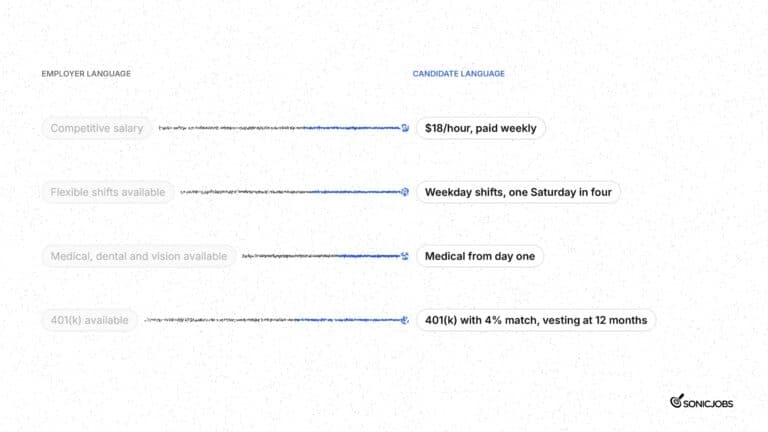
Across SonicJobs CareerGPT clients, 30% to 35% of candidate questions had no clear answer in the employer’s own career site content. When a candidate asks about shift patterns, pay, or training and the site has no answer, the conversation ends. The candidate moves on.
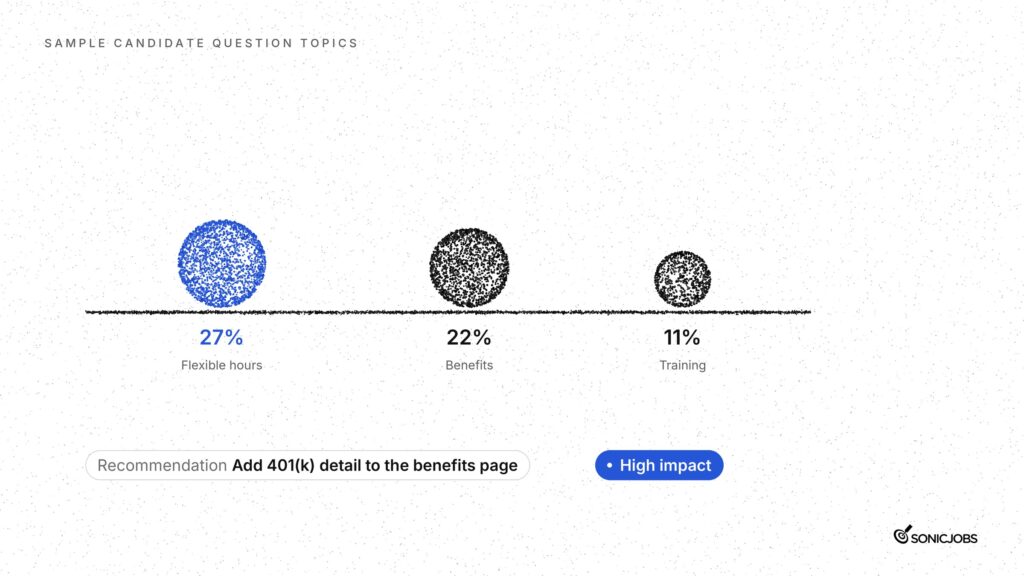
The CareerGPT dashboard groups conversations by topic, including role search, location and benefits, and flags where the employer’s content left questions unanswered. Employers can see exactly which topics are generating questions and where the gaps are. SonicJobs homepage data shows the kind of detail this surfaces: candidate question topics including flexible hours (27%), benefits (22%) and training (11%), with specific recommendations such as adding 401(k) detail to the benefits page.
Keyword mismatch means relevant candidates see no results.
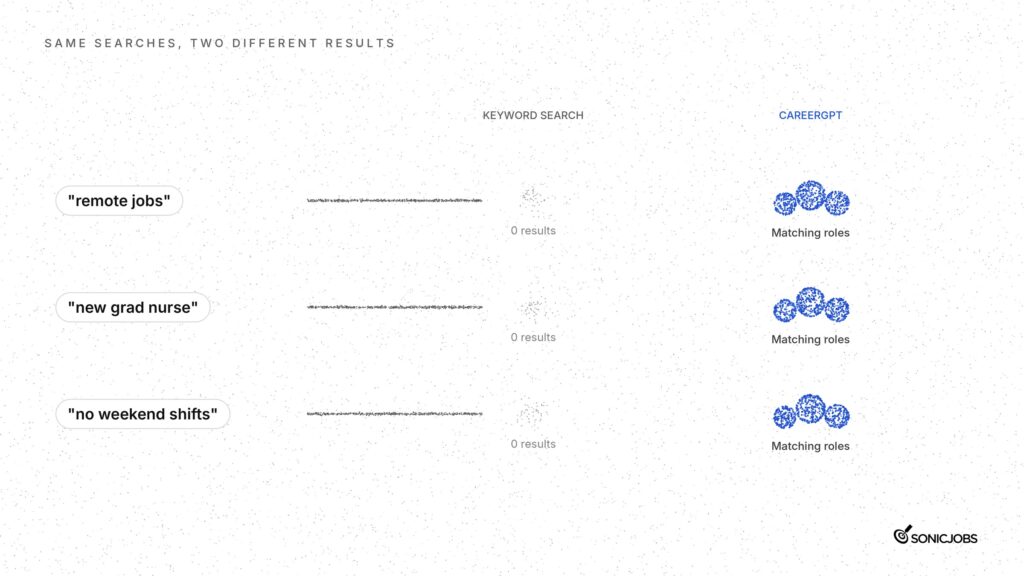
A candidate who wants part-time evening work in a warehouse may not know that the internal job title is “distribution associate, second shift.” On a keyword search, they type what they know and get nothing back. On one employer’s career site, searches for “remote jobs,” “new grad nurse” and “no weekend shifts” each returned zero results. Asked the same things through CareerGPT, the candidate received matching roles, including results that recognized “new grad nurse” as equivalent to RN residency and registered nurse postings.
As job search moves into AI-driven dialogue formats, candidates no longer need to guess which keywords will surface relevant roles. They can describe their qualifications, skills, shift preferences and location in their own words.
Employer brand inconsistency when candidates cross-reference external AI sources.
Research from Wiser shows that 44% of candidates have used AI in their job search and expect structured, direct answers. When the employer’s career site content does not align with what external AI assistants say about the organization, candidates receive a fragmented picture. One source may describe benefits in detail; another may have nothing.
CareerGPT answers only from the knowledge sources the employer has connected, which may include the career site, uploaded documents, and selected external sources such as Glassdoor or LinkedIn if the employer has chosen to add them. This keeps the information candidates receive consistent with what the employer has reviewed and approved. Employers can also update connected knowledge when an answer is incomplete or does not reflect the company accurately.
What to Look for in a Conversational AI Career Agent
Not every conversational tool on the market is built for the job discovery use case. Before evaluating options, talent acquisition teams should agree on the capabilities that actually matter for candidates arriving at a career site with real, specific needs.
Must-Have Features for Employer Career Sites
Natural-language job discovery. Candidates should be able to describe what they want in their own words, not just type a job title. A tool that only matches keywords will miss the candidate who says “part-time warehouse work near Tucson with no weekend shifts” because they do not know which title to search for.
Multi-requirement search in a single query. Location, shift pattern, pay expectations, and qualifications should all be combinable in one request. Forcing candidates to run four separate filters is a version of the same problem keyword search creates.
Role-specific follow-up Q&A. Once a candidate finds a job they want to explore, they should be able to ask questions about that specific role: its benefits, its schedule, its requirements. A tool that returns the same overview paragraph to every follow-up is a recruiting chatbot, not a career agent.
Employer control over knowledge sources. The agent should answer only from the sources the employer has approved: the career site, the job feed, uploaded documents, and any external sources the employer chooses to connect. Candidates should not receive answers drawn from sources the employer has not reviewed.
Fast deployment with no ATS migration. Implementation that requires replacing the applicant tracking system (ATS) or rebuilding the career site adds months and budget to a decision that should be straightforward. Look for a tool that integrates via a script and can go live within days of the job feed and content being ready.
Multilingual support without separate deployments. Candidates search in the language they are comfortable in. A single deployment should handle multiple languages without requiring the employer to set up parallel instances.
Candidate data privacy. Conversations should not be used to train third-party AI models or shared with external AI providers. Employers are responsible for the experience on their own career site, and that responsibility extends to how candidate data is handled.
Analytics and content gap identification. The employer should be able to see what candidates asked, which searches returned no results, and where questions went unanswered. Aggregate metrics alone are not enough: the actual questions and responses need to be reviewable.
CareerGPT, SonicJobs’ conversational AI career agent, meets each of these criteria. It sits on the employer’s existing career site with no ATS migration and no rebuild required; adding the script takes minutes, and the tool can go live in days once the job feed, content, and approvals are in place. It answers only from the knowledge sources the employer connects, which can include the career site, the job feed, PDFs, and selected external sources such as LinkedIn, Glassdoor, or Reddit when the employer has chosen to enable them. Candidate conversations are not shared with ChatGPT, Claude, or any other AI provider, and are not used to train AI models. CareerGPT supports Spanish, French, German, Mandarin, Hindi, and other languages, with job descriptions staying in whichever language the employer published them. The CareerGPT dashboard groups conversations by topic, filters by date range, and shows which conversations led to job views and application starts, giving recruiting teams structured data on what candidates actually asked and where the content fell short. 90% of CareerGPT conversations reached a relevant job result and 64% led to an application start.
How Talent Acquisition Teams Use Conversational AI Agents on Career Sites
The strategies below reflect how employers are putting CareerGPT to work on their career sites today. Each one addresses a distinct point in the candidate journey, from the first search to a specific follow-up question about a role.
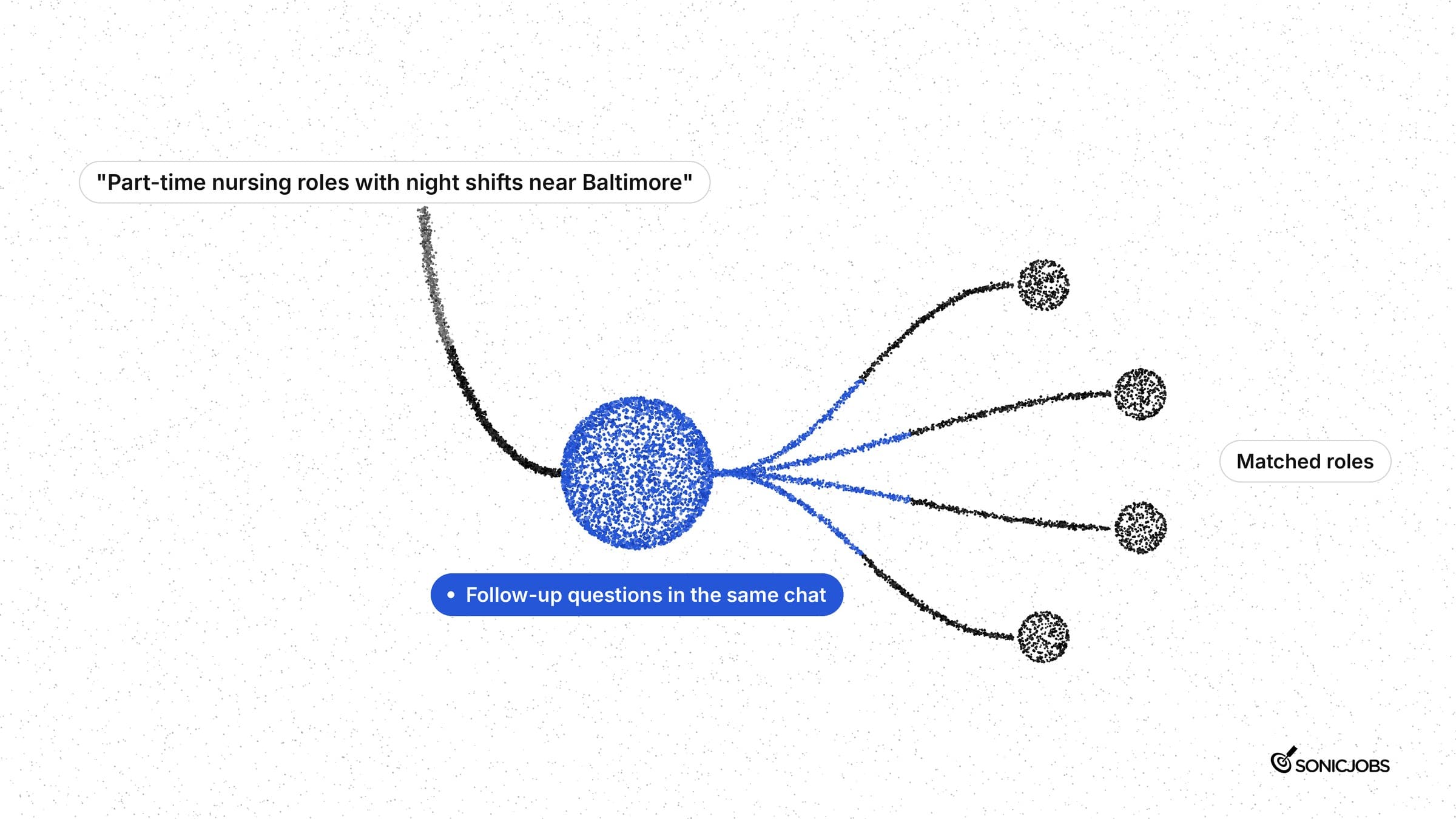
Natural-language job discovery. A candidate arrives at a hospital career site and types “part-time nursing roles with night shifts near Baltimore.” CareerGPT reads the full request, draws on the connected job feed, and returns matched roles without requiring the candidate to know the right job title or navigate a filter panel. The conversation replaces a sequence of keyword attempts that may each return nothing.
Multi-requirement search. A single query can combine role type, location, shift pattern, pay band, and qualification. The candidate does not have to chain filter steps or repeat the search after each refinement. CareerGPT holds the full context and adjusts results as the candidate adds or changes a requirement in the same conversation.
Role-specific follow-up Q&A. Once a candidate opens a job, they can ask about the specific role: the healthcare benefits, team structure, training program, or what the schedule looks like in practice. CareerGPT answers from the knowledge sources the employer has connected, including the career site, the job feed, uploaded documents, and approved external sources such as LinkedIn or Glassdoor. If the employer has not provided an answer, CareerGPT says so.
Content gap identification. The CareerGPT dashboard groups candidate conversations by topic and shows which questions went unanswered. Sample data from the SonicJobs homepage illustrates the pattern: flexible hours accounted for 27% of question topics, benefits for 22%, and training for 11%, with a content recommendation to add 401(k) detail to the benefits page flagged as high impact. Across SonicJobs CareerGPT clients, 30% to 35% of candidate questions had no clear answer in the employer’s own career site content. The dashboard turns that gap into a specific content task rather than a general impression.
Employer brand consistency. Every answer CareerGPT gives draws from sources the employer has approved and connected. Candidates do not receive information from sources outside that set unless the employer has explicitly included them. Recruiters and content managers control what CareerGPT knows and can update it when details change.
AI channel visibility. SonicJobs also offers Employer GPT Visibility as a separate product, sold together with CareerGPT as one package. Employer GPT Visibility runs browser agents that ask candidate questions on ChatGPT, Claude and Gemini anonymously, the way a real candidate would, so the results are not shaped by who is asking. Employers see where they appear, how they compare with competitors, and which sources the answers cite. Queries run repeatedly so employers track performance over time rather than relying on a single check.
Johns Hopkins Medicine is among the employers running CareerGPT live on their career site today.
What sets CareerGPT apart from alternatives in this category is the combination of on-site job discovery, role-level Q&A from employer-approved sources, and a clear data layer that shows what candidates asked and where the content fell short. It sits on the employer’s existing career site without replacing the applicant tracking system (ATS) or requiring a site rebuild. The companion product, Employer GPT Visibility, extends that picture to the external AI assistants where candidates increasingly start their search.
Best Practices for Employers Deploying a Conversational AI Career Agent
The six practices below apply at every stage: before launch, at go-live, and once the agent is live and generating data. Each one is grounded in how CareerGPT works or in what SonicJobs has observed across its CareerGPT clients.
Audit your career site content before launch. Across SonicJobs CareerGPT clients, 30% to 35% of candidate questions had no clear answer in the employer’s own career site content. Walk through your highest-traffic pages, your benefits content and your role descriptions before go-live. The gaps you find are the ones CareerGPT will encounter on day one.
Define your knowledge source list before connecting anything. CareerGPT answers only from the sources the employer explicitly connects: the career site, the job feed, uploaded documents such as PDFs, and any approved external sources the employer chooses to add, such as LinkedIn, Glassdoor, Reddit or the employer’s YouTube and social media pages. External sources are opt-in, not defaults. Agreeing on that list internally before go-live prevents situations where CareerGPT draws on a source that has not been reviewed or approved.
Use the CareerGPT dashboard to close content gaps iteratively. The dashboard groups conversations by topic, including role search, location and benefits, filters by date range and shows which conversations led to job views and application starts. It also surfaces specific content gap recommendations. A prompt such as “Add 401(k) detail to the benefits page: High impact” tells your content team exactly what to write and why it matters. Treat the dashboard as a standing content brief, not a one-time report.
Plan your approvals process before deployment, not after. Employers using traditional recruiting chatbots can spend 6 to 9 months reviewing and approving answers to likely candidate questions. Because CareerGPT answers from connected knowledge sources rather than a bank of pre-approved responses, the process is different: once the job feed, content and source approvals are in place, CareerGPT can go live in days. The work is in preparing the sources, not in scripting individual answers.
Track AI channel performance alongside career site performance. Employer GPT Visibility, a separate SonicJobs product sold together with CareerGPT as one package, measures how the employer appears on ChatGPT, Claude and Gemini when candidates ask relevant questions. Browser agents ask those questions anonymously, the way a candidate would, so results are not shaped by who is asking. Queries run repeatedly, giving employers a view of performance over time rather than a single snapshot. CareerGPT shows what candidates ask on your site; Employer GPT Visibility shows how those same questions play out on public AI assistants.
Use multilingual capability where your candidate population needs it. CareerGPT supports Spanish, French, German, Mandarin, Hindi and other languages without requiring a separate deployment for each market. Job descriptions remain in the language the employer published them in. If you hire in markets where English is not the primary language of your candidates, confirm your knowledge sources are accurate in those languages before enabling them.
Advantages of a Conversational AI Career Agent for Employer Career Sites
Each benefit below connects to a specific outcome, not a general promise.
90% of conversations reach a relevant job result; 64% lead to an application start. across live CareerGPT deployments. Most career site traffic leaves without applying. A conversational AI career agent that consistently gets candidates to a relevant role and then to an application start changes the return on every recruitment marketing dollar already being spent.
Every candidate prompt becomes first-party intent data the employer owns. When a candidate types what they are actually looking for, that question is captured as structured data: the role type, the location, the benefit they need, the doubt they have. Employers keep that data. It is not available through job board analytics or through AI assistants, which share no search data with employers.
It addresses drop-off before a candidate ever reaches the application form. Research indicates that 94% of candidates who view a job posting do not complete an application. A meaningful share of that drop-off happens earlier, at the career site itself, when a candidate cannot find a role that fits their situation. A conversational AI career agent surfaces the right role before the candidate gives up.
The CareerGPT dashboard shows exactly which questions went unanswered. Conversations are grouped by topic (role search, location, benefits and others), filtered by date, and linked to job views and application starts. Employers can see where their content left a candidate without a clear answer and act on that directly, whether by updating a web page or uploading a document.
Deployment takes days, not months, and requires no ATS migration. CareerGPT is added via a one-line script or Google Tag Manager. Once the job feed, content sources and approvals are in place, it goes live. The employer’s existing applicant tracking system (ATS) and application journey stay exactly as they are.
Candidate conversations stay private. CareerGPT is grounded in the knowledge the employer connects. Conversations are not shared with ChatGPT, Claude or any other AI lab, and they are not used to train AI models. Employers can tell candidates that with confidence.
How SonicJobs CareerGPT Brings Conversational Job Search to Your Career Site
CareerGPT is SonicJobs’ conversational AI career agent for employer career sites. It sits alongside the employer’s existing site and applicant tracking system (ATS) without requiring either to be rebuilt or replaced. Adding it takes a one-line script or a Google Tag Manager tag, and it can go live in days once the job feed, content and approvals are in place.
How a candidate conversation works
A candidate opens CareerGPT on the career site and describes what they are looking for in their own words. CareerGPT returns matched roles and lets the candidate refine through follow-up questions without starting the search again. When a candidate opens a specific role, they can ask about its details, shift patterns, pay, benefits, requirements, and CareerGPT pulls the answer from the employer’s connected information. If the information is not there, it says so.
CareerGPT answers only from the knowledge sources the employer connects: the career site, the job feed and uploaded documents such as PDFs. Employers can also connect selected, approved external sources, LinkedIn, Glassdoor, Reddit, the employer’s YouTube channel and social pages, depending on what they want CareerGPT to draw on. It does not read external sites by default; the employer decides what is included.
When the candidate is ready to apply, they continue through the employer’s existing application process. CareerGPT hands them off; it does not collect applications or candidate details inside the conversation.
What the employer sees
The CareerGPT dashboard groups conversations by topic (role search, location, benefits and others), filters by date range and shows which conversations led to job views and which led to application starts. Employers can review and export this data. Repeated questions with no good answer in the current content appear here, giving recruiting and content teams a specific list of gaps to address.
Candidate conversations are not shared with ChatGPT, Claude or any other AI lab, and they are not used to train AI models.
CareerGPT is available in multiple languages, including Spanish, French, German, Mandarin and Hindi. Job descriptions remain in the language the employer originally published them in. CareerGPT is live across a number of career sites, including Johns Hopkins Medicine.
SonicJobs has been building AI agents since 2019, and CareerGPT is their eighth generation.
Employer GPT Visibility: the paired but separate product
SonicJobs sells two products together as one package. CareerGPT handles what happens on the employer’s career site. Employer GPT Visibility handles what happens off it.
Employer GPT Visibility uses browser agents to ask candidate questions on ChatGPT, Claude and Gemini anonymously, the way a candidate would, so the results reflect what a real candidate sees rather than a personalized response shaped by who is asking. Queries run repeatedly, so employers see how their visibility on those platforms changes over time, which competitors appear in the same answers and which sources are cited. It is a separate visibility measurement product, not a feature of CareerGPT.
Key Takeaways: Getting Started with Conversational Job Search on Your Career Site
Candidates now arrive at career sites expecting to describe what they want in plain language, not enter a job title into a keyword box. According to CVViz (2026), 78% of candidates say the quality of a company’s career portal influences whether they decide to apply. A career site that cannot answer a direct question or surface a relevant role loses that candidate.
The core points from this guide:
- Natural-language search is the default expectation. Candidates combine shift patterns, location, pay, qualifications and other requirements into a single question. Keyword filters cannot handle that kind of input.
- Follow-up questions matter. Candidates who open a role want specific answers about that role. A response that redirects them to a recruiter ends the conversation.
- Deployment does not require a rebuild. CareerGPT goes live via a one-line script in days, once the job feed, content and approvals are in place. No career site rebuild and no applicant tracking system (ATS) migration are required.
- Results are measurable. 90% of CareerGPT conversations reached a relevant job result and 64% led to an application start.
- The career site is one side of the picture. SonicJobs also sells Employer GPT Visibility alongside CareerGPT. It measures how an employer appears on ChatGPT, Claude and Gemini when candidates ask the questions that matter for that employer’s hiring, and shows which competitors are being cited instead.
To see how CareerGPT works on an employer career site, contact SonicJobs or request a demo at sonicjobs.com.
FAQs About AI Chatbots and Conversational Job Search on Career Sites
What is conversational job search on a career site?
Conversational job search lets candidates describe what they are looking for in their own words, rather than entering a job title and location into a keyword search box. They can combine requirements such as shift pattern, pay band, location, and qualifications in a single request and follow up with questions about individual roles. SonicJobs CareerGPT brings this experience to an employer’s existing career site, drawing on connected knowledge sources to return relevant jobs and answer candidate questions directly.
How does natural-language job search work for candidates?
CareerGPT reads the candidate’s full request and uses it to surface relevant roles from the employer’s job feed, rather than matching individual keywords. A candidate can write a sentence such as “part-time warehouse roles near Leeds with no weekend shifts” and receive results that reflect all of those requirements at once. They can then ask follow-up questions without starting the search again. SonicJobs built CareerGPT to keep the conversation going so candidates refine their search through dialogue rather than repeated keyword attempts.
Can candidates combine multiple requirements like shift pattern, location, pay, and qualifications in one search?
Yes. CareerGPT is designed to handle multi-requirement requests in a single input. A candidate might ask for a day-shift nursing role within ten miles of a specific city, paying above a certain rate, that does not require prior hospital experience. CareerGPT reads all of those conditions together and returns results that reflect the full request. Candidates can then add or change conditions through follow-up messages. This is the core difference between conversational search and a keyword search box that handles one variable at a time.
What is CareerGPT and how does it work on an employer career site?
CareerGPT is SonicJobs’ conversational AI career agent. It sits on an employer’s existing career site as a floating widget or embedded search bar. Candidates type their own questions or choose from suggested starting points, and CareerGPT responds using the knowledge sources the employer has connected: the career site, the job feed, and uploaded documents such as PDFs. There is no need to rebuild the career site or migrate to a different applicant tracking system (ATS). When a candidate is ready to apply, they continue through the employer’s existing application process.
How is CareerGPT different from a traditional recruiting chatbot?
Traditional recruiting chatbots typically return the same overview paragraph regardless of what the candidate asks next, and direct any detailed follow-up to a recruiter. CareerGPT is built to answer the follow-up. If a candidate asks about a specific benefit, the shift structure for one role, or what employees say about working there, CareerGPT retrieves the specific detail from connected sources rather than repeating a summary. If the employer has not provided the information, CareerGPT tells the candidate so. SonicJobs built CareerGPT explicitly to replace that loop, not replicate it.
What knowledge sources does CareerGPT draw on to answer candidate questions?
CareerGPT answers only from the knowledge sources the employer connects. The core sources are the career site, the job feed, and uploaded documents such as PDFs. Employers can also choose to connect approved external sources including LinkedIn, Glassdoor, Reddit, and the employer’s own YouTube and social media pages. CareerGPT does not read external sites by default. Employers control which sources are active and can update or replace them at any time. Answers include citations showing candidates where the information came from.
How quickly can CareerGPT go live on an existing career site?
CareerGPT is added via a script that takes minutes to place on the career site. It can go live in days once the job feed, content sources, and any internal approvals are in place. There is no career site rebuild and no ATS migration required. By contrast, traditional recruiting chatbots can take 6 to 9 months to configure, because employers must review and approve answers to hundreds of likely candidate questions individually. CareerGPT draws its answers from connected knowledge sources rather than a pre-approved script.
What data does CareerGPT give employers about candidate intent?
The CareerGPT dashboard groups conversations by topic, including role search, location, and benefits, and filters by date range. Employers can see which conversations led to job views and which led to application starts. They can also review the actual questions candidates asked and identify searches that returned no results. 90% of CareerGPT conversations reached a relevant job result and 64% led to an application start. Employers can export conversation data and use it to identify content gaps on their career site.
What percentage of candidate questions go unanswered on employer career sites?
Across SonicJobs CareerGPT clients, 30% to 35% of candidate questions had no clear answer in the employer’s own career site content. Common gaps include questions about what employees say about working at the company, specific benefit details, and role requirements. When CareerGPT cannot find an answer in connected sources, it tells the candidate. Employers use these unanswered questions to identify what content to add or improve on their career site.
How does SonicJobs Employer GPT Visibility connect to CareerGPT?
CareerGPT and Employer GPT Visibility are two separate SonicJobs products sold together as one package. CareerGPT works on the employer’s own career site. Employer GPT Visibility is a separate tool that measures how the employer appears on ChatGPT, Claude, and Gemini when candidates ask relevant questions, and shows how that compares with competitors the employer names. Browser agents ask those questions anonymously, the way a candidate would, so results are not shaped by who is asking. Content gaps found through CareerGPT can inform the questions tracked in Employer GPT Visibility.
Is CareerGPT available in multiple languages?
Yes. CareerGPT is available across countries and languages including Spanish, French, German, Mandarin, and Hindi. Job descriptions remain in the language the employer originally published them in. Candidates can ask questions in their preferred language and receive answers drawn from connected knowledge sources. SonicJobs designed this to support employers with internationally distributed hiring, where candidates may be searching in different languages across different locations. The language coverage is part of the core CareerGPT product, not a separate module.
What should employers look for when evaluating an AI career agent for their career site?
Employers should confirm that the agent answers from employer-controlled knowledge sources rather than making up information. It should support multi-requirement searches in natural language and follow-up questions about individual roles. Deployment should not require a career site rebuild or ATS migration. The agent should record what candidates ask, which searches return no results, and where conversations led to application starts. CareerGPT from SonicJobs meets each of these criteria, and its CareerGPT dashboard gives employers direct access to that conversation data for ongoing review and content improvement.